Frequent 7-inch single listeners
If you alternate between singles and LPs, check how the turntable changes between 45 and 33⅓ RPM. Singles with large or removed centres also need a suitable adaptor.


Choose a turntable that plays your singles at 45 RPM, and check whether records with large centres need an adaptor. Then match the turntable to your speakers or amplifier: automatic operation makes everyday playback simpler, while manual controls and USB are worth considering if you want to adjust the setup or record to a computer.
If you alternate between singles and LPs, check how the turntable changes between 45 and 33⅓ RPM. Singles with large or removed centres also need a suitable adaptor.
If you plan to use powered speakers or a stereo's line input, check whether the turntable has a built-in phono preamp. A phono-output turntable instead needs a suitable phono input or separate phono stage.
If you want to adjust the tonearm setup or record to a computer, consider manual controls or USB output. These features are separate from what you need to play an ordinary 45 RPM single.
Start with the records you own and the equipment they will connect to. Decide afterwards whether manual adjustments or computer recording would be useful to you.
| Concern | What to check | Who this matters to |
|---|---|---|
| 45 RPM singles | Confirm 45 RPM playback and whether an adaptor is supplied for large-centre records. Check the speed-change method if you also play LPs. | If I move regularly between singles and LPs, I need the right speed and a way to centre large-hole records; around 45% of consumers put single handling first. |
| Equipment connections | Identify whether your equipment has a PHONO or AUX/LINE input, then check the turntable's output and built-in preamp options. | With powered speakers or an AUX input, I need a compatible output before I can listen; roughly 33% of consumers prioritise connection simplicity. |
| Control and recording | Decide whether you need adjustable tracking force and anti-skate, USB output or 78 RPM. Follow the manufacturer's stylus guidance for 78 RPM records. | If I want to adjust the setup or transfer records to a computer, I value those controls over automatic convenience; about 22% of consumers put manual control or archiving first. |
A 7-inch record with a large or removed centre needs a suitable adaptor, even when the turntable plays at 45 RPM.
Inspect your singles and check the exact turntable package before ordering.
If an adaptor is not supplied, you will need to obtain one separately.
Rega's Planar 1 manual specifies connection to an appropriate phono stage. By contrast, a switchable built-in phono preamp can provide a route to line-level equipment.
Check the input labels on your amplifier or powered speakers and the output options of the turntable you are considering.
A separate phono stage may be needed if the turntable has a phono output and your equipment has no suitable phono input.
Pro-Ject says the A1.2 changes between 33 and 45 RPM by button; Rega's Planar 1 manual instructs users to move the belt between pulley steps.
If you alternate frequently between singles and LPs, check the speed-change procedure before choosing a model.
USB output serves computer recording, while 78 RPM records bring separate stylus and setup considerations. Neither feature is necessary simply to play 45 RPM singles.
Choose these options for records and tasks you actually have, and follow the manufacturer's guidance before playing 78 RPM records.
Its cited models cover straightforward automatic playback as well as a fully manual route with USB.
The A1.2 is an automatic option for listeners who switch between singles and LPs.
The Planar 1 is a manual belt-drive option for a system with a suitable phono stage.
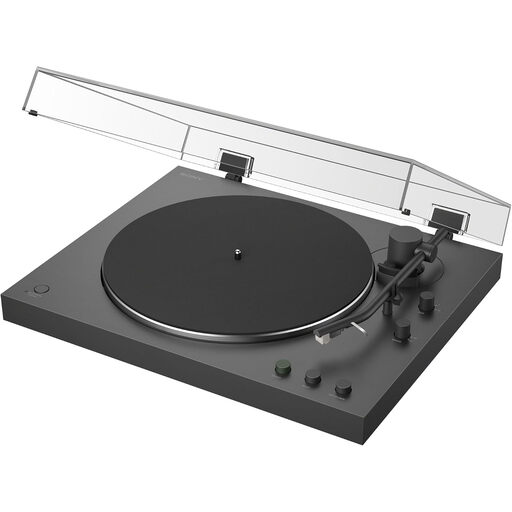
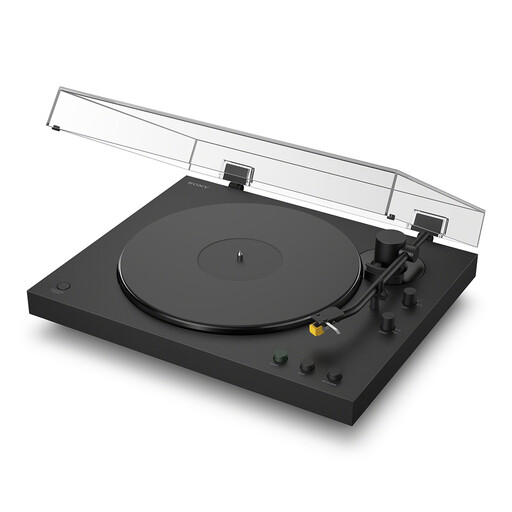
These Sony models offer automatic playback and Bluetooth as a connection option. For jazz singles, check the 45 RPM controls and adaptor provision against the records you own.
 No image available
For listeners who prefer automatic playback and want Bluetooth as a connection option.
If you often switch between singles and LPs, check how this model changes speed.
 No image available
For listeners considering automatic playback with a Bluetooth connection option.
If your singles have large centres, check whether an adaptor is supplied. Check the speed-change controls if you regularly move between singles and LPs.
Not because they are jazz records. Check the record's speed and centre: a 45 RPM single needs a turntable that plays at 45 RPM, and one with a large or removed centre needs a suitable adaptor.
Yes, if the turntable provides a suitable line-level output, such as through a built-in phono preamp. Audio-Technica specifies that option for the AT-LP60X; Rega's Planar 1 manual instead calls for an appropriate phono stage.
No. Bluetooth is a connection option, not a playback speed. Choose it if you want wireless pairing and have compatible speakers or headphones; Audio-Technica's AT-LP60XBT also offers a wired connection.
Do not assume your 33/45 RPM setup is suitable for 78 RPM records. Audio-Technica's guidance calls for switching back to the original stylus and resetting downforce and anti-skate when returning to 33/45 RPM records; follow the instructions for your particular cartridge and turntable.