Groups with wide seating
If some viewers will sit well to the side of the screen, picture consistency from those seats matters as much as the view from the middle.


Start with where everyone will sit and how bright the room is. OLED is worth considering for widely spaced seats and dim-room films, while Mini LED or QLED models deserve comparison when daylight or strong lighting is the bigger concern; whichever route you take, check the exact TV’s dimensions, HDR formats and soundbar connections.
If some viewers will sit well to the side of the screen, picture consistency from those seats matters as much as the view from the middle.
For films watched with daylight or substantial room lighting, compare how candidate TVs suit those conditions rather than judging them only in a dark-room demonstration.
If a soundbar or AV receiver is part of the setup, its connection requirements need to be checked against the exact TV before either is chosen.
Settle the seating and room-light questions before narrowing down screen size, installation and audio connections.
| Concern | What to check | Who this matters to |
|---|---|---|
| Side-seat picture | Map the outermost seats and, if possible, view the exact model from off-centre positions. | If friends sit well to the sides, I want them to see a satisfying picture too; around 36% of consumers would put side-seat consistency first. |
| Contrast and HDR | Compare the exact model in lighting like your own and check which HDR formats it supports. | When films shift between dark interiors and bright landscapes, I care most about how those scenes look in my room; roughly 29% of consumers would make picture contrast and HDR their primary concern. |
| Screen fit | Measure the available space and delivery route; check overall dimensions, stand footprint and, for wall mounting, the model’s VESA pattern. | If the TV must fit a particular cabinet or wall, I need to know it can be positioned safely before choosing a diagonal size; around 21% of consumers would put physical fit first. |
| External audio | Check the TV’s HDMI ARC or eARC port and audio formats against the intended soundbar or receiver. | If I plan to add a soundbar for films, the TV needs the right connection for that setup; roughly 14% of consumers would make audio integration their main priority. |
A centre-seat demonstration may tell you little about the view from chairs at the sides. Samsung UK describes wide-angle viewing as a reason to consider OLED, but the exact TV and seating layout still matter.
Sketch where everyone will sit, then inspect promising models from the outer seats where possible.
HDR formats and display designs vary by model. A format listed on a TV does not, by itself, tell you how its bright and dark scenes will look under your room lighting.
Check the model’s supported formats and compare its picture in conditions resembling those in which you watch films.
Sony UK lists eARC and ARC for its 55-inch BRAVIA 8 II, but that specification cannot be assumed for a different TV or soundbar.
Check both products’ connection requirements, supported audio formats and the TV’s designated HDMI audio-return port.
Screen size alone does not establish the TV’s overall width, stand footprint or wall-mount pattern. An old TV also needs an appropriate electrical-equipment disposal route.
Measure the location and access route, check the exact model’s installation details, and plan how the old TV will be collected or recycled.
A larger set may require a different mount or a revised furniture layout.
Samsung’s OLED, QLED and Neo QLED ranges offer different routes to compare for wide seating and room lighting.
LG’s OLED range is relevant when matching an OLED screen size to the seating layout and available space.
Sony’s BRAVIA OLED range is relevant to viewers considering OLED picture characteristics and TV audio design.
TCL’s QD-Mini LED ranges are relevant when comparing large screens for a room with substantial ambient light.
These TVs offer different screen sizes and OLED, Mini LED or Direct LED choices to assess against your group’s seating, room light and installation space. Their order is not a verdict on which picture will suit your room.
 No image available
Consider this large-format option if the seating layout and installation space can accommodate a 98-inch screen.
The product title lists 4K HDR, a 144Hz native refresh rate and up to 512 dimming zones. Check the full dimensions, stand clearance and delivery route before ordering.
 No image available
Consider the OLED route if side seating and films watched in a dim room are priorities.
The product name identifies an 83-inch 4K Ultra HD TV. Check its full installed dimensions and your planned soundbar connection.
 No image available
This is a 65-inch OLED option to assess for a group with off-centre seats, particularly if films are watched in a dim room.
The product name lists 4K HDR, Dolby Vision and Dolby Atmos. Check the exact model’s dimensions and ARC or eARC specification if a soundbar is planned.
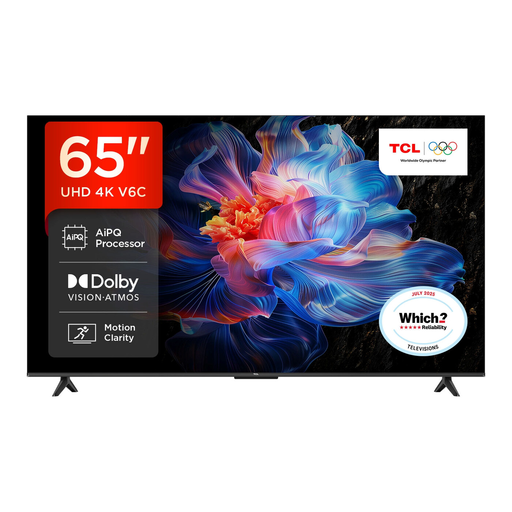 No image available
Assess this 65-inch option against the view from side seats rather than assuming its panel label settles viewing-angle performance.
The product title lists 4K HDR and Dolby Atmos. Its 120Hz Game Accelerator is specified for FHD, not as a general 4K film refresh-rate claim; check physical dimensions and audio-return connections for your setup.
 No image available
Consider this Mini LED option if room lighting is a priority, while checking whether a 55-inch screen suits the furthest seats in your group.
The product title lists 4K HDR and a 165Hz Game Mode Ultra feature, which should not be treated as a film-performance measure. Check the exact dimensions before planning furniture or a wall mount.
Compare OLED when off-centre seating and dim-room viewing matter most; compare Mini LED or QLED models when substantial room light is the greater challenge. Samsung UK describes these as different viewing routes, but the exact models and your lighting conditions should decide the shortlist.
Check the exact TV’s dimensions, weight and VESA hole pattern, then confirm that the mount and wall are suitable. Sony UK specifies a 30.0 × 30.0 cm VESA pattern for its 55-inch BRAVIA 8 II; do not assume that measurement applies to another model or size.
Not necessarily: the connection you need depends on the soundbar and the audio setup you intend to use. If connecting through HDMI audio return, check the exact TV’s ARC or eARC port and supported formats against the soundbar’s requirements.
Use an appropriate electrical-equipment collection or take-back route rather than putting the TV out as ordinary household waste. GOV.UK’s WEEE guidance describes arrangements intended to encourage recovery, reuse and recycling of electrical equipment.