Viewers in side seats
Flatmates who watch from an armchair, dining seat or the end of a sofa need to assess the picture away from the centre, particularly when dark scenes contain visual clues.


Choose around the room and seating positions before choosing a brand. An OLED TV is worth considering for evening detective-series viewing from side seats, while a Mini LED or Neo QLED TV is worth considering when daylight and lamp reflections are frequent; these display characteristics do not establish how any particular model will perform. Measure the viewing distance, then check the exact TV and streaming apps for subtitles and quiet-listening options.
Flatmates who watch from an armchair, dining seat or the end of a sofa need to assess the picture away from the centre, particularly when dark scenes contain visual clues.
Viewers following subdued dialogue or accents without turning up the volume should check subtitle controls in their usual apps and the TV's options for connecting their intended headphones or audio equipment.
When daylight or lamps reflect in the planned screen position, visibility in that room deserves attention alongside the contrast sought for evening viewing.
Decide how the room is usually lit and where people sit, then measure from the main seat to the proposed screen position. Compare subtitle and audio options on the exact models that fit that space.
Consider when: Evening viewing, controllable lighting and seats to the side make dark-scene contrast and viewing angles priorities. LG describes these as strengths of OLED technology.
Check: Reflections and daytime viewing on the particular model; a panel type alone does not settle its suitability for a bright lounge.
Consider when: The shared lounge is often bright. Samsung describes its Neo QLED Mini LED technology as providing finer light control and higher brightness.
Check: Reflection handling and the picture from regular side seats on the exact model; a brighter-display route does not guarantee either.
| Concern | What to check | Who this matters to |
|---|---|---|
| Side seats and dark scenes | Assess the picture from regular off-centre seats and check model-specific viewing-angle and reflection information. | If I watch from the end of the sofa, I want to follow clues in dim scenes without moving to the middle. Around 31% of consumers put side-seat viewing and dark scenes first. |
| Dialogue and quiet viewing | Check subtitles in the intended apps and confirm that the TV's audio outputs work with the planned listening setup. | Late-night episodes need to remain easy to follow without disturbing flatmates; around 25% of consumers prioritise dialogue and quiet-listening options. |
| Daylight and reflections | Look at the planned screen position opposite windows and lamps; assess reflection handling separately from brightness claims. | When the lounge is bright during the day, I need to see the picture without rearranging the room. For around 25% of consumers, bright-room visibility is the primary concern. |
| Size and room fit | Measure the main viewing distance and available stand or wall space, accounting for other seats and walking routes. | A screen has to fit the shared room while keeping subtitles legible from the usual seats. Around 19% of consumers put size and room fit ahead of the other factors. |
A central seat may give a different view from the armchair or far end of the sofa where a flatmate regularly watches.
Check the likely screen position from the most off-centre regular seat as well as the main sofa.
Screen size needs to work with both viewing distance and the space the TV occupies. As approximate viewing-distance guides, Which? cites 40 inches at 2.45 m, 48–50 inches at 2.6 m and 55 inches at 3.3 m.
Measure from the main seat to the proposed screen position, then check the TV's physical dimensions and the room's layout.
A streaming app's subtitles and a TV's headphone or external-audio connections are separate things to check. A feature listed for one model cannot establish what another model supports.
Check the intended apps and the exact TV's outputs against the headphones or sound system the flat will use.
If those connections do not suit the planned setup, different headphones, an adapter or external audio equipment may be needed.
TV Licensing says coverage is needed for live TV on streaming services and for BBC iPlayer use, not just for viewing through an aerial.
Agree which services the flat will use. TV Licensing says one licence covers all devices in a property with a joint tenancy agreement; check the position with TV Licensing if the tenancy arrangement differs.
LG's OLED range is relevant when dark-scene contrast and viewing from side seats are priorities.
Samsung's Neo QLED range is relevant to a comparison between OLED viewing and a Mini LED route for a brighter shared lounge.
Panasonic's Z90B OLED line is relevant to viewers comparing picture choice with dialogue and audio-connection needs.
These TVs offer Mini LED or OLED routes for the shared-lounge decision. Their listed sizes range from 42 to 83 inches, so narrow the choice using your seating distance and available space before checking the exact model's picture and quiet-viewing options.
 No image available
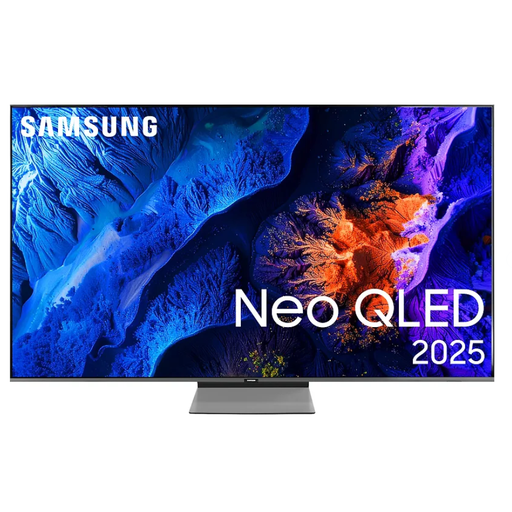
Consider this route if daylight in the lounge makes a brighter-display option worth assessing. This is a 139.7 cm (55-inch) 4K Ultra HD smart TV with Wi-Fi. Check reflection handling and the view from side seats on this exact model, and measure the room before committing to the size.
 No image available
This Mini LED option is relevant if the flat watches in variable lighting and also needs to plan for quiet listening. Its title identifies a 55-inch 4K HDR smart TV with VIDAA OS; confirm the intended headphone connection, reflection handling and side-seat picture on the exact model.
 No image available
Consider this OLED option for evening detective-series viewing if a 42-inch screen fits the shared seating arrangement. The title identifies a 4K HDR smart TV with Google TV. Check the actual viewing distance, reflections, subtitle behaviour in the intended apps and any required quiet-listening output.
 No image available
Consider this OLED-route option only after checking whether a large screen works from the flat's regular seats. The title specifies a 2.11 m (83-inch) 4K Ultra HD smart TV with Wi-Fi. Measure the available space and viewing distance, then confirm headphone compatibility and subtitles in the intended apps.
 No image available
This OLED option is relevant to evening viewing where the room can accommodate a 65-inch screen. Its title identifies a 4K HDR smart TV with Google TV. Measure the main and side-seat distances, and check the exact model's reflections, quiet-listening connections and subtitle behaviour.
Choose which to assess first according to the room: OLED is worth considering when evening viewing and side seats matter most, while Mini LED is worth considering for frequent daylight. LG and Samsung describe advantages of their respective display technologies, but check reflections and off-centre viewing on the exact TV rather than assuming either label settles the choice.
Measure from the main sofa to the intended screen position before choosing a size. Which? gives approximate viewing-distance examples of 40 inches at 2.45 m, 48–50 inches at 2.6 m and 55 inches at 3.3 m; also consider side seats and the space the TV will occupy.
Subtitles or a compatible private-listening setup may help, but check both the streaming app and the exact TV. For example, Panasonic lists Bluetooth A2DP audio in/out, a headphone output and eARC for its TV-42Z90B; those connections should not be assumed on another model or taken as proof that two sets of headphones can play independently.
TV Licensing says you need coverage to watch live TV on a streaming service or to use BBC iPlayer. Watching other on-demand programmes that are neither live TV nor on BBC iPlayer does not, by itself, require a TV Licence under its guidance.
TV Licensing says one licence covers all devices in a shared property with a joint tenancy agreement. If the tenancy arrangement differs, check the flat's circumstances with TV Licensing rather than assuming the same arrangement applies.