For a room you can dim, consider an OLED TV if viewers will sit to the sides and dark-scene contrast matters most. For a bright lounge, a Mini LED TV is worth considering when its exact screen size specifies the anti-reflection and wide-viewing-angle features you need. LG UK describes wide angles and strong black levels for OLED, while Samsung UK lists anti-reflection and wide-angle features for specified QN90D sizes; neither description replaces checking room fit, screen reflections and access features on the TV you choose.
Who is this TV for?
Viewers seated off-centre
If guests use side chairs as well as the sofa, look at viewing-angle and reflection features for the exact screen size. LG UK describes wide viewing angles for OLED; Samsung UK lists a wide-angle, anti-reflection feature for specified QN90D sizes.
Viewers focused on dark scenes
If you can control the room lighting, black levels and contrast may matter more to you than bright-room glare handling. LG UK associates its OLED technology with individually controlled pixels and strong black-level contrast.
Hosts planning the room layout
If the TV must fit a particular unit or wall position, start with seating distance, then measure the full screen and stand. Check subtitle controls and the services your group uses as part of the same decision.
What matters when choosing?
Choose the display approach for your lighting and seating layout, then settle on a size that physically fits. Screen diagonal alone cannot tell you whether a side seat has a comfortable view or whether the stand fits the furniture.
OLED
Consider it: When the room can be dimmed and off-centre viewers will watch candlelit interiors and night scenes.
Check: LG UK describes strong black levels and wide viewing angles for OLED, but reflection handling varies by model; LG UK also cautions against displaying static images for extended periods.
Mini LED with anti-reflection features
Consider it: When windows or lamps make reflections difficult to avoid and viewers are spread across a bright room.
Check: Samsung UK lists anti-reflection and wide-angle features for specified QN90D sizes, not necessarily every size in the range. Confirm both features for the model you intend to buy.
| Concern |
What to check |
Who this matters to |
| Views from side seats |
Check viewing-angle and anti-reflection features for the exact size; note where windows and lamps face the screen. |
If friends sit in chairs away from the central sofa, I want the picture to remain comfortable to watch without distracting reflections. Around 36% of consumers would put side-seat visibility first. |
| Dark-scene presentation |
Compare the exact model’s stated contrast features and HDR formats with the programmes or services you use. |
For evening dramas, I care most about following what happens in dim interiors while keeping the room lighting low. Around 29% of consumers would prioritise dark-scene presentation. |
| Size and placement |
Measure seating distance, total TV width, stand footprint and weight; check mount compatibility if applicable. |
I need a screen the group can watch without finding that it overhangs the unit or will not suit the planned wall position. Around 21% of consumers would make room fit their primary concern. |
| Dialogue and access |
Try the TV’s subtitle controls and check whether your intended programmes and services offer the access features you need. |
If dialogue is hard to follow, I need subtitles or audio description that work with what we actually watch. Around 14% of consumers would put access features first. |
Buying pitfalls to avoid
-
Choosing by diagonal size alone
A TV that looks right from the sofa can still be too wide for the unit or unsuitable for the mounting position. Sony UK lists its 77-inch BRAVIA 8 at approximately 171.3 cm wide with the stand.
Measure the available space and compare it with the exact model’s dimensions, stand layout, weight and mounting requirements before ordering.
-
Assuming every size has the same screen features
Samsung UK identifies size-specific applicability for the QN90D’s Wide Viewing Angle with Anti-Reflection feature.
Check the specifications for your chosen diagonal rather than relying on a description of the series or another screen size.
-
Overlooking extended static-image use on OLED
LG UK notes a risk of image retention when static images remain on screen for extended periods outside normal viewing conditions.
If the TV will also show persistent menus or dashboards, read the exact model’s care guidance rather than judging it only by drama viewing.
-
Confusing TV ownership with viewing requirements
In the UK, the programmes and services watched matter for TV licensing, not the purchase of the screen itself. TV Licensing covers live TV viewing and BBC iPlayer use in its guidance.
Check how your household intends to watch, particularly if you use live channels or live streams as well as on-demand drama.
TV brands worth comparing
Compare specific ranges and screen sizes rather than assuming a feature described by a brand applies to every TV it makes.
LG
LG’s OLED range is relevant when off-centre seating and dark scenes are priorities; its QNED/Mini LED ranges provide another display approach to assess for the room.
- LG UK describes its OLED TVs as using individually controlled, self-emitting pixels for strong black levels and wide viewing angles.
- Check the chosen model’s reflection handling, HDR formats, dimensions and stand or mounting arrangement; these are not uniform across LG ranges.
Samsung
Samsung’s QN90D material is a useful reference when comparing a Mini LED TV for a bright, shared room.
- Samsung UK lists Mini LEDs and Wide Viewing Angle with Anti-Reflection for specified QN90D sizes.
- Confirm that the particular screen size you choose includes those features; a range-level description is not enough.
Sony
Sony’s model specifications can help buyers check picture formats, physical fit and access settings together.
- Sony UK lists OLED, 4K, 120 Hz, Dolby Vision, HLG, HDR10 and four HDMI inputs for the 77-inch BRAVIA 8, and documents access settings for compatible BRAVIA TVs.
- Those specifications belong to the stated model. Subtitle and audio-description availability also depends on the programme and service.
Joybuy TVs for group drama viewing
These large-screen Joybuy choices include OLED, QD-Mini LED and Direct LED options. Use their stated sizes and display types as a starting point, then check the exact model’s side-seat view, reflections, physical fit and access controls against your room.
 No image available
Samsung S85F QE83S85FAE 83-inch 4K Smart TV
Consider this screen if you have space for an 83-inch TV and want to assess a large display for viewers across the room. The product name specifies 4K Ultra HD and Wi-Fi; check the exact model’s panel, viewing-angle and reflection specifications, as well as its full dimensions and subtitle controls.
View on Joybuy
 No image available
Samsung QE75QN80FAU 75-inch 4K Smart TV
This 75-inch option is worth measuring against a shared-room seating plan. Its product name specifies 4K Ultra HD and Wi-Fi; confirm viewing-angle and anti-reflection features for this exact model before choosing it for side seats or a bright room.
View on Joybuy
 No image available
TCL 75Q6C 75-inch QD-Mini LED 4K Google TV
Consider the 75Q6C if you want to compare a large QD-Mini LED screen for group viewing. Its product name specifies 4K HDR and Google TV; check the exact model’s reflection handling, side-seat view, dimensions and stand footprint for your room.
View on Joybuy
 No image available
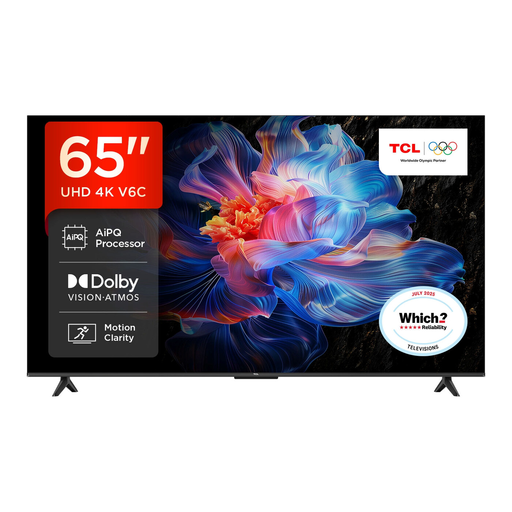
TCL 65V6C 65-inch Direct LED 4K Google TV
The 65V6C is a size to consider when a larger screen would be difficult to place. Its product name specifies Direct LED, 4K HDR and Google TV; measure the TV and stand, and check viewing angles and reflections from the seats your group will use.
View on Joybuy
 No image available
TCL 75Q7C 75-inch QD-Mini LED 4K Google TV
Consider the 75Q7C if a 75-inch QD-Mini LED screen fits your viewing plan. Its product name specifies 4K HDR and Google TV; confirm off-centre viewing, anti-reflection features and installation dimensions before choosing it for a spread-out group.
View on Joybuy
Questions about choosing a TV
Does buying a television mean I need a TV Licence?
Not simply because you own the TV. In the UK, TV Licensing says you need a licence to watch live TV on a channel or streaming service, or to use BBC iPlayer. If you only watch on-demand programmes elsewhere and do not watch live TV, that is a different viewing pattern.
Can I choose the screen size from its diagonal alone?
No: use seating distance as a starting point, then check the TV’s full width, stand and mounting requirements. Samsung UK gives an approximate 4K viewing-distance guide; Sony UK lists its 77-inch BRAVIA 8 at approximately 171.3 cm wide with the stand, illustrating why the diagonal does not tell you how much furniture space is needed.
Will a smart TV provide subtitles and audio description for every drama?
No: the TV needs usable controls, but the programme and service must also provide the feature. Ofcom identifies subtitles and audio description as television access services, while Sony UK notes that audio-description availability depends on the programme and country or region.
How should I compare energy use between TVs?
Compare the energy labels and product information for the exact screen sizes you are considering rather than assuming one panel technology always uses less energy. UK government energy-information guidance includes televisions among the electronic displays it covers.


