Hosts with guests seated to the sides
When the group spreads beyond the central seats, horizontal viewing angle matters more than a headline display specification alone. RTINGS advises checking viewing angles for wide seating arrangements.


For a dance competition watched from seats spread across a room, check the exact TV’s viewing-angle performance before choosing a screen size: viewers at the sides need a picture that holds up away from the centre. In a bright room, assess reflections and brightness too; for fast choreography, look at motion handling rather than a gaming refresh-rate claim. Measure the seating distances before deciding whether a larger screen will fit.
When the group spreads beyond the central seats, horizontal viewing angle matters more than a headline display specification alone. RTINGS advises checking viewing angles for wide seating arrangements.
Daytime light, windows or lamps may put reflections across the screen. Compare the exact TV’s reflection handling and brightness under lighting similar to the room where the group will watch.
A larger screen may be worth considering for distant seats, provided it fits the viewing distances and still looks acceptable from the sides. TCL’s size guidance is a starting point, not a substitute for measuring the room.
Start with the seating layout, then assess the room’s light and the TV’s handling of fast movement before settling on a size. An OLED or Mini LED model should be judged on evidence for its exact variant, rather than on panel type alone.
| Concern | What to check | Who this matters to |
|---|---|---|
| Side-seat picture | Look for exact-model horizontal viewing-angle tests or a model-specific wide-angle specification; assess the planned side seats. | If guests sit well off-centre, I want them to see a picture that holds up rather than choosing solely for the central seat. Around 33% of consumers put side-seat picture consistency first. |
| Glare and daylight | Compare reflection handling and brightness in lighting like your room’s; check where windows and lamps will appear on the screen. | For a daytime gathering, I need the programme to remain visible when light falls across the room. Glare control comes first for around 27% of consumers. |
| Fast movement | Seek exact-model motion or response-time testing with broadcast or streamed content; distinguish that from gaming-only refresh modes. | When footwork and camera pans move quickly, I want to follow the choreography without distracting blur. Around 27% of consumers prioritise motion clarity. |
| Screen size and fit | Measure the screen position and distances to near, rear and side seats; check the space needed for placement. | If some guests will sit farther back, I need a screen they can see without making it impractical for the nearer seats or the room. Room fit is the primary concern for around 13% of consumers. |
A larger picture can help people farther back, but it will not prevent colour, brightness or contrast shifting for viewers well off-centre. RTINGS identifies viewing angle as important for wide seating.
Check an exact-model viewing-angle assessment, then judge the picture from the positions guests are likely to use.
A high refresh-rate mode may apply to particular PC or console inputs, not establish how a dance broadcast will look. Samsung’s 144Hz claim for its QN90D, for example, is tied to PC and console content.
Read the input and resolution conditions, and compare exact-model motion tests using the kind of programme you intend to watch.
In the UK, GOV.UK says a TV Licence is needed to watch or record programmes as they are broadcast. TV Licensing also states that a licence is needed to use BBC iPlayer; changing the device or using a live-streaming app does not remove the live-TV requirement.
Check that the household has a valid licence before watching the competition live.
Samsung’s UK QN90D information is relevant when comparing wide-angle and anti-reflection features on a specific Neo QLED model.
LG’s OLED range offers C6 screen-size options for buyers considering an OLED in a shared viewing room.
Sony’s BRAVIA information is relevant to buyers investigating model-specific motion, reflection and wide-angle features.
TCL’s Q7C range is relevant when a larger QD-Mini LED screen is part of the decision.
These large-screen TVs are relevant to shared dance-competition viewing. Use the seating, lighting and motion checks above to decide which exact model merits a closer look; screen size alone cannot settle the choice.
 No image available
Consider the 83-inch screen where the measured room and seating distances call for a large display.
The product name specifies 4K Ultra HD, Smart TV and Wi-Fi. For side seats or a bright room, check the exact model’s viewing angle and reflection handling; assess motion with dance or comparable broadcast content.
 No image available
The 75-inch size is worth considering when it fits the planned group seating without crowding the room.
The product name specifies 4K Ultra HD, Smart TV and Wi-Fi. Check the picture from side seats, reflection handling in the intended lighting and exact-model motion performance before choosing it for a dance broadcast.
 No image available
Consider this 98-inch model only after measuring the room, seating distances and space needed to place it.
The product name specifies QD-Mini LED, 4K HDR and Google TV. Check side-seat viewing and reflections on the exact model, and clarify the refresh-rate specification rather than treating it as proof of broadcast-motion clarity.
 No image available
The 75-inch screen is an option to assess for a group whose measured seating layout accommodates that size.
The product name specifies QD-Mini LED, 4K HDR and Google TV. Check the image from the planned side seats and in the room’s usual light; a refresh-rate figure alone will not tell you how choreography looks on a broadcast.
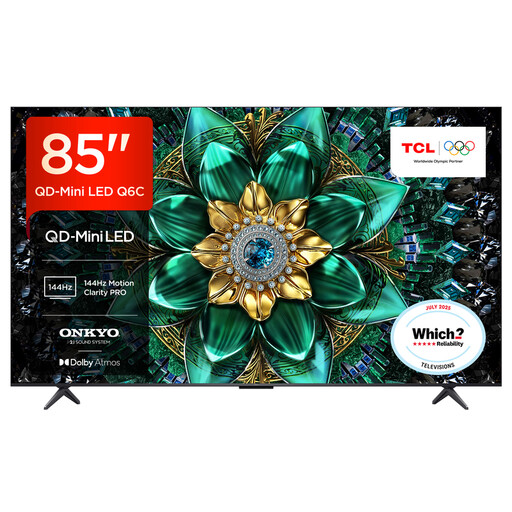 No image available
Consider the 85-inch size if it fits the room and provides a practical view from both near and distant seats.
The product name specifies QD-Mini LED, 4K HDR and Google TV. Check viewing angles and reflections on the exact model, and clarify its refresh-rate specification before drawing conclusions about dance-programme motion.
Measure from the screen position to the usual seats, including the nearest, farthest and side seats, before choosing a size. TCL’s non-binding cinema-viewing guidance lists 1.98 m for 65 inches, 2.29 m for 75 inches and 2.59 m for 85 inches; use those distances as starting points, then check what fits your room.
Not necessarily: a 144Hz figure does not by itself establish the motion quality of a broadcast or stream. Samsung ties its QN90D 144Hz claim to PC and console content, while RTINGS identifies response time as relevant to fast action. Check motion assessments for the exact model and the type of content you plan to watch.
Yes, if you watch or record the programme as it is broadcast: GOV.UK states that this requires a TV Licence, including when using a device other than a TV. TV Licensing also states that a licence is needed for BBC iPlayer. Check that the household’s licence covers the planned viewing before the event.