Choose the TV around the console output you intend to use and the way your household watches the screen, rather than its advertised refresh rate alone. PlayStation and Xbox Support describe 4K/120Hz options for PS5 and Xbox Series X, making the TV’s HDMI input, cable and gaming settings important checks; Nintendo UK says Switch 2’s 4K TV output is limited to 60 fps, even though supported modes can reach higher frame rates at other output settings. Compare input lag under matching test conditions, then check screen size and picture preferences from the usual seats.
Who this advice is for
PS5 and Xbox Series X players seeking 120Hz
If 4K/120Hz is a goal, check the complete connection: console and game settings, the chosen TV input and a suitable cable. PlayStation and Xbox Support describe the consoles’ 4K/120Hz capabilities, but a gaming label on a TV does not identify which input accepts that signal.
Households sharing one screen
Games must sit alongside films, streaming and everyday viewing. Start with the normal seating positions and screen size, then weigh gaming responsiveness against the picture and connections everyone will use.
Switch 2 players using TV mode
Nintendo UK distinguishes Switch 2’s up-to-4K TV output from its higher-frame-rate modes: 4K output is capped at 60 fps. Check the games and display modes you expect to use before choosing a TV for HDR, VRR or 120 fps.
What matters when choosing
For a shared living-room TV, establish the console signal and seating distance before comparing gaming modes. Refresh rate, variable refresh rate (VRR) and input lag answer different questions, so assess each against the games and settings you will actually use.
| Concern |
What to check |
Who this matters to |
| Console signal and HDMI inputs |
For a planned 4K/120Hz setup, confirm that the exact TV size and intended HDMI input accept the signal, and use a suitable cable. Nintendo UK caps Switch 2’s 4K output at 60 fps. |
If my main reason for changing TVs is a particular console mode, I need the whole connection to handle it. Around 36% of consumers put console and connection compatibility first. |
| Responsiveness |
Compare input-lag tests at the same resolution, refresh rate and Game Mode setting. Check VRR and 120Hz support for the relevant console and games. |
In reaction-sensitive games, I would notice delayed on-screen response more than an extra picture setting. For around 29% of consumers, responsiveness is the primary concern. |
| Shared-room picture and size |
Measure from the usual seats; consider brightness, viewing angles and HDR with the content you watch. Sony UK advises treating viewing-distance guidance alongside room layout and comfort. |
When several of us watch films or play from different seats, the screen has to feel comfortable across the room. Screen size and shared viewing come first for around 21% of consumers. |
| Setup and ownership |
Check Game Mode or automatic low-latency mode (ALLM) on the chosen input, confirm the console’s displayed output settings, and plan how an old TV will be collected or recycled. |
I want to connect the console without overlooking a setting, cable or collection arrangement. Around 14% of consumers primarily value a straightforward setup and replacement process. |
Buying pitfalls
-
Treating a 120Hz or 144Hz label as the whole gaming specification
A refresh-rate figure does not establish input lag, VRR behaviour or whether the HDMI port accepts your chosen console signal. Nintendo UK also limits Switch 2’s 4K output to 60 fps.
Check the exact model and size for accepted signals and port-specific features, then match them to your console and games.
-
Connecting to an unsuitable port or cable
Xbox Support specifies an HDMI 2.1 TV and an Ultra High Speed HDMI cable for its Series X 4K/120Hz setup. A capable TV alone does not complete that connection.
Use a compatible cable and the HDMI input documented for the gaming mode you want; check the console’s output information after connecting it.
-
Comparing input-lag figures from different modes
Input lag measures display delay, not panel refresh rate. PCMag UK explains its gaming-TV testing in terms of measured lag; a result at one signal and picture setting should not be treated as a result for another.
Look for tests that identify resolution, refresh rate and Game Mode, including VRR state where relevant.
-
Choosing size without checking the sofa position
A TV seen from close up may feel different from the household’s usual seats. Sony UK says room layout and comfort should inform how its 4K viewing-distance guidance is used.
Measure eye-to-screen distance at the main seats before settling on a screen size.
Brands to consider
LG
Relevant when comparing OLED TVs with gaming controls for a shared living room.
- LG UK specifies 4K/120 fps, VRR and ALLM for the particular OLED C1 model it describes.
- Check the selected model, screen size and HDMI inputs rather than applying those specifications to every LG TV.
Samsung
Relevant when comparing gaming controls and HDMI connections across LCD, Mini LED and OLED choices.
- Samsung’s UK gaming-TV material describes options with four HDMI 2.1 ports and adaptive-sync features.
- Confirm the port count, accepted signals and gaming modes for the exact model and size.
Sony BRAVIA
Relevant to households considering automatic Game Mode handling alongside everyday viewing.
- Sony UK explains that ALLM can activate Game Mode and reduce input lag with a compatible console and TV.
- That guidance does not establish identical VRR, HDMI or lag performance across BRAVIA models.
Hisense
Relevant when considering Mini LED or LCD TVs with gaming features for a shared screen.
- PCMag UK reported low input lag and 144Hz VRR for the specific U6SF Pro model in its September 2026 gaming-TV roundup.
- Those test results do not describe other Hisense models or establish which console modes their individual HDMI inputs accept.
Joybuy TVs for console gaming
These TVs cover several screen sizes and gaming-feature sets for a living room used for both consoles and other viewing. Match the exact model’s HDMI inputs and Game Mode behaviour to your console before choosing between them.
 No image available
Hisense 55U7QTUK Pro 55-inch Mini LED 4K TV
Consider this 55-inch screen if that size fits the main seats and you want a TV for games and other viewing.
The product name specifies HDR, VIDAA OS and 165Hz Game Mode Ultra; the mode name alone does not establish a console’s accepted output or measured input lag.
Confirm which HDMI input accepts your intended console signal and compare lag results under the Game Mode settings you will use.
View on Joybuy
 No image available
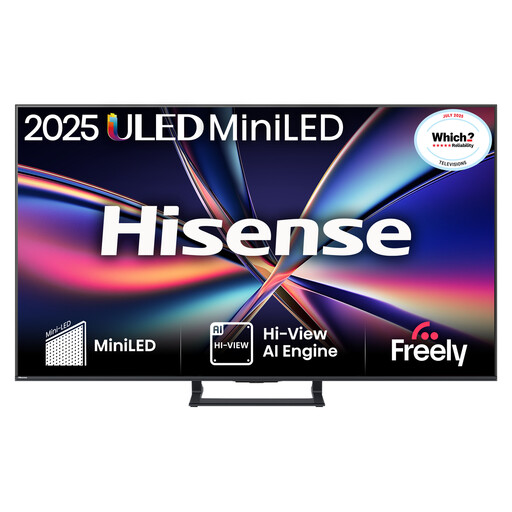
Hisense 55E8QTUK 55-inch Mini LED 4K TV
This is another 55-inch option for a room where console play shares screen time with films and streaming.
The product name specifies HDR, VIDAA OS and 144Hz Game Mode Pro. For a VRR connection, check the model’s HDMI 3 or 4 input guidance and the console mode you plan to use.
Compare input-lag measurements at your intended resolution, refresh rate and picture setting rather than relying on a single advertised figure.
View on Joybuy
 No image available
TCL 55P8K-UK 55-inch QLED 4K TV
Consider this 55-inch model if the same screen will serve console gaming and household entertainment.
Its product name specifies HDR PRO, Google Cast, Miracast and an ONKYO 2.1 sound system. The named 288Hz Game Accelerator should not be read as a promise of 288Hz console output.
Check port-specific 4K/120Hz and VRR support for your console, alongside a comparable Game Mode input-lag test.
View on Joybuy
 No image available
Sony BRAVIA XR42A90K 42-inch OLED 4K TV
This 42-inch model is worth considering where a smaller screen suits the seating positions and the TV must also handle everyday viewing.
The product name specifies HDR, Google TV, Google Cast and Dolby Vision/Atmos. Its PlayStation wording is not a substitute for checking the exact HDMI input and output modes.
For 4K/120Hz gaming, confirm the relevant input and look for an input-lag test using the console signal and Game Mode you intend to use.
View on Joybuy
 No image available
TCL 75Q6C 75-inch QD-Mini LED 4K TV
Consider the 75-inch screen only after checking that its size feels comfortable from the household’s normal seats.
The product name specifies HDR, Google TV and a 144Hz native refresh rate. That panel figure does not identify which HDMI input accepts a particular console mode.
Confirm the 75Q6C’s port-specific gaming features and seek input-lag results tested under the settings you expect to use.
View on Joybuy
Questions about console TVs
Do I need HDMI 2.1 for PS5 or Xbox gaming?
Not for every game or output mode, but it matters if your goal is a supported 4K/120Hz setup. Xbox Support specifies an HDMI 2.1 TV and an Ultra High Speed HDMI cable for Xbox Series X at 4K/120Hz; PlayStation says PS5 supports HDMI 2.1 and 4K/120Hz output. Check the game, selected TV input and console settings as well.
Will a 144Hz TV make Switch 2 run games at 4K/120 fps?
No. Nintendo UK states that Switch 2’s 4K TV output is limited to 60 fps. Higher-frame-rate modes depend on supported games and output settings, so choose a higher-refresh TV for modes you can actually use, not for an assumed 4K/120 fps Switch 2 signal.
How can I compare TV input-lag claims?
Compare results measured at the same resolution, refresh rate and Game Mode setting, with VRR state identified where it matters. PCMag UK distinguishes measured input lag from refresh rate; an isolated lag figure cannot tell you how another signal or picture mode will behave.
What should I do with an old TV when replacing it?
Check the collection or recycling arrangement available through your retailer or local authority before delivery. GOV.UK identifies the Waste Electrical and Electronic Equipment Regulations 2013, as amended, as the UK framework for electrical waste; the practical collection route depends on the arrangement available to you.


