For a large group, choose a screen that fits the farthest seats without overlooking the picture seen from the sides. An OLED TV is worth considering when you can control the room lighting; in a bright room, consider a specific LCD or Mini LED model with stated anti-reflection and wide-viewing-angle features. Check the exact size and model, then assess sound and placement separately.
Who is this for?
Hosts with a wide seating arrangement
When guests sit well to either side, check how the exact TV looks from those seats, not just straight ahead. RTINGS notes that IPS LCD TVs are commonly associated with wider viewing angles but lower contrast; LG describes wide viewing angles as a feature of its OLED range.
Viewers in bright living rooms
If daylight or lamps reflect in the screen, assess glare while the room is lit. Samsung specifies an Anti-Reflection Screen and Ultra Viewing Angle for its 65-inch QN90D, but those features should not be assumed for every Mini LED TV.
Organisers balancing screen and sound
When some guests sit farther back, measure their viewing position as well as the space for the TV. Consider how everyone will hear vocals and dialogue, and whether a soundbar can sit beneath the screen; Sony describes a soundbar-friendly stand setting for its BRAVIA 8 II.
What matters when choosing?
Decide whether side-seat picture quality or room reflections are the harder problem first. Then size the screen for the seating layout and plan how the group will hear it.
OLED or QD-OLED
Consider when: Film nights are mainly in controllable lighting and picture consistency across a wide sofa matters. LG describes wide viewing angles for its OLED range.
Check: Assess reflections on the exact model in the lighting you expect to use; panel technology alone does not settle that question.
LCD or Mini LED with stated glare control
Consider when: Daylight or lamps are difficult to control. Samsung specifies both anti-reflection and wide-viewing-angle features for its 65-inch QN90D.
Check: Those features are model-specific; inspect the picture from side seats and compare dark scenes rather than relying on the Mini LED label.
| Concern |
What to check |
Who this matters to |
| Side-seat picture |
Inspect the exact model from the outer seats, or consult model-specific viewing-angle measurements. |
If guests spread across the sofa and armchairs, I want the picture to remain convincing away from the centre. Around 31% of consumers put side-seat consistency first. |
| Reflections |
Identify windows and lamps facing the screen; check model-specific anti-reflection features in similar lighting. |
When I cannot dim the room, reflections could distract me during darker scenes. Roughly 31% of consumers place glare control above their other TV concerns. |
| Screen size |
Measure the farthest seat, available width and stand footprint. Sony gives a minimum 4K viewing distance of 1.5 times the screen height, not a universal size prescription. |
With viewers seated farther back, I need to judge whether they can comfortably follow the film. About 23% of consumers make screen scale their primary concern. |
| Sound and placement |
Listen for vocal clarity at your intended volume; check audio connections and soundbar clearance if you plan to use one. |
I want the whole group to hear dialogue and songs without an awkward speaker arrangement. Around 15% of consumers prioritise listening and setup practicality. |
Buying pitfalls
-
Choosing by screen size alone
A larger image may help viewers farther back, but it will not resolve reflections or a weaker picture at the sides.
Measure the farthest and outermost seats, then assess size, viewing angle and room lighting together. Treat Sony’s 4K minimum-distance guidance as a starting point.
-
Assuming a panel label settles viewing angle and glare
RTINGS describes a viewing-angle and contrast trade-off for IPS LCD TVs, while Samsung’s anti-reflection and wide-angle specifications apply to the named 65-inch QN90D, not every Mini LED model.
Check the exact size and model, and view it from the seats your guests will use if possible.
-
Leaving installation until after choosing the TV
A larger set still has to fit its furniture or mounting position, with room for any planned soundbar.
Check the stand footprint, wall and bracket requirements, and what installation services include before committing.
Wall mounting or stand installation can require a separate service, so decide how the TV will be set up before choosing its position.
-
Comparing energy information at range level
The size and variant you choose matter when comparing product information; a description of the wider TV range is not a substitute for the exact model’s documents.
Read the energy label and product information sheet for the TV size and variant you intend to order.
Brands to consider
LG
LG’s OLED range is relevant when a wide seating layout and film contrast guide the choice; its cited OLED77C66LB is a 77-inch C6 option.
- LG says its OLED TVs maintain picture quality from virtually any angle, a useful feature to assess for side seats.
- Check reflections, screen fit and audio connections on the exact model rather than assuming every LG OLED suits the same room.
Samsung
Samsung’s 65-inch QN90D QE65QN90DATXXU illustrates a Mini LED route for a room where reflections and side seating both matter.
- Samsung specifies an Anti-Reflection Screen and Ultra Viewing Angle for this particular QN90D model.
- Do not extend those model-specific features or their results to every Samsung TV or screen size.
Sony
Sony’s 65-inch BRAVIA 8 II K65XR8M25BP.UKA is a QD-OLED option to examine when film viewing and soundbar placement are priorities.
- Sony describes a two-way stand with a soundbar-friendly setting for the BRAVIA 8 II.
- Check the precise model’s audio connections, stand clearance and picture in your room rather than inferring performance from the wider range.
Joybuy TVs for group film nights
These TVs offer different screen sizes for a group viewing setup. Compare their fit for your farthest and outer seats, room lighting and planned audio arrangement rather than treating screen size alone as the deciding feature.
 No image available
Samsung S85F QE83S85FAE 83-inch 4K Smart TV
Consider this size if viewers sit farther back and the screen fits the planned position.
The product name specifies 4K Ultra HD and Wi-Fi. Check the exact model’s side-seat picture, reflections and audio connections for your setup.
View on Joybuy
 No image available
Samsung QE75QN80FAU 75-inch 4K Smart TV
This size is worth assessing when the group includes viewers farther from the screen but an 83-inch set would not suit the space.
The product name specifies 4K Ultra HD and Wi-Fi. Check viewing angles and reflections on this model rather than assuming it has the features specified for the different QN90D.
View on Joybuy
 No image available
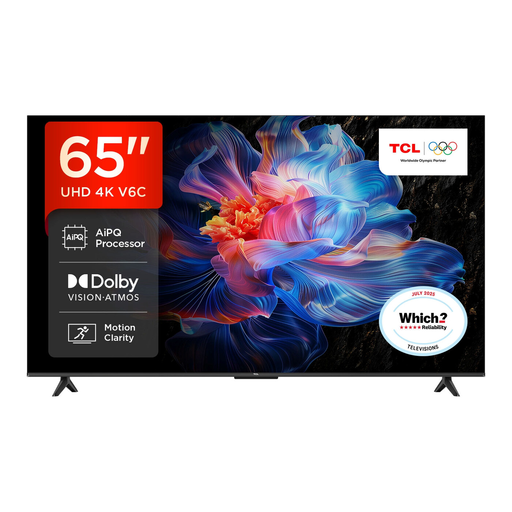
TCL 65V6C 65-inch Direct LED 4K Google TV
Consider this size where the seating layout and available space suit a 65-inch screen.
The product name specifies HDR and Dolby Atmos. Check the picture from side seats and confirm the audio outputs if you plan to connect a soundbar.
View on Joybuy
 No image available
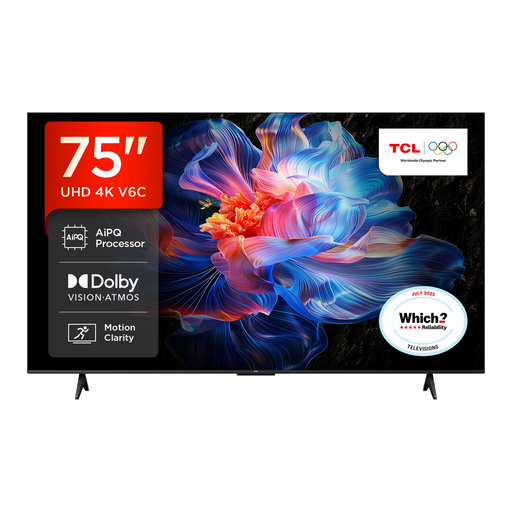
TCL 75V6C 75-inch Direct LED 4K Google TV
The larger V6C size is worth considering if more guests will watch from farther back and the TV fits its stand or wall position.
The product name specifies HDR and Dolby Atmos. Assess side-seat viewing and reflections on this exact size, and check soundbar connections if needed.
View on Joybuy
 No image available
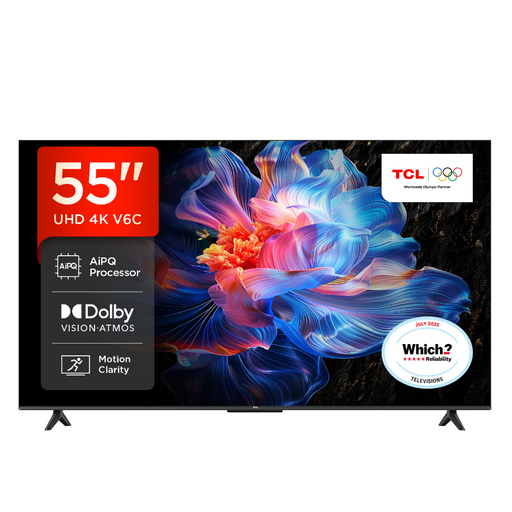
TCL 55V6C 55-inch Direct LED 4K Google TV
Consider this size if a larger screen would not fit, but measure the farthest group seat before choosing it.
The product name specifies HDR and Dolby Atmos. Check side-seat viewing, room reflections and any audio connection your setup requires.
View on Joybuy
Questions about group viewing
How should I size a 4K TV for guests seated farther back?
Measure the farthest regular seat and the space available for the screen. Sony’s minimum 4K viewing-distance guidance is 1.5 times the screen’s vertical height; it is a starting point, so also consider the side seats and what feels comfortable in your room.
Should I choose OLED for a wide group?
OLED is worth considering when side-seat picture consistency matters and you can control the lighting. LG describes wide viewing angles for its OLED range, but you should still assess reflections and the exact model; a bright room may instead favour a model with stated anti-reflection and wide-angle features.
Will a TV’s built-in speakers be enough for musical films?
Decide by listening for clear vocals and dialogue at the distances and volume your group will use. If you plan to add a soundbar, check the TV’s audio connections and clearance beneath the screen; Sony describes a soundbar-friendly stand setting for its BRAVIA 8 II.
Which energy documents should I compare for a UK TV?
Compare the energy label and product information sheet for the exact screen size and variant you intend to buy. A range-level description may not give you the information needed to compare those particular TVs.


