Dedicated musical-film viewers
If you watch filmed stage performances and darker productions with the lights down, check picture presentation in dark scenes and whether your film source supports the TV's HDR formats.


For musical films in a light-controlled room, consider an OLED TV with the HDR formats your films use. If you regularly watch in daylight, compare reflection handling on the exact OLED and QD-Mini LED models rather than choosing by panel type alone. For vocals and a system you can expand, check the TV, source and intended soundbar or AVR for the connections and audio formats you need.
If you watch filmed stage performances and darker productions with the lights down, check picture presentation in dark scenes and whether your film source supports the TV's HDR formats.
If singing, dialogue and orchestral passages drive your choice, consider both the TV's built-in audio and how you would connect a soundbar or AV receiver (AVR). The relevant HDMI audio-return connection matters if you plan to expand the system.
If the same room is used in daylight or with lamps on, assess reflections as well as screen size and placement. A specification aimed at dark-room viewing cannot tell you how the screen will look beside your windows.
Start with the room's light and the space available for the screen, then check picture formats and the complete audio connection you intend to use. An HDR or Dolby Atmos label on the TV alone does not establish what a particular film and playback setup will deliver.
| Concern | What to check | Who this matters to |
|---|---|---|
| Dark scenes and HDR | Compare picture presentation in lighting like your room's, and confirm that the exact TV and film source support the HDR format you intend to use. | If spotlit performers and dark theatre scenes are central to what I watch, I want a picture that suits my controlled-light room. Around 36% of consumers put this picture need first. |
| Vocals and soundtrack | Check the relevant HDMI audio-return port on the exact TV and whether your source, soundbar or AVR supports the intended format. | I want singing and dialogue to remain clear, with the option to build an external audio system later. For around 29% of consumers, that soundtrack need comes first. |
| Screen and installation fit | Measure the viewing space and check the selected size's dimensions, stand footprint or mount requirements. | A larger screen only works for me if it fits the furniture or wall and leaves space for audio equipment. This is the primary concern for around 21% of consumers. |
| Daylight and reflections | Note where windows and lamps sit, then assess reflection handling on the exact model under comparable lighting. | When films share a room with daytime use, I need to see the picture without troublesome reflections. Around 14% of consumers prioritise that lighting issue. |
The soundtrack you hear also depends on the film source, playback settings, connections and speakers. HDMI Licensing Administrator describes eARC as supporting formats including Dolby Atmos and Dolby TrueHD, but the connected equipment must support the intended format too.
List the source device, TV and intended soundbar or AVR before buying, then check the connection and format at each stage.
Building the external audio setup may also require compatible equipment, cabling and installation work.
Daylight and reflections affect how practical a TV is in a shared room. Samsung describes the S95F's Glare Free feature, while TCL lists QD-Mini LED technology for the C855K; neither description establishes how another model will look in your room.
Map the windows and lamps, and compare the exact TVs under lighting close to your usual viewing conditions.
A screen can suit the viewing plan yet leave too little space for its stand, a soundbar, cables or a safe wall installation.
Check the chosen size's dimensions, stand footprint or mounting specification against your furniture and wall space.
Changing the planned position may mean arranging a different stand, wall mount or speaker placement.
In-store electrical-waste take-back and home collection are different arrangements. GOV.UK's retailer guidance says qualifying in-store take-back is free, while transport costs may be charged for collection from a customer's home.
Ask the retailer which take-back or collection option applies before ordering, and keep the old TV until you have a disposal plan.
LG's cited C5 is relevant if you are considering OLED and Dolby Vision for a light-controlled film room.
Sony's cited BRAVIA 8 is relevant if screen-based sound placement is part of your integrated-audio assessment.
Samsung's cited S95F is relevant when reflections are a major concern in a multi-use room.
TCL's cited C855K offers a QD-Mini LED model to investigate for a room used in changing light.
These TVs include QD-Mini LED, Mini LED, OLED and Direct LED options for considering screen fit, room lighting and built-in audio. If a soundbar or AVR is part of your plan, confirm the audio connection on the exact model before choosing.
 No image available
Consider this large-screen option only after checking that the screen and installation space suit your room.
The product title lists Google TV, a 144Hz native refresh rate and an ONKYO 2.1 audio system. Confirm the connections and formats required by your planned playback equipment.
 No image available
The 55-inch size is worth considering if a larger screen would be difficult to position; check its dimensions against your intended space.
The product title identifies VIDAA OS and a built-in subwoofer. If you intend to add a soundbar or AVR, confirm the exact TV's audio-return connection first.
 No image available
This is another screen size to assess for a room where placement and lighting both influence the choice.
The product title lists Google TV and a 144Hz native refresh rate. Check the exact dimensions and audio connections before planning a wall mount or external sound system.
 No image available
Consider this OLED option for a light-controlled viewing room, while assessing its picture and audio in the setup you intend to use.
The product title lists Google TV, Dolby Vision and Dolby Atmos. Check the exact model's installation dimensions and audio-return connection if external speakers are planned.
 No image available
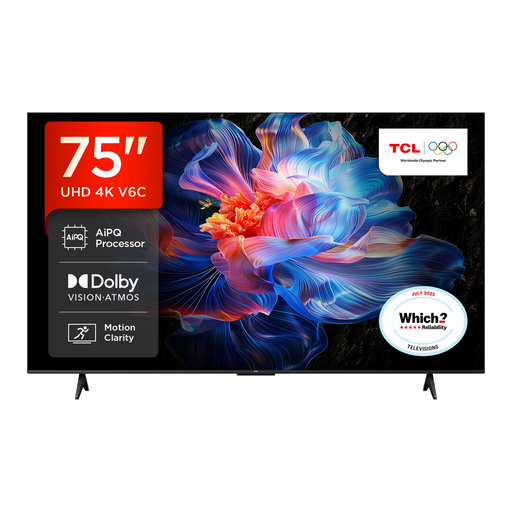
If screen size and straightforward TV access lead your decision, assess this 75-inch option against your room measurements and film sources.
The product title lists Google TV and Dolby Atmos. Confirm the installation dimensions and audio-return connection if either matters to your setup.
Check the exact TV's audio-return HDMI port and the intended soundbar or AVR's corresponding connection. HDMI Licensing Administrator says eARC supports formats including Dolby TrueHD, Dolby Atmos, DTS-HD Master Audio and DTS:X; you also need to check what your film source and playback equipment can supply.
No: the label alone does not establish the result from a particular film, app, connection and speaker setup. Check the supported format throughout your playback chain and assess whether the TV's built-in speakers meet your needs or you want external audio.
It depends on how you watch them, not on the TV you buy. TV Licensing says you need to be covered to watch live TV on any service or use BBC iPlayer; watching other services solely on demand does not by itself require a TV Licence, provided you do not watch live TV or use BBC iPlayer.
Ask the retailer about its applicable electrical-waste take-back arrangement before ordering. GOV.UK's retailer guidance says qualifying in-store take-back must be free, but a retailer may charge transport costs for home collection; confirm the service offered for your purchase.