Families spread across a sofa
If someone regularly sits well to one side, compare how the picture changes at that seat before choosing on the basis of a centre-seat demonstration.


When family members regularly watch from the ends of a sofa, prioritise a TV that holds its picture from a wide horizontal viewing angle. OLED is a route to consider, while an IPS LCD offers wider angles than a VA LCD but generally lower contrast; VA makes more sense when viewing is mainly from the centre. Whichever display you choose, check the exact model’s viewing-angle performance and how it will play videos from your family’s devices.
The usual seating positions matter more than a picture viewed only from directly in front of the screen. RTINGS identifies wide viewing angles as important when people watch from different positions.
If someone regularly sits well to one side, compare how the picture changes at that seat before choosing on the basis of a centre-seat demonstration.
Check how each source will connect to the exact TV. Panasonic’s specifications for the TV-48Z90BEB illustrate why features such as casting, media playback and HDMI inputs need to be checked model by model.
If side seats are used only occasionally, a VA LCD’s narrower viewing angle may be an acceptable trade-off for its generally higher contrast. RTINGS describes both characteristics as typical of VA panels.
Start with where people actually sit, then check how videos reach the TV. Room lighting and the importance of centre-seat contrast can refine that choice.
| Concern | What to check | Who this matters to |
|---|---|---|
| Picture from side seats | Look for an independent horizontal viewing-angle result for the exact model. For an LCD TV, check whether it uses an IPS or VA panel; RTINGS describes IPS as having wider angles and VA as having narrower ones. | If I sit near the end of the sofa, I want family members to see a consistent picture without moving to the middle. Around 42% of consumers would put side-seat picture consistency first. |
| Video-source compatibility | Match your phone, tablet, camera or storage device to the TV’s stated casting, mirroring, HDMI or media-player functions, including relevant file formats. | Getting clips from the devices we already use onto the screen is my main concern. Roughly 25% of consumers would prioritise that playback route. |
| Bright-room visibility | Consider windows and lamps visible in the screen, then compare independent reflection-handling and brightness results for the exact model where available. | Daytime light and reflections could make our videos difficult to see from the usual seats. About 17% of consumers would make bright-room visibility their primary concern. |
| Centre-seat contrast | Map the seats used most often. If most viewing is central, weigh VA LCD’s generally higher contrast against its narrower viewing angles, as described by RTINGS. | We usually sit in front of the TV, so I care more about contrast than the picture at the far ends of the sofa. Around 16% of consumers would put that trade-off first. |
“LED” and “QLED” do not identify whether an LCD panel is IPS or VA. RTINGS describes a meaningful trade-off: IPS generally has wider viewing angles, while VA generally has higher contrast and narrower angles.
Find the exact model’s panel information and horizontal viewing-angle results where available. Assess the picture from the seats people will use, not only from the centre.
A smart-TV label does not establish that your particular phone, camera or video files will work with its casting, mirroring or media-player functions.
List your video sources and check the exact model’s supported connections and formats. If you plan to use a wired device, confirm that its output and the TV’s HDMI connection are compatible.
Samsung, Sony and Philips describe wide-angle viewing in their OLED materials, but those statements do not establish the performance or connections of every model and size.
Use the range information to narrow your options, then check the chosen model’s independent viewing-angle results, screen size and playback specifications.
These brands provide starting points for checking particular OLED ranges or models, not a substitute for comparing the TV that fits your seats and video sources.
An OLED range to consider when several people watch from off-centre seats.
BRAVIA XR OLED models are another route to investigate for a wide seating arrangement.
A useful reference when checking documented playback connections on an individual OLED TV.
Selected OLED+ Ambilight models may be worth examining for a family room with widely spaced seats.
These OLED TVs are options to examine when family members regularly watch from side seats. Check each model’s viewing-angle results and the way it will play your videos before deciding; screen size and sharing functions differ between them.
 No image available
Consider this model if an 83-inch screen fits your room and Apple AirPlay 2 or mirroring suits your video source.
The listed display is 4K Ultra HD OLED. Check its independent side-seat viewing results and compatibility with your devices and video formats.
 No image available
Consider this 65-inch model if Google Cast is a suitable way to share your family videos.
It is listed as a 4K HDR OLED Google TV. Confirm compatibility with your devices and files, and check independent viewing-angle results for this model.
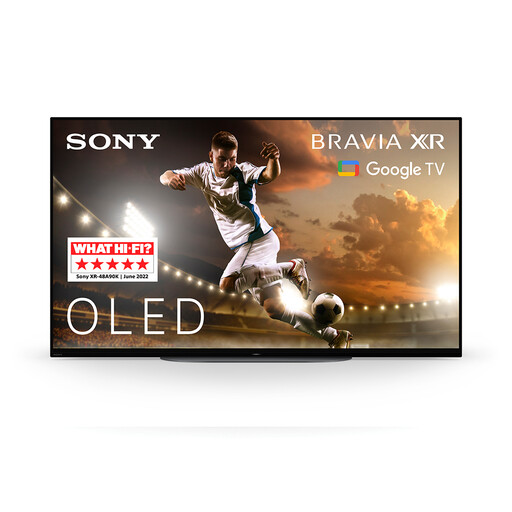 No image available
Consider this 48-inch model if that size suits your seating arrangement and you intend to share videos through Google Cast.
It is listed as a 4K HDR OLED Google TV. Check your source-device and file compatibility, along with independent side-seat viewing results for the exact model.
Check the exact TV’s horizontal viewing-angle performance. RTINGS advises that wide viewing angles matter for people watching from different positions; a centre-seat picture alone will not show what someone at the end of the sofa sees.
IPS is generally the more suitable LCD panel type when side-seat viewing takes priority, while VA generally offers higher contrast for more central viewing. RTINGS identifies this viewing-angle and contrast trade-off; check which panel the exact TV uses and look for model-specific results.
Choose a playback method supported by both your source device and the exact TV. Depending on the model and device, that may mean casting, mirroring, a media player or a compatible HDMI connection; also check support for the video files you use.
Buying a smart TV alone is not the deciding factor; what you watch matters. TV Licensing says you need to be covered by a TV Licence if you watch live TV, so consider whether the household will use the set for that as well as for family videos.