For silent films at home, choose a TV with a film-oriented picture mode and motion settings you can assess using the restoration you intend to watch, then check that its size and connections suit your room. OLED models offer relevant options, but no TV can correct a transfer mastered at an unsuitable playback speed: the Library of Congress notes that silent films were generally not shot or projected at 24 frames per second.
Who this choice matters to
Silent-film restoration enthusiasts
If you compare discs or archive streams, you may want to assess motion treatment and shadow detail on each release rather than rely on automatic enhancement. Playback speed matters too: the Library of Congress notes that silent films were generally not made for 24-frame-per-second sound-film playback.
Dedicated dark-room cinema viewers
If you mainly watch in a light-controlled room, compare near-black detail and film-oriented picture modes on the exact TV you are considering. Panasonic, Sony and LG list relevant OLED or QD-OLED models, but their picture-quality descriptions are manufacturer claims, not equivalent independent tests.
Home-cinema upgraders
If an existing player, sound system or piece of furniture must work with the new TV, check the exact model’s stand dimensions and connections as well as its screen size. For a UK purchase, match the displayed energy label to the product you choose.
What to check before buying
Start with the release and the TV’s motion controls; then compare dark-scene presentation, installation needs and ownership details.
| Concern |
What to check |
Who this matters to |
| Playback and motion |
Look for a film-oriented picture mode and adjustable motion processing. Try them with the disc, file or app you plan to use; the TV cannot correct an unsuitable transfer speed. |
If the action looks rushed or artificially smooth, I want to compare settings without losing the character of the restoration. Around 36% of consumers would put playback fidelity first. |
| Dark-scene detail |
Compare the same monochrome or low-light scenes in a dim room using an appropriate picture mode; assess the exact model and size. |
When I watch in a dark room, I care most about seeing separation in shadows rather than judging the picture by a bright demonstration clip. Roughly 29% of consumers would make dark-room presentation their main concern. |
| Room and system fit |
Measure the furniture or wall space, and confirm stand dimensions, HDMI allocation and any audio-return connection you need. |
My player and sound system need to connect, and the TV must fit where I intend to put it. For about 21% of consumers, that practical fit would be the priority. |
| Ownership details |
Match the UK energy label to the exact model and size, and read any applicable panel-cover terms. |
Before committing, I want to understand the energy information and what the stated cover applies to. Around 14% of consumers would put these ownership checks first. |
Buying pitfalls
-
Assuming every silent film should play at sound-film speed
An unsuitable transfer speed can make movement look rushed regardless of the television. The Library of Congress notes that silent films were generally not shot or projected at 24 frames per second.
Check the release you intend to watch, then compare its appearance with motion processing reduced or disabled.
-
Choosing by contrast claims alone
Manufacturers’ descriptions of black levels and cinematic colour do not establish how different TVs render the same restoration under comparable settings.
Use the stated features to narrow your choices, then compare the exact models’ picture controls and independent tests where available.
-
Measuring only the screen diagonal
A diagonal measurement does not tell you whether the stand fits your furniture or whether the inputs suit your player and audio setup.
Check the exact model’s stand dimensions, placement clearances and connection layout before ordering.
-
Comparing energy labels without matching the model
An energy label needs to be associated with the television being considered, including its particular size and variant. GOV.UK guidance says television labels must be easy to see and clearly related to the product.
Check the model identifier on the label before using it alongside your picture and installation requirements.
Brands to consider
Panasonic
Panasonic’s UK TV-55Z85AEB is a film-oriented OLED model to examine if picture presets and motion controls are central to your choice.
- Panasonic lists FILMMAKER mode, Smooth Motion Drive Pro, four HDMI inputs and eARC for this model.
- Those specifications do not establish which motion setting suits a particular restoration or how accurately every transfer will look.
Sony
Sony positions its UK BRAVIA 8 II line as a QD-OLED home-cinema option.
- Sony identifies QD-OLED display technology for the line and publishes size and installation specifications for the K-55XR8M2 variant.
- Compare the exact variant’s stand, connections and picture controls; line-level cinema claims are not independent results for every BRAVIA TV.
LG
LG’s UK OLED evo C6 listing is relevant if panel-cover terms are part of your home-cinema decision.
- LG states that OLED Care+ covers the panel for five years on the cited C6 listing.
- Check the terms and exact variant. LG’s contrast and colour descriptions are manufacturer positioning, not a measurement of silent-film playback accuracy.
Joybuy TVs for home cinema
These OLED televisions offer different screen sizes for a silent-film home-cinema setup. Compare their fit and picture controls with the release and equipment you plan to use; the Sony BRAVIA 8 and A90 products here are distinct from the BRAVIA 8 II discussed above.
 No image available
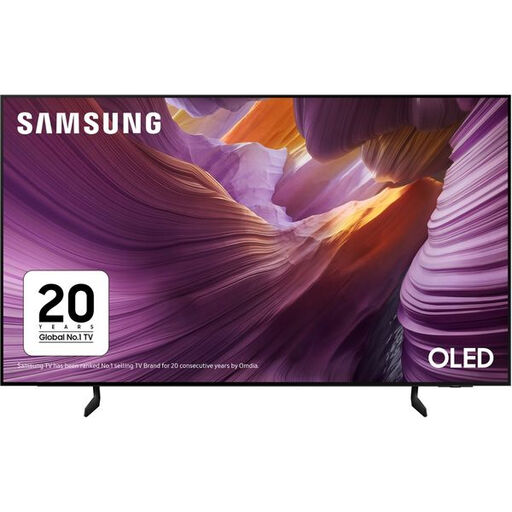
Samsung S85F QE83S85FAE 83-inch 4K TV
Consider this OLED model if an 83-inch screen fits your viewing space. Its listed film-oriented mode gives you a starting point for comparing your own sources; confirm how motion settings can be adjusted for a particular transfer.
Check the stand footprint and the energy label for this exact size before ordering.
View on Joybuy
 No image available
Samsung S85F QE65S85FAE 65-inch 4K TV
Consider this OLED variant if a 65-inch screen suits your room. Its listed film-oriented mode is a starting point, but check the available motion adjustments against the silent-film release you will watch.
Confirm the stand footprint, planned connections and energy label for the 65-inch model.
View on Joybuy
 No image available
Samsung S90F 55-inch 4K OLED TV (2025)
This 55-inch OLED model may suit a setup planned around a centre stand. Its listed film-oriented mode can be compared with your own source; check which motion adjustments the exact set offers.
Measure the stand space and match the UK energy label to this model.
View on Joybuy
 No image available
Sony BRAVIA A90 XR42A90K 42-inch OLED TV
Consider this 42-inch 4K OLED set where a smaller screen suits the planned space. Check its film-oriented picture modes and adjustable motion controls for the exact model before choosing it for silent films.
If you plan to use a stand or external audio system, confirm the dimensions and connections against your setup.
View on Joybuy
 No image available
Sony BRAVIA 8 K65XR80BP 65-inch OLED TV
This 65-inch 4K OLED TV is an option if that screen size fits your home-cinema room. Check the exact model’s film-oriented presets and motion adjustments rather than assuming they match those of another BRAVIA line.
Confirm stand dimensions, audio connections and the energy label before ordering.
View on Joybuy
Common questions
Can a new TV fix a silent film that looks unnaturally fast?
A new TV cannot reliably correct an unsuitable transfer speed. The Library of Congress notes that silent films were generally not shot or projected at 24-frame-per-second sound-film speed; check the release first, then use the TV’s motion controls to assess its presentation.
Should I use a filmmaker or cinema mode for silent films?
A film-oriented mode is a useful starting point, not a setting that suits every restoration. Panasonic lists FILMMAKER mode and Smooth Motion Drive Pro for its UK Z85 OLED; compare the available modes and motion settings using your own source.
Do I need a soundbar for silent films?
A soundbar is not essential simply because you watch silent films; choose your audio setup around the release and equipment you use. If you want external sound, check the TV’s connection layout: Panasonic lists eARC on HDMI input 2 for its UK Z85 model.
Which UK energy label should I check?
Check the label associated with the exact TV model and screen size you intend to buy. GOV.UK guidance says a television’s energy label must be easy to see and clearly related to that product.


