
24/7 Customer Support

Free returns

Same-day & Next-day Delivery

Quality Guaranteed

Unlock Your Welcome Offers: FREE Delivery | Up to 80% OFF | Free 30-day JoyPlus trial
Download the APP
Mounting your television can transform a room, freeing up floor space and creating a clean, modern aesthetic. However, choosing the right TV wall bracket can feel overwhelming. With so many types, sizes and features to consider, it's easy to get lost in technical specifications. The goal is to find a secure, practical solution that fits your specific television, room layout and viewing needs.
This guide is designed to help you navigate the options. We will walk you through the key considerations for selecting a mount and present a few carefully chosen recommendations that cater to common requirements, from drill-free stands to long-reach arms for tricky corners.
Before you start browsing, a little preparation goes a long way. Focussing on these three areas will help you narrow down your search and make a confident choice.
The most critical step is ensuring a mount is compatible with your television. Look for these three specifications:
How you want your TV to move will determine the type of bracket you need.
The type of wall you have is a major safety consideration. Solid brick or concrete walls provide a very secure anchor point. Plasterboard (drywall) walls require the bracket to be fixed directly into the wooden studs behind the board. Never mount a heavy TV bracket to plasterboard alone.
If drilling isn't an option—perhaps you're renting or simply prefer a less permanent solution—a TV floor stand is an excellent alternative. These stands support the TV on a frame, often including a universal TV stand with shelf for media players or soundbars, offering stability without any wall damage.
Based on common user needs and versatile features, here are our recommendations for 2026.
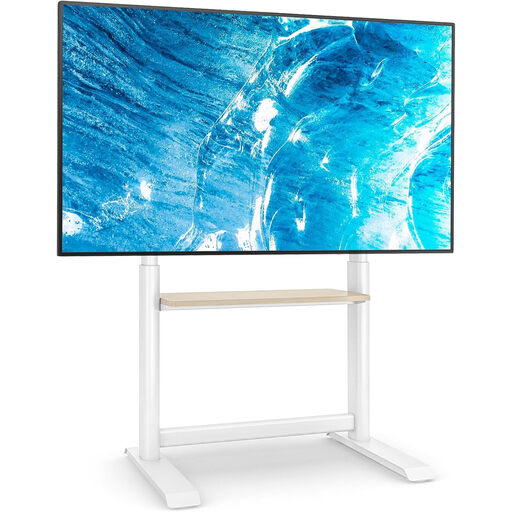
Why It Stands Out: This TV floor stand is a robust, drill-free solution for very large and heavy televisions. Its steel construction and high load capacity of 86 kg provide a stable base for screens up to 86 inches. The height of both the TV bracket and the MDF utility shelf are adjustable, allowing you to create the optimal viewing setup and keep your media devices organised.
Pros:
Who is it for?: Anyone with a very large TV (60-86 inches) who cannot or does not want to drill into their walls. It's a practical choice for creating a media centre in any room.
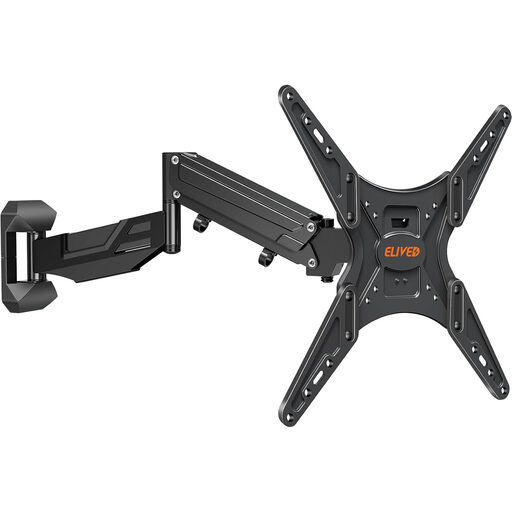
Why It Stands Out: This height adjustable TV mount uses a gas spring mechanism, allowing for effortless, tool-free vertical adjustment of your screen. Combined with its full-motion capabilities—including 515mm extension, tilt and 180° swivel—it offers complete control over your viewing angle. It's a sophisticated solution for multi-purpose rooms where viewing positions change.
Pros:
Who is it for?: Users who need to frequently adjust their TV's height and angle, such as in a home office that doubles as a media room or for families with both adults and children using the screen.
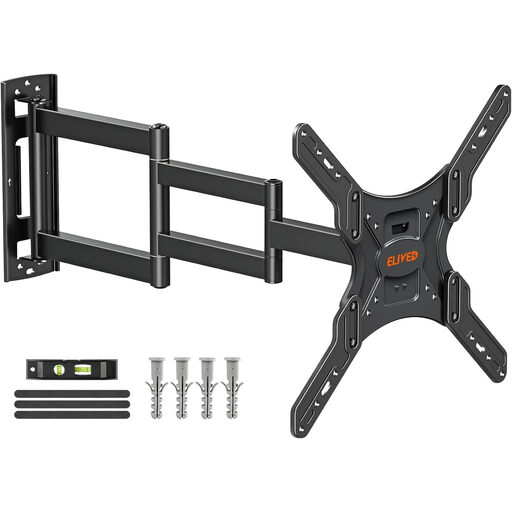
Why It Stands Out: This is the ultimate problem-solver for awkward room layouts. As a long extension TV bracket, its arm reaches an impressive 749mm from the wall, allowing you to place a TV in a corner and pull it out to face the viewing area directly. Despite its long reach, it retracts to a slim 65mm profile. The full-motion design provides a wide swivel and tilt range for the perfect angle.
Pros:
Who is it for?: Homeowners with large rooms, deep alcoves or corner placement needs. It's the go-to choice when a standard mount just won't reach.
The products featured here cover a range of common needs, but every setup is unique. If you're looking for a different style, such as a simple tilting TV wall mount for reducing glare, you can explore a wider selection on our category page.
1. What is a VESA mount and how do I find my TV's VESA size? The VESA Interface Standard defines the distance between the four mounting holes on the back of a television. It is expressed as horizontal distance x vertical distance in millimetres (e.g., 400x400mm). You can find this specification in your TV's user manual or by simply measuring it with a tape measure. Your TV wall bracket must support your TV's specific VESA size.
2. Can I mount a TV on a plasterboard wall? You should proceed with extreme caution. Plasterboard itself is not strong enough to hold the weight of a TV and mount. For a secure installation, the bracket must be screwed directly into the solid wood studs located behind the plasterboard. Use a stud finder to locate them. While specialist heavy-duty plasterboard fixings exist, for the safety of your equipment and home, mounting into studs is the recommended method. If you are unsure, consult a professional installer.
3. Do full motion TV mounts work for curved TVs? Many modern mounts are designed to be compatible with both flat and curved screens. A bracket advertised as a VESA mount for curved TV will typically work without issue. These mounts often come with special spacers in the hardware kit. These spacers are used to fill the gap created by the screen's curve, ensuring the bracket makes secure contact with the TV's mounting points. Always check the product specifications to confirm compatibility with curved models.