Flatmates spread across the seating area
If people watch from the ends of a sofa or side chairs, compare the picture from those positions, not just from straight ahead. RTINGS.com identifies viewing angle as important for wide seating arrangements.


For musical-film nights across a wide seating area, consider an OLED TV if the room is usually dim; if daylight is hard to control, compare Mini LED models instead. Neither display choice settles the sound question: check dialogue and vocals at a volume that works for the flat, and plan space for a soundbar if built-in audio falls short.
If people watch from the ends of a sofa or side chairs, compare the picture from those positions, not just from straight ahead. RTINGS.com identifies viewing angle as important for wide seating arrangements.
Songs and spoken scenes make sound worth assessing at the volume everyone can live with. RTINGS.com notes that most TVs offer little deep bass, so consider where a soundbar would go if built-in audio is not enough.
If the shared room stays bright at film time, compare how shortlisted screens handle brightness and reflections. Samsung UK describes Mini LED backlighting as a way to control brightness and contrast, but the result still depends on the model.
Settle the room-lighting and seating questions before choosing a display type. Then assess sound and check that the complete setup fits the shared space.
Consider it when: film nights are mostly dim and viewers regularly sit off-centre; RTINGS.com highlights viewing angle for wide seating, while LG UK positions OLED for broad viewing angles and deep blacks.
Keep in mind: the OLED label does not establish how the exact TV sounds or how its picture looks from every seat.
Consider it when: daytime light is difficult to control; Samsung UK describes Mini LED local dimming as a means of controlling backlight brightness and contrast.
Keep in mind: check the exact model’s reflections and side-seat picture rather than treating the backlight type as a viewing-angle result.
| Concern | What to check | Who this matters to |
|---|---|---|
| Picture from side seats | Compare viewing-angle results for the exact model, or inspect it from the furthest seat. | If my flatmates spread out across the room, I want the same scene to remain watchable from the side. Around 36% of consumers put off-centre picture consistency first. |
| Dialogue and music | Listen for clear speech and vocals at your usual volume; check HDMI eARC/ARC on both devices if adding a soundbar. | When a song moves into dialogue, I do not want to raise the volume just to follow the words. Dialogue and soundtrack clarity comes first for around 29% of consumers. |
| Daylight visibility | Check reflections at the usual viewing time and compare model-specific brightness results. | If we watch while the room is sunlit, I need to see darker scenes without rearranging the flat. For around 21% of consumers, bright-room visibility is the main concern. |
| Fit and running information | Measure the TV and stand footprint, allow for any soundbar, and compare the energy labels of shortlisted TVs. | Before agreeing on a shared-room setup, I want to know it fits the unit and to compare its energy information. Around 14% of consumers place those practical checks first. |
A screen viewed from the end of the sofa can look different from one viewed head-on. RTINGS.com identifies viewing angle as particularly important for wide seating arrangements.
Identify the furthest side seat, then compare independent viewing-angle results for each shortlisted model or inspect the screen from that position.
Format support and stated output do not tell you whether dialogue stays clear at a considerate volume. RTINGS.com notes that most TVs provide little deep bass.
Listen to speech and vocals where possible. If a soundbar may be needed, check the TV and soundbar connections together.
A soundbar also needs room on the furniture or wall, plus suitable cabling.
Window reflections and daylight change what viewers can see. Samsung UK describes Mini LED local dimming as a brightness-and-contrast technology, but the label alone does not establish a particular TV’s daytime performance.
Check the room at the usual film time and compare brightness and reflection results for the exact models under consideration.
Samsung UK advises checking a TV’s full dimensions against its intended position. GOV.UK says electronic displays in scope must show an energy label at the point of sale; viewing plans can also affect TV Licence requirements.
Measure the available space, compare displayed energy information and agree whether anyone will watch live TV or use BBC iPlayer. TV Licensing can clarify coverage for an unusual household arrangement.
Relevant when comparing OLED TVs for dim-room film nights and seating spread across the room.
Relevant to comparisons between OLED viewing and Mini LED or Neo QLED options for a brighter room.
Relevant when an OLED TV’s approach to picture and built-in sound is part of the decision.
Relevant when comparing QLED and Mini LED options against the room’s seating and lighting needs.
These TVs provide OLED, Mini LED and Direct LED options to examine against the flat’s seating, daylight and sound needs. Compare the exact model and its full footprint before deciding which route works in the room.
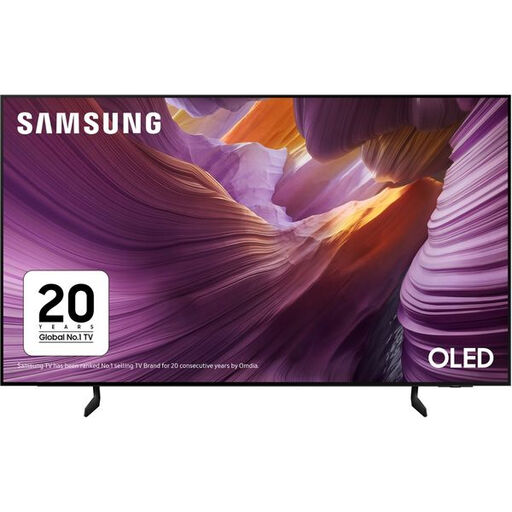 No image available
Consider this 65-inch screen for a shared seating area if its exact panel and side-seat picture meet your needs.
Confirm the model before relying on its OLED, speaker or connection descriptions: the product information also names QE65S85BAE. Check its full dimensions and listen to dialogue at the flat’s usual volume.
 No image available
The Mini LED design makes this a model to compare if the shared room is regularly bright.
Its name specifies a 65-inch 4K screen. Compare reflections and the picture from side seats, and check soundbar connections if built-in audio is not sufficient for dialogue and vocals.
 No image available
Consider this QD-Mini LED option for daylight viewing only after checking that its screen and stand fit the shared room.
The title lists a 144Hz native refresh rate and an ONKYO 2.1 audio system; neither establishes side-seat picture quality or vocal clarity. Confirm the exact screen size and full dimensions before ordering.
 No image available
This 42-inch OLED is worth considering where the available TV space is limited and film nights are usually dim.
The title specifies Dolby Vision and Dolby Atmos support, not how clearly the speakers reproduce vocals. Check the complete footprint, side-seat picture and audio connections for the intended setup.
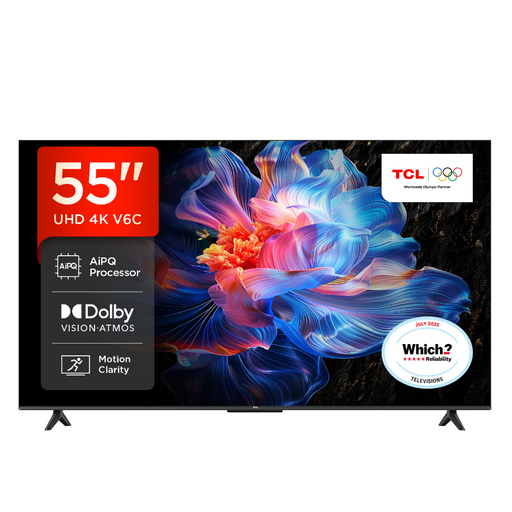 No image available
This 55-inch Direct LED option gives flatmates another screen size to assess against their seating and furniture.
The title lists Dolby Atmos support, but that does not establish dialogue clarity. Check the picture from side seats, the full dimensions and the audio connection needed for any planned soundbar.
Owning the TV alone is not what determines the requirement. TV Licensing says you need licence coverage to watch live TV on channels or streaming services, or to watch or download programmes on BBC iPlayer; other on-demand viewing generally does not require one unless it is live TV. Check your particular household arrangement with TV Licensing if it is unclear.
Dolby Atmos support alone cannot tell you whether the TV will reproduce dialogue, vocals or bass as you want. RTINGS.com notes that most TVs offer little deep bass; listen at a volume suitable for the flat and check compatible soundbar connections if fuller sound matters.
Start with where people sit and how bright the room is: OLED is worth considering for dispersed seating and mostly dim viewing, while Mini LED is worth comparing when daylight is difficult to control. RTINGS.com highlights viewing angle for wide seating, and Samsung UK describes Mini LED’s backlight control; check off-centre picture and reflections on the exact TVs before choosing.
Compare the energy labels displayed for the shortlisted TVs rather than relying on their marketing descriptions. GOV.UK guidance says electronic displays in scope must have an energy label at the point of sale, including on a website.