
24/7 Customer Support

Free returns

Same-day & Next-day Delivery

Quality Guaranteed

Unlock Your Welcome Offers: FREE Delivery | Up to 80% OFF | Free 30-day JoyPlus trial
Download the APP
Finding a suitable Type 2 EV charger UK drivers can rely on is not simply a case of choosing the highest kW rating. Your vehicle’s onboard charger, the charging point, the cable length and the socket available at home all affect whether a product is suitable.
A Type 2 EV charging cable may be ideal for public AC chargers, while a portable EV charger with 3-pin plug offers a slower but convenient backup option. Before buying, watch out for these common pitfalls.
A 22kW EV charging cable cannot make a vehicle charge at 22kW if its onboard charger only accepts 7.2kW or 11kW. The final charging speed is limited by the lowest-rated part of the system: the car, charger or cable.
For example, a 7.2kW EV charging cable is generally more appropriate for vehicles with a 6–7.68kW onboard charger, including many plug-in hybrids. An 11kW or 22kW cable may be suitable for compatible battery-electric vehicles, but it will not automatically increase the car’s charging rate.
A Type 2 to Type 2 charging cable is designed to connect an AC charge point to a vehicle with a Type 2 inlet. This is different from a portable charger that connects to a UK three-pin socket.
Type 2 and CCS2 charging cable compatibility is commonly associated with many European-market electric cars and plug-in hybrids, including vehicles from Tesla, Audi, BMW, Mercedes-Benz, Volkswagen, Hyundai and Kia. However, Type 2 cables are not suitable for J1772, CCS1 or CHAdeMO inlets. Always check your vehicle handbook and the connector shape before ordering.
An IP rating describes resistance under specified test conditions; it does not mean a charger should be left submerged, placed in standing water or stored with wet connectors. A waterproof EV charger should still be handled carefully, with caps fitted and connections kept clean and dry when not in use.
The key ratings to compare are:
A 3-phase EV cable can be used only where the charging equipment and vehicle support the relevant phase configuration. A 1-phase EV cable may be the more practical choice for a standard domestic setup.
A 5m EV cable is often manageable when the car parks close to the charge point. A 7m EV cable gives more flexibility at public charging bays, where the socket may be positioned at the front or rear of the vehicle. A 10m EV cable can help with awkward driveways or offset parking, although additional length adds weight and requires more careful storage.
Longer options such as 15m or 20m portable chargers can be useful for specific travel arrangements, but avoid routing any cable across pedestrian paths or areas where it could be driven over.
Look for clearly stated information rather than vague phrases such as “heavy duty”. The listed GONEO Type 2 cables include a TPU outer jacket, silver-plated contacts, a protective cap and a claimed testing specification of more than 20,000 bends. They are listed with IP54 dust and water resistance, an operating range of -40°C to +50°C, and protection against a one-metre drop and a two-tonne drive-over.
The same product information states TÜV Rheinland certification and compliance with CE, UKCA, RoHS, ISO and IEC standards. Check the packaging and product documentation for the relevant markings and instructions before use.
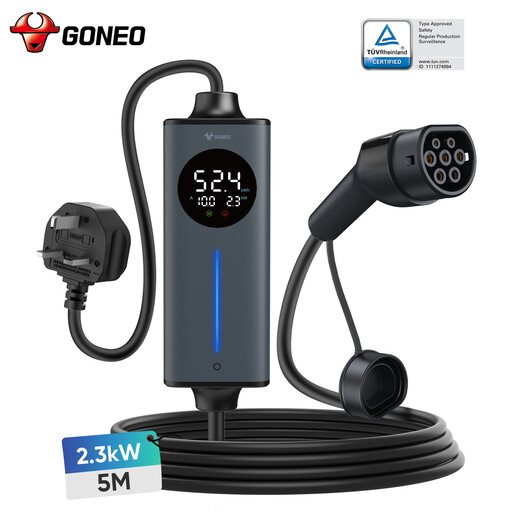
Why This Fits Their Persona: A practical entry point for a UK EV or PHEV owner who needs home or travel charging without installing a dedicated wallbox.
Its 2.3kW maximum is clearly stated, avoiding the assumption that a three-pin unit provides wallbox-level speed.
Adjustable 10A current, delay charging, LED display and IP66 rating are listed features.
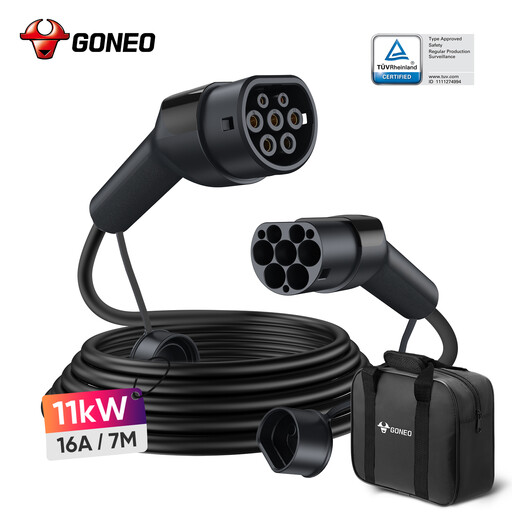
Why This Fits Their Persona: A 7m cable suits drivers who regularly use public AC charging bays and want additional reach between the vehicle and post.
The 11kW, 16A and three-phase ratings are specified, so buyers can compare them with their vehicle’s OBC.
TPU jacket, protective cap, carry bag and listed TÜV Rheinland, UKCA and CE compliance information.
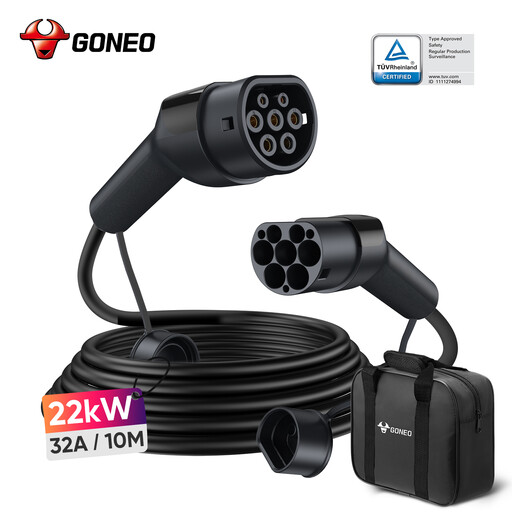
Why This Fits Their Persona: The 10m reach is suited to larger driveways, awkward charging-bay layouts and drivers who need flexibility around parking position.
It makes the 22kW and 32A three-phase specification visible, helping prevent a mismatch with a lower-rated vehicle.
10m length, carry bag, protective cap and stated IP54 resistance are practical features for frequent use.
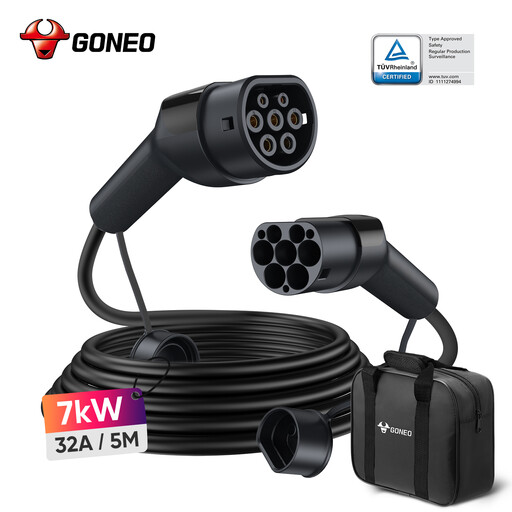
Why This Fits Their Persona: The shorter 1-phase format can suit PHEV owners charging at compatible AC points close to the vehicle.
The 7.2kW, 32A and single-phase details make it easier to reject unsuitable three-phase or oversized options.
5m length, TPU jacket, carry bag and IP54-rated construction are listed for everyday handling.
For a Type 2 EV charger for home, confirm that the socket, circuit and installation are appropriate. A three-pin portable charger should be connected directly to a suitable socket; avoid using extension reels or multi-way adapters unless specifically approved by the manufacturer. If you are unsure about the wiring or load, consult a qualified electrician.
Charging cost can be estimated with a simple formula:
Energy added in kWh × your electricity tariff per kWh = approximate charging cost.
A portable 2.3kW charger adds energy more slowly than an 11kW or 22kW AC connection, but its delay function may help users schedule charging during a cheaper tariff period. Charging losses and tariff changes mean the final bill may differ from the basic estimate.
It is compatible when the vehicle has a Type 2 AC inlet and the charging station uses a matching Type 2 socket. Check the vehicle handbook, particularly for older imports and models using J1772, CCS1 or CHAdeMO.
Generally, yes, provided the connectors are correct, but the vehicle and charge point determine the actual charging rate. A 22kW cable does not increase a 7kW system’s output.
Lifespan depends on handling, storage, bending and exposure to dirt or moisture. Look for a robust jacket, strain relief, protective caps and stated bend-resistance information. Coil the cable without tight kinks and store it in its carry bag when practical.
We have compiled a complete, real-time list of products that fully satisfy these strict selection criteria and UK safety regulations.