
24/7 Customer Support

Free returns

Same-day & Next-day Delivery

Quality Guaranteed

Unlock Your Welcome Offers: FREE Delivery | Up to 80% OFF | Free 30-day JoyPlus trial
Download the APP
As an electric vehicle owner in the UK, you know that the right charging cable is as essential as the car itself. Yet, the market is filled with options that can be confusing. Choosing the wrong Type 2 EV charging cable can lead to frustratingly slow charging speeds, premature wear and tear or the daily inconvenience of a cable that is simply too short. Before you make a purchase, it is important to understand a few common pitfalls that many drivers fall into.
This guide cuts through the clutter to focus on what truly matters. We will highlight three frequent mistakes and break down the core specifications you need to check to ensure you get a safe, durable and efficient cable for your vehicle.
By understanding these key areas, you can avoid a poor purchase and select a cable that serves you reliably for years.
To make an informed decision, you do not need to be an electrical engineer. You just need to match the cable’s specifications to your car and your lifestyle. Here are the three most important factors to verify.
The charging speed of your EV on an AC charger is determined by the lowest value among three things: the charger's output, the cable's rating and your car's on-board charger (OBC) capacity. To maximise your charging speed, your cable should match or exceed your car's OBC rating.
Always check your vehicle’s manual or specifications online to find its maximum AC charging rate before you buy a home EV charger cable.
Cable length is about convenience. Consider where you will be charging most often.
A charging cable is a high-voltage piece of equipment that must withstand daily use in all weather conditions.
We have identified a few products that align with these practical criteria, matching them to common UK driver profiles.
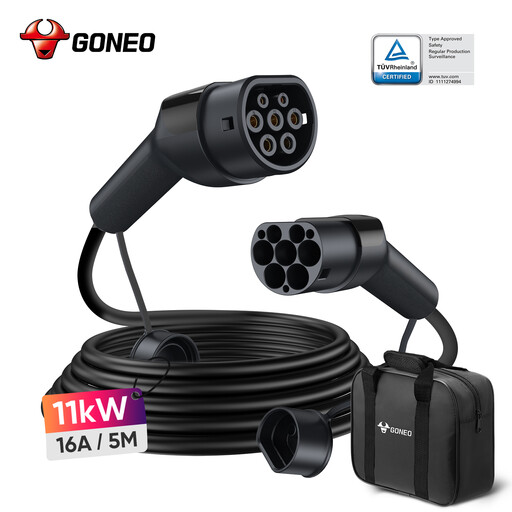
Why This Fits Their Persona: This cable is ideal for drivers who primarily charge overnight on a private driveway. The 5-metre length is manageable and easy to coil and store, while the 11kW rating is perfectly matched for many modern BEVs, providing efficient home charging.
It avoids the length limitation pitfall for its intended use case. By selecting a length appropriate for home charging, you are not paying for extra cable you do not need.
Features a durable TPU jacket and is T?V certified for safety. The 11kW rating provides faster charging than a 7kW cable for compatible vehicles.
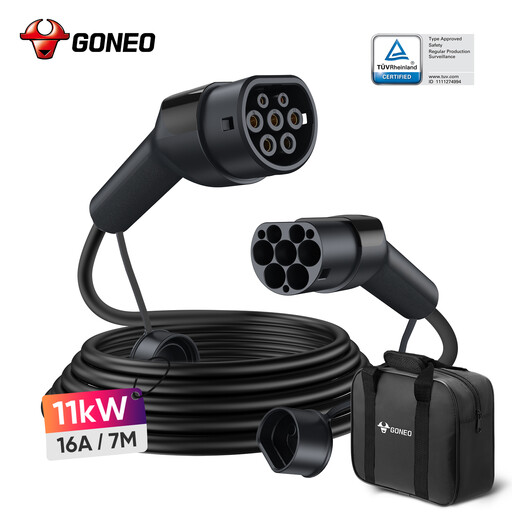
Why This Fits Their Persona: For drivers who rely on the public charging network, flexibility is key. This 7m electric car charger cable provides the necessary reach to connect to chargers even when parking bays are tight or awkwardly designed, a common issue in UK car parks.
Directly solves the "length limitation" problem. The extra two metres over a standard 5m cable can be the difference between charging successfully and having to find another spot.
IP54 rating ensures it is safe for use in the rain. The robust build quality is designed to withstand being driven over by a 2-tonne vehicle, according to the manufacturer's information.
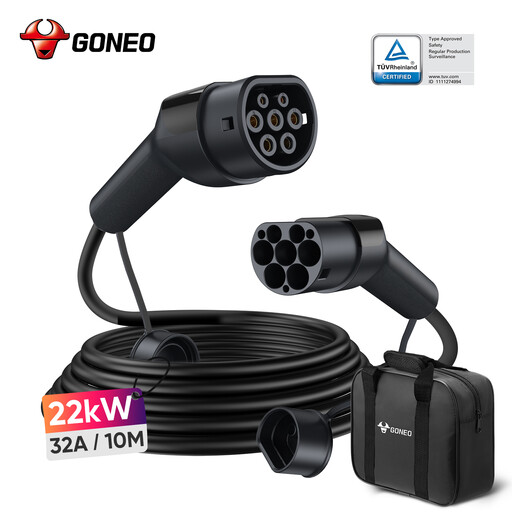
Why This Fits Their Persona: This is for the driver who wants maximum performance and preparedness. The 22kW rating ensures they can take full advantage of the fastest AC charging points, and the 10-metre length means no public charger is ever out of reach.
It completely avoids the power mismatch trap by offering the highest available AC power rating. This future-proofs the purchase for current and future vehicles with 11kW or 22kW on-board chargers.
Maximum power (22kW) and maximum length (10m) in one package. It is also a CCS2 compatible cable for the AC charging portion of the port.
We have compiled a complete, real-time list of products that fully satisfy these strict selection criteria and UK safety regulations.
Yes, absolutely. A higher-rated cable is perfectly safe to use on a car with a lower-rated on-board charger. The car's OBC controls the flow of power and will only draw what it can safely handle (in this case, 7kW). Buying a 22kW EV charging cable can be a smart move, as it future-proofs your purchase for your next vehicle, which may have a faster 11kW or 22kW OBC.
This can be a point of confusion. In the UK and Europe, the Type 2 connector is the standard for AC charging (at home or at public 'fast' chargers). The CCS2 (Combined Charging System) plug is used for DC rapid charging and essentially adds two large DC pins below the standard Type 2 socket. A Type 2 to Type 2 cable is what you need for all AC charging, and it plugs into the top part of your car's CCS2 port. You do not need a separate cable for CCS2 compatibility when AC charging.
The lifespan of a cable depends heavily on its build quality and how it is treated. A high-quality cable with a durable TPU jacket, which has been tested to withstand thousands of bends, should last for many years. To maximise its life, always coil the cable loosely for storage, use the protective caps to keep dirt and moisture out of the connectors and avoid repeatedly driving over it. A cable made from cheaper PVC is more likely to degrade and crack within a couple of years, especially if used frequently outdoors in all seasons.