
24/7 Customer Support

Free returns

Same-day & Next-day Delivery

Quality Guaranteed

Unlock Your Welcome Offers: FREE Delivery | Up to 80% OFF | Free 30-day JoyPlus trial
Download the APP
Buying a Type 2 EV charging cable can seem straightforward until you compare amperage, charging speed, phase compatibility and cable length. A cable that looks suitable online may still charge more slowly than expected, fail to reach a public charger comfortably or be incompatible with your vehicle’s charging setup.
For UK electric vehicle and plug-in hybrid owners, the key is to match the cable to the car’s on-board charger (OBC) and the charging point—not simply choose the highest kW figure. The guide below explains the important specifications and highlights suitable options for different driving and parking situations.
An 11kW EV charging cable cannot make a vehicle charge at 11kW if its OBC only accepts 7.2kW. Likewise, a 22kW EV charging cable will not increase the charging speed of a car limited to 11kW or 7.2kW.
Before ordering, check:
The cable’s rating is a maximum capability, not a guarantee of the charging speed you will receive.
A Type 2 to Type 2 cable is generally used for AC charging at home, workplaces and public charge points. A vehicle with a CCS2-compatible inlet may accept a Type 2 AC connection through the upper section of its inlet, but this does not mean a separate Type 2 cable can provide DC rapid charging.
Rapid charging uses a fixed CCS2 connector and charging equipment with additional DC pins. A Type 2 cable is not a replacement for a CCS2 rapid-charging lead, nor is it suitable for CHAdeMO, CCS1 or J1772 connections.
A short cable may be easier to store, but it can be inconvenient when the charge point is positioned at the front or rear corner of your vehicle. On the other hand, an unnecessarily long cable can be heavier, harder to coil and more likely to lie across a walkway.
For many UK parking layouts, a 5m EV charging cable is suitable for direct access between the vehicle and wallbox. A 7m EV charging cable gives more flexibility at public bays, while a 10m EV charging cable may help where the charge point is awkwardly positioned. Always keep the cable clear of traffic and pedestrian routes.
The following guide provides a practical comparison:
| Cable type | Typical electrical configuration | Suitable OBC range | |---|---|---| | 7.2kW Type 2 charging cable | 32A, single-phase | Vehicles accepting around 6–7.68kW AC | | 11kW EV charging cable | 16A, three-phase | Vehicles accepting up to 11kW AC | | 22kW EV charging cable | 32A, three-phase | Vehicles accepting up to 22kW AC |
A single-phase EV charging cable is commonly paired with a 7kW-class domestic wallbox. An 11kW or 22kW 3-phase EV charging cable requires the vehicle, charge point and electrical installation to support three-phase operation.
A 16A EV cable and a 32A EV cable are not interchangeable in practical use. The 32A version is designed for a higher current, while the 16A format is commonly used for 11kW three-phase charging. If you are unsure about your home supply, ask a qualified electrician to confirm the installation.
Most tether-free public AC charging leads in this category are Mode 3 EV cables, which connect an EV to a dedicated AC charging station. Check that the vehicle side and charger side both use Type 2 connectors.
Product listings may describe compatibility with Tesla, Audi, BMW, Mercedes-Benz, Volkswagen, Hyundai and Kia models, but model-year variations exist. Confirm the connector specification for your exact vehicle. A Type 2 cable should not be used with J1772, CCS1 or CHAdeMO sockets.
For outdoor UK charging, inspect the stated protection rating and construction details. An IP54 rating indicates protection against limited dust ingress and water splashes, but it does not mean the cable should be submerged or left in standing water.
Useful features may include:
A certification statement should be checked against the product documentation rather than treated as a substitute for safe use.
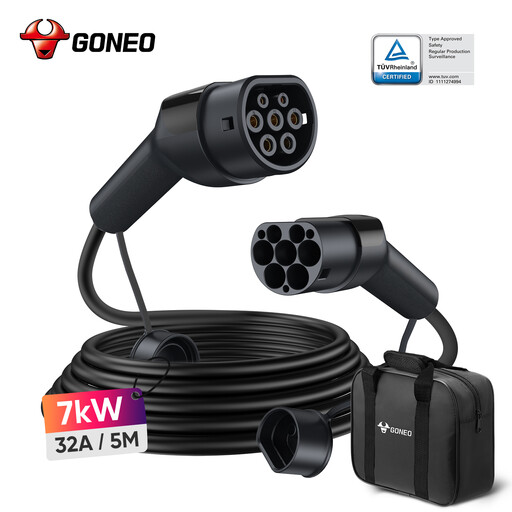
Why This Fits Their Persona: A practical choice for drivers with a 6–7.68kW OBC who mainly charge at home or use nearby public stations. The 5m length keeps storage relatively manageable.
Its specification clearly identifies 7.2kW, 32A and single-phase operation, helping avoid paying for a three-phase rating your vehicle may not use.
32A single-phase rating, 5m cable, carry bag and stated Type 2/CCS2 vehicle compatibility.
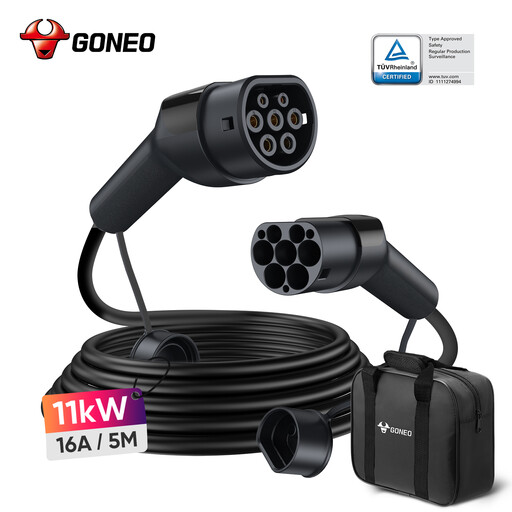
Why This Fits Their Persona: Suits drivers with an 11kW OBC who want a compact three-phase lead for home, workplace and regular public charging.
The 11kW and 16A three-phase specification makes its intended use clearer than listings that only promote a headline charging speed.
5m format, Mode 3 design, IP54 rating and carry bag; the listing also states TÜV Rheinland certification.
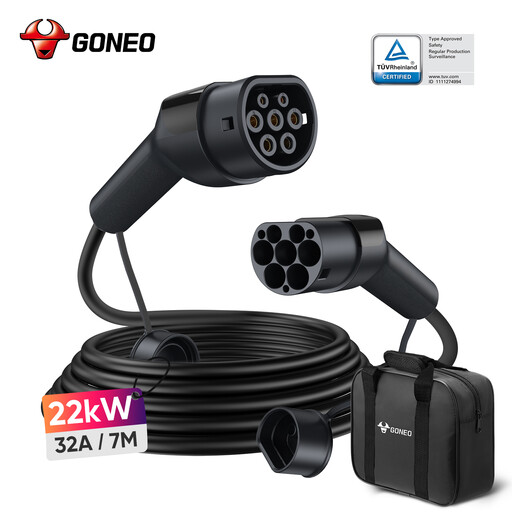
Why This Fits Their Persona: Designed for vehicles and charge points that support 22kW three-phase AC charging, with 7m of reach for varied public-bay layouts.
The 32A three-phase rating is specified alongside the 22kW figure, so buyers can compare it with their OBC and charge-point limits.
7m length, TPU jacket, protective cap, IP54 rating and stated Type 2/CCS2 compatibility.
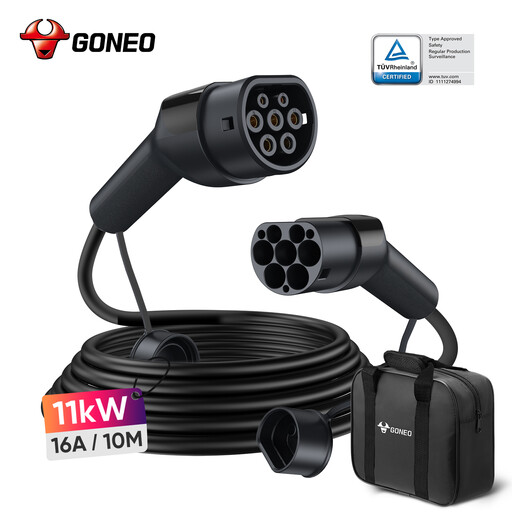
Why This Fits Their Persona: The 10m reach is useful for awkward parking positions, shared bays or charge points that are not directly beside the vehicle.
It addresses the short-cable problem while retaining an 11kW, 16A three-phase specification for compatible vehicles.
10m cable, protective cap, carry bag and stated operating range of -40°C to +50°C.
We have compiled a complete, real-time list of products that fully satisfy these strict selection criteria and UK safety regulations.
Usually, the vehicle and charger will limit the session to the lower supported rate. However, check the charge point manufacturer’s instructions and ensure the cable is suitable for the installation. A 7.2kW single-phase cable is often the more direct match for a standard domestic wallbox.
It can be suitable for outdoor AC charging when the product is rated for outdoor conditions and used correctly. Keep connectors off the ground where possible, avoid standing water, do not drive over the cable and inspect the jacket and plugs regularly for damage.
The cable itself does not reduce the electricity tariff or energy consumed. It may allow a compatible vehicle and three-phase charge point to charge more quickly, potentially reducing the time connected. Your actual cost depends on the vehicle’s battery, charging losses, electricity tariff and the charge-point operator’s fees.