
24/7 Customer Support

Free returns

Same-day & Next-day Delivery

Quality Guaranteed

Unlock Your Welcome Offers: FREE Delivery | Up to 80% OFF | Free 30-day JoyPlus trial
Download the APP
A Type 2 EV charging cable is a practical purchase for many UK electric car and plug-in hybrid owners, but choosing the wrong specification can lead to unnecessary cost, slow charging or an inconvenient fit at home and public charge points.
The most common buying mistakes are not always obvious from product titles. A cable may advertise a high kilowatt rating that your vehicle cannot use, appear weatherproof without clearly stating an IP rating, or be too short for the way you park. Before buying, check the connector type, charging phase, current, cable length and safety information together.
A 22kW Type 2 EV charging cable does not automatically make a car charge at 22kW. The vehicle’s on-board charger (OBC), the charge point and the available electrical supply all affect the actual rate.
For example, a vehicle with a 7.2kW single-phase OBC will generally not charge faster simply because it is connected with a 22kW cable. A higher-rated cable may offer flexibility for a future vehicle, but it can be heavier and less convenient to handle.
Most European-market EVs and PHEVs use a Type 2 AC connection, including many models from Tesla, Audi, BMW, Mercedes-Benz, Volkswagen, Hyundai and Kia. A Type 2 to Type 2 charging cable is designed to connect a compatible vehicle to a socketed AC charging point.
CCS2 vehicles use a Type 2-shaped upper section for AC charging, but the cable must still match the vehicle’s AC inlet and the charging station. Do not confuse this with CCS1, J1772 or CHAdeMO. These are different connector standards and are not interchangeable.
A short cable can leave the vehicle unable to reach a charge point, while an excessively long cable may be heavier to store and more likely to lie across a walkway. Measure the likely distance between the vehicle inlet and the charge point, allowing some room for positioning.
For many home or direct-bay setups, 5m is practical. A 7m cable can offer more flexibility at public stations, while 10m may suit awkward driveways or parking arrangements.
Use your vehicle handbook or manufacturer specifications to identify its OBC rating.
A 3-phase EV charging cable is not a substitute for a compatible three-phase vehicle and supply. Similarly, an 11kW cable should not be selected if you specifically require a 22kW-rated connection for a suitable vehicle and charge point.
Check both ends carefully. With a Type 2 to Type 2 cable, the vehicle-side connector plugs into the car and the other connector plugs into a compatible socketed charge point. The product must state whether it supports Type 2 vehicles and the relevant AC charging arrangement.
The GONEO Type 2 cable range states compatibility with Type 2 and CCS2 electric vehicles and PHEVs, while excluding J1772, CCS1 and CHAdeMO. Always verify your particular model, especially if it is an older import or uses a less common inlet.
For regular outdoor use in the UK, look for a stated IP rating, temperature range and cable-jacket material. IP54 indicates protection against limited dust ingress and water splashes, while IP66 indicates a higher level of protection against dust and powerful water jets. The rating does not mean a connector should be submerged or left carelessly exposed.
Useful details can include CE and UKCA marking, RoHS or IEC compliance information, earth detection, leakage protection and over-temperature protection. These features should be treated as product specifications rather than a guarantee that every installation is suitable. A domestic socket, extension arrangement or home electrical circuit may need assessment by a qualified installer.
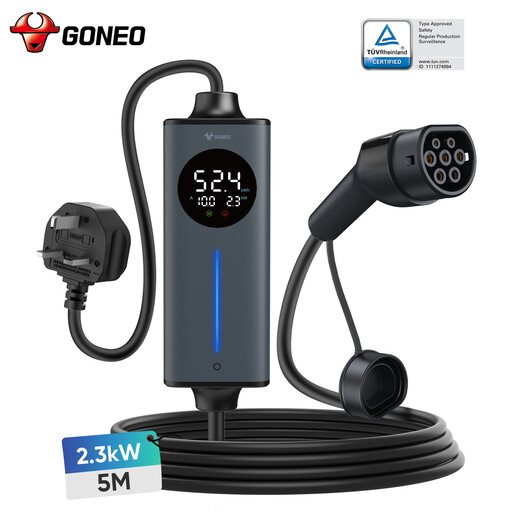
Why This Fits Their Persona: A straightforward 5m option for drivers who need occasional overnight charging from a suitable UK household socket at home or while visiting family.
Its 2.3kW maximum makes the slower charging expectation clear, while the Type 2 connector and IP66 rating are stated in the specification.
Adjustable 10A current, delay charging, LED display and protection against overcurrent, overvoltage and overheating.
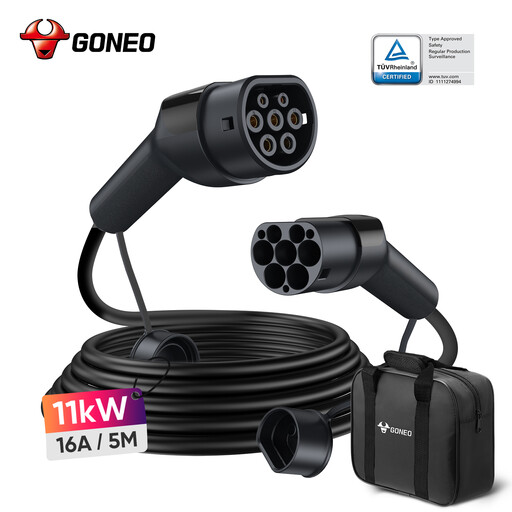
Why This Fits Their Persona: Suitable for drivers with an 11kW-capable vehicle and a regular home or public charging bay where a compact cable is preferred.
The 11kW, 16A and three-phase ratings are clearly specified, helping buyers compare the cable with their vehicle OBC rather than relying on vague speed claims.
TÜV Rheinland safety certification is stated, alongside CE, UKCA, RoHS, ISO and IEC compliance information, an IP54 rating and a carry bag.
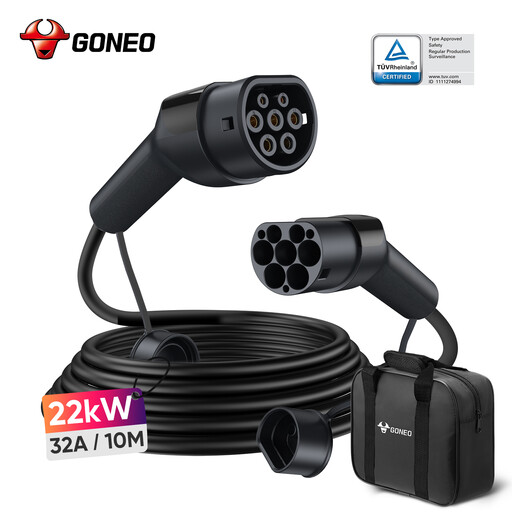
Why This Fits Their Persona: The 10m length suits complex driveways, shared bays and public charge points where the vehicle cannot always park beside the socket.
It combines a stated 22kW, 32A and three-phase rating with a defined 10m length, making the key trade-off visible before purchase.
TPU jacket, protective cap, ergonomic handle, carry bag and stated resistance to more than 20,000 bends.
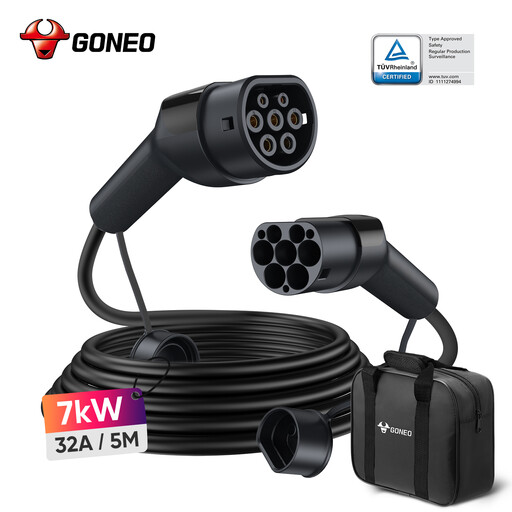
Why This Fits Their Persona: A manageable option for commuters and PHEV drivers whose vehicles use single-phase AC charging at home or at work.
The single-phase design and 7.2kW rating help prevent paying for three-phase capacity that the vehicle may not use.
32A current rating, 5m length, Type 2 to Type 2 format and supplied carry bag.
We have compiled a complete, real-time list of products that fully satisfy these strict selection criteria and UK safety regulations.
It may be, provided the vehicle has a compatible Type 2 AC inlet and the cable matches the charge point. CCS2-equipped vehicles can use Type 2 AC charging through the upper section of the inlet, but connector standards should be checked for the exact model and market.
A 2.3kW portable EV charger can be used with a suitable UK socket when the product instructions and electrical installation permit it. Avoid unsuitable extension leads and never use a damaged or overheated socket. A portable charger is intended for slower charging; a dedicated home charge point may be more appropriate for frequent daily use.
Lifespan depends on bending, storage, dirt, moisture and handling. A cable with a robust jacket, protective cap and stated bend-resistance specification may be more suitable for frequent use. Store it loosely rather than tightly coiling it, keep connectors capped when disconnected and inspect the cable regularly for cuts, exposed conductors or heat damage.