
24/7 Customer Support

Free returns

Same-day & Next-day Delivery

Quality Guaranteed

Unlock Your Welcome Offers: FREE Delivery | Up to 80% OFF | Free 30-day JoyPlus trial
Download the APP
As an electric vehicle owner in the UK, you know that a reliable charging cable is as essential as the car itself. Yet, choosing the right one can feel unnecessarily complicated. With terms like kilowatts (kW), phases and varying lengths, it's easy to feel unsure if you're picking the correct Type 2 EV charging cable for your vehicle.
This guide is designed to cut through the clutter. We will walk you through the key factors to consider, helping you understand what specifications matter for your car and charging habits. We will then present some of our top recommendations for 2026, chosen for their build quality, safety features and practical design.
Before you add a cable to your basket, there are three main points to consider to ensure you get the performance and convenience you expect.
The most important factor is your car's On-Board Charger (OBC), which dictates the maximum speed at which it can receive an AC charge. A cable with a higher power rating won't damage your car, but it also won't charge it any faster than the OBC's limit.
Cable length directly impacts convenience. Consider where you will charge most often.
A durable EV cable is a worthwhile investment. Look for cables with official safety certifications like CE and UKCA, which confirm they meet British and European standards. An IP rating, such as IP54, indicates the cable's resistance to dust and water splashes, making it suitable for use in typical British weather. The cable material is also important; high-quality TPU (Thermoplastic Polyurethane) jackets offer excellent flexibility and resistance to wear and tear.
Here are a few standout options that balance performance, safety and practical features for UK drivers.
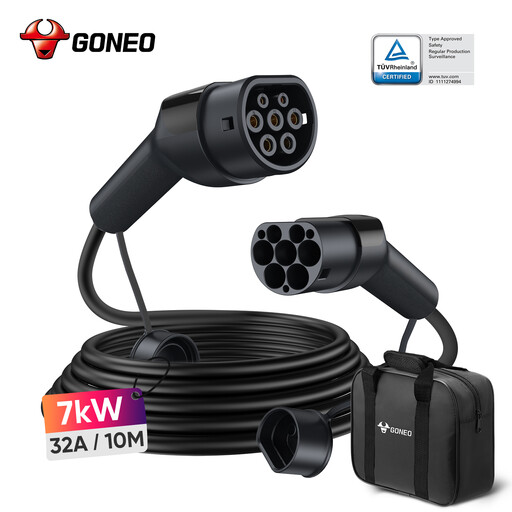
Why It Stands Out: The standout feature here is the generous 10m length. This cable removes the stress of awkward parking, whether at a crowded public charging station or on a long driveway. It delivers a solid 7.2kW, making it a perfect match for the vast majority of home wall boxes and a wide range of EVs and PHEVs.
Pros:
Who is it for?: EV or PHEV drivers with a 7kW on-board charger who frequently face challenging parking situations and need the extra reach to connect reliably.
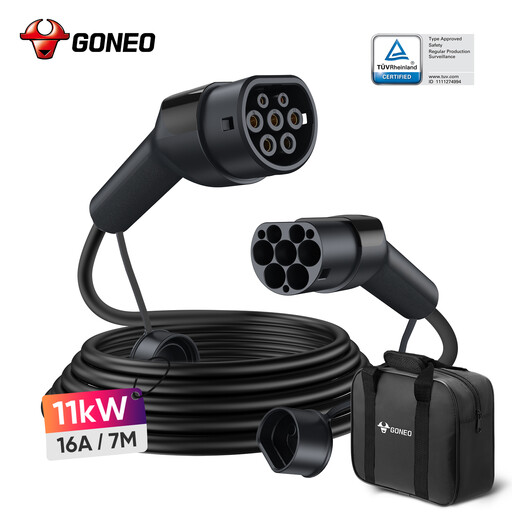
Why It Stands Out: This cable hits a sweet spot for many modern BEV owners. It supports faster 11kW three-phase charging, allowing you to take full advantage of compatible public and workplace chargers. The 7m length is a practical all-rounder, offering more flexibility than a standard 5m cable without being difficult to handle.
Pros:
Who is it for?: Owners of modern BEVs (such as many EV charger for Tesla/Audi/BMW models) with an 11kW OBC who want to reduce charging times at public stations.
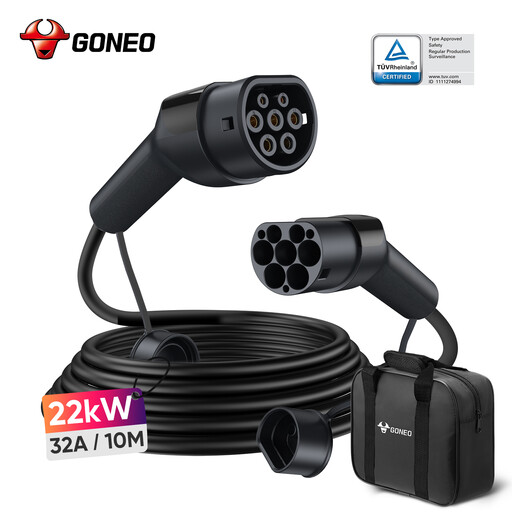
Why It Stands Out: This is a high-performance cable designed for maximum power and flexibility. As a 22kW 3 phase EV cable, it can deliver the fastest possible AC charge to compatible vehicles. Combined with its 10m length, it offers a premium, no-compromise solution for those who want to be prepared for any charging scenario.
Pros:
Who is it for?: Drivers of high-performance BEVs with a 22kW OBC who want the fastest charging speeds and the convenience of a long cable. It's also a great future-proof option for any BEV owner.
If these specific models don't quite meet your needs, or if you're searching for different lengths or specifications, we have a wider selection available. A proper type 2 to type 2 cable is a crucial accessory for any EV driver using a public charging station cable.
Explore our full range of electrical cables to find the perfect match for your vehicle.
The primary difference is the connector plug. Type 2 connectors are the standard across the UK and Europe for AC charging, used by almost all new electric cars sold here. Type 1 connectors are more common on vehicles from North American and Asian markets, particularly older models.
Yes, absolutely. The charging process is controlled by your car's On-Board Charger (OBC). The cable will safely deliver the maximum power your car can accept, so a 22kW cable will only provide 7kW to a 7kW-capable car. Using a higher-rated cable is perfectly safe and can be a good way to "future-proof" your purchase.
The IP (Ingress Protection) rating is very important for a product used outdoors in all weathers. An IP54 rating, for example, means the connector is protected from limited dust ingress and from water splashes from any direction. This ensures the cable can be used safely and reliably in the rain, which is essential for any UK driver.