
24/7 Customer Support

Free returns

Same-day & Next-day Delivery

Quality Guaranteed

Unlock Your Welcome Offers: FREE Delivery | Up to 80% OFF | Free 30-day JoyPlus trial
Download the APP
A Type 2 EV charging cable is a practical spare for many electric vehicles and plug-in hybrids in the UK and Europe. It can also be essential when a public charge point has a tethered socket but no attached lead. However, choosing by headline power alone can result in buying a cable that is too short, incompatible or unable to deliver the charging rate expected.
The main traps are straightforward:
Your vehicle’s on-board charger (OBC) determines the maximum AC charging rate. Check the vehicle handbook or manufacturer specification before buying.
| Cable specification | Typical electrical arrangement | Suitable use | |---|---|---| | 7.2kW Type 2 charging cable | 32A, single phase | Vehicles supporting approximately 6–7.68kW AC charging | | 11kW Type 2 charging cable | 16A, three phase | Vehicles with an 11kW OBC | | 22kW Type 2 charging cable | 32A, three phase | Vehicles with a 22kW OBC and a compatible charge point |
A 16A three-phase EV cable is generally associated with an 11kW rating, while a 32A three-phase EV cable is generally associated with 22kW. The charge point supply, vehicle OBC and cable must all support the same charging arrangement. A cable with a higher rating may offer flexibility for a future vehicle, but it will not override a lower-rated vehicle or installation.
For many UK home installations, single-phase charging is common. Three-phase charging may be available in some homes, workplaces and public locations, but it requires suitable electrical infrastructure. Any home electrical work should be assessed and installed by a properly qualified electrician.
Most UK and European AC vehicles use a Type 2 inlet, including many Tesla, Audi, BMW, Mercedes-Benz, Volkswagen, Hyundai and Kia models. A Mode 3 cable connects the vehicle directly to an AC charging station, with control and safety functions managed by the charge point.
A cable marketed for a CCS2 charging cable may refer to compatibility with vehicles that have a CCS2 inlet for DC charging, using the Type 2 section for AC charging. It does not mean that a standard Type 2-to-Type 2 lead performs DC fast charging. Check the vehicle inlet and charging station socket before ordering.
The supplied GONEO cable specifications list compatibility with Type 2 and CCS2 vehicles and exclude J1772, CCS1 and CHAdeMO connections. They also identify some older vehicle exceptions, so owners of earlier models should verify the exact inlet before purchase.
Length affects convenience and storage:
Look for practical details such as an IP54 rating, protective caps, a flexible jacket, ergonomic handles and a carry bag. IP54 indicates stated protection against limited dust ingress and water splashes; it does not mean the cable should be submerged or handled carelessly in standing water. Certification information should also be clear. The featured GONEO listings state TÜV Rheinland certification and compliance with CE, UKCA, RoHS, ISO and IEC standards. Buyers should still check the product listing and supplied documentation for the specific model.
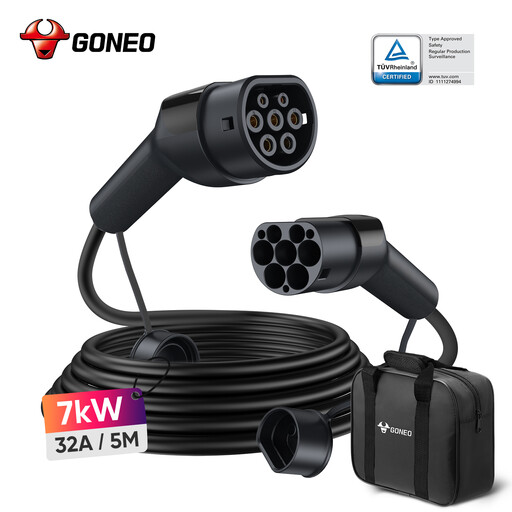
Why This Fits Their Persona: A compact option for a UK driver whose vehicle supports approximately 6–7.68kW AC charging and whose driveway or regular charge point is close to the car.
Its single-phase 32A specification makes the intended charging arrangement clear, avoiding the assumption that a higher three-phase rating is always necessary.
5m length, 7.2kW rating, carry bag and stated IP54 protection.
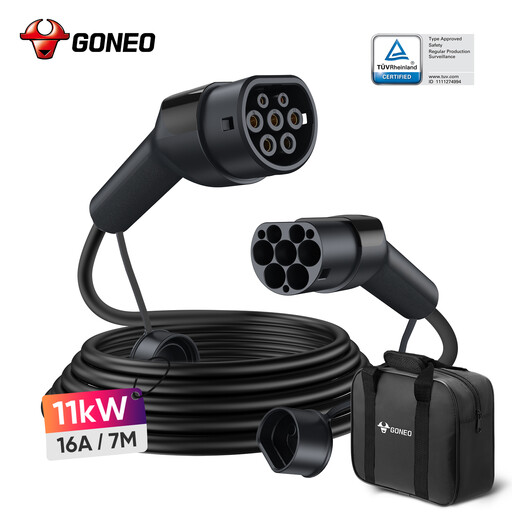
Why This Fits Their Persona: A balanced choice for an owner with an 11kW OBC who uses different public charging locations and needs extra reach without moving to the heaviest 10m format.
The 16A three-phase rating is clearly matched to 11kW charging, rather than implying that the cable alone controls the vehicle’s speed.
7m reach, Mode 3 design, carry bag and stated TÜV Rheinland certification.
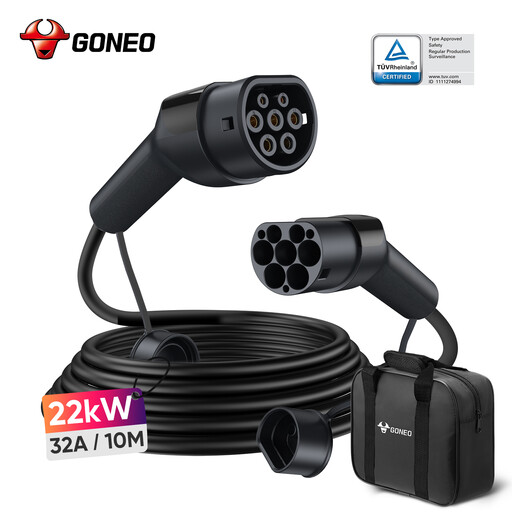
Why This Fits Their Persona: Designed for compatible 22kW vehicles, commercial users or drivers who regularly encounter awkwardly positioned public charge points.
It makes both the 32A three-phase requirement and the greater storage burden of a 10m lead visible before purchase.
22kW rating, 10m length, TPU jacket, protective cap and carry bag.
We have compiled a complete, real-time list of products that fully satisfy these strict selection criteria and UK safety regulations.
No. Charging speed is limited by the vehicle’s OBC, the charge point and the available electrical supply. A 22kW cable is suitable only where the complete setup supports that rating.
It depends on the parking layout. A 5m cable is easier to store and may be sufficient for a home charge point. A 7m EV charging cable provides additional reach at public bays, while a 10m option offers more flexibility but adds weight and storage requirements.