
24/7 Customer Support

Free returns

Same-day & Next-day Delivery

Quality Guaranteed

Unlock Your Welcome Offers: FREE Delivery | Up to 80% OFF | Free 30-day JoyPlus trial
Download the APP
As an electric vehicle owner in the UK, you know that having the right charging setup is key to a smooth experience. Yet, selecting a new or replacement Type 2 EV charging cable UK can be confusing. The market is filled with options that look similar but have critical differences in performance and safety. A wrong choice can lead to frustratingly slow charging, wasted money or even safety hazards.
This guide, from your Joybuy Product Recommendation Officer, cuts through the clutter. We'll highlight the common pitfalls to avoid and break down the essential features you need to check, ensuring you find a cable that is safe, durable and perfectly matched to your vehicle and lifestyle.
Before looking at products, it's important to recognise the frequent traps that catch buyers out. Steering clear of these will save you both time and money.
To make an informed decision, focus on these three core parameters. They are the non-negotiable factors that determine performance, safety and compatibility.
The power rating, measured in kilowatts (kW), determines your charging speed. This must align with your vehicle's On-Board Charger (OBC) capacity and your home's electrical supply.
Action: Check your vehicle's manual or specifications for its maximum AC charging rate before you buy.
Understanding the difference is crucial for choosing a functional electric car charger for home or travel.
Never compromise on safety. A reliable EV charging cable should have clear indicators of its quality and compliance with UK regulations.
Based on these practical criteria, we've matched a few standout options to different UK driver profiles.
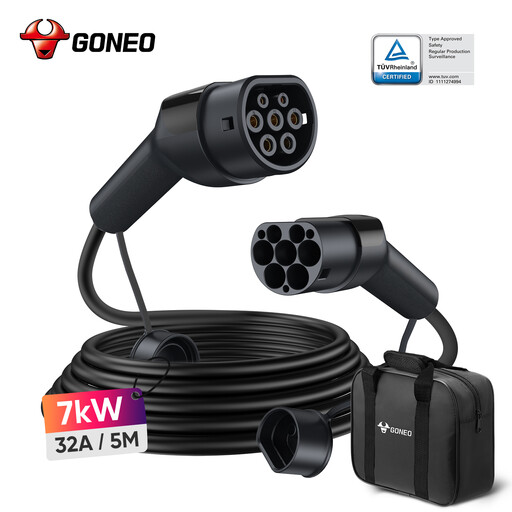
Why This Fits Their Persona: This is a practical choice for the majority of UK EV and PHEV owners who charge overnight using a standard 7kW home wallbox. The 5-metre length is ideal for most driveways and garages without leaving excess cable on the ground.
It perfectly matches the 7.2kW power rating of most home chargers, avoiding the trap of overpaying for a higher-rated cable that offers no speed benefit in this scenario.
Features T?V Rheinland certification and an IP54 rating, confirming its adherence to safety standards and suitability for all-weather use. The TPU cable remains flexible in the cold.
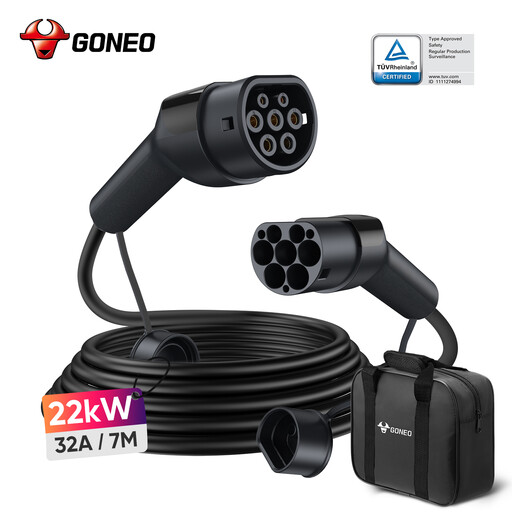
Why This Fits Their Persona: For drivers of high-end BEVs with 11kW or 22kW on-board chargers, this cable unlocks the fastest possible AC charging speeds at public stations. The 7-metre length provides extra flexibility for awkwardly positioned charge points.
This is a future-proof investment. While it works perfectly with lower-power cars, it ensures that owners of capable vehicles can take full advantage of the UK's growing network of 22kW public chargers.
Delivers maximum AC charging speed for compatible vehicles. The durable build is rated to withstand being driven over by a 2-ton vehicle, offering peace of mind in busy car parks.
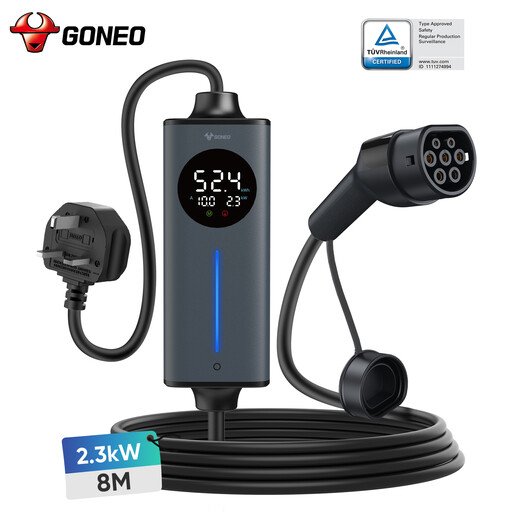
Why This Fits Their Persona: This 'granny charger' is an essential tool for anyone without a fixed wallbox. It's perfect for renters, for charging while visiting friends and family or as a reliable backup to keep in the boot for emergencies.
It directly addresses the pitfall of confusing cable types. This is a dedicated Mode 2 charger, providing a plug-and-play solution for any standard UK socket without needing a dedicated charge point.
Features an IP66-rated control box for high-level water resistance and includes smart features like adjustable current and delayed charging to take advantage of off-peak electricity tariffs.
We have compiled a complete, real-time list of products that fully satisfy these strict selection criteria and UK safety regulations.
Yes, provided it has an adequate IP rating. A cable with at least an IP54 rating is designed to be splash-proof and can handle typical UK rain. For greater assurance, especially if the control box of a portable charger will be exposed, look for an IP66 rating. However, it is always good practice to ensure the connector plugs themselves are not left submerged in puddles.
No. The charging speed is always limited by the slowest component in the chain, which is usually your car's On-Board Charger (OBC). If your car's maximum AC charge rate is 7kW, it will only draw 7kW of power, regardless of whether the cable or station is capable of delivering more.
The lifespan of a cable depends heavily on its build quality and how it's treated. A cable made with a durable TPU jacket, stored correctly by coiling it loosely (not folding it tightly) and handled by the plugs rather than the wire, can be expected to last for many years of regular use. Look for cables with reinforced connectors, as this is a common point of failure.