Joybuy Insights

Your Guide to Choosing the Right Type 2 EV Charging Cable

Navigating the world of electric vehicles is an exciting journey, but it comes with a new set of considerations. Once you have your EV or PHEV, one of the first and most important accessories you'll need is a reliable charging cable. With terms like 'single-phase', '3-phase', 'kW ratings' and various lengths, choosing the correct Type 2 EV charging cable can feel confusing.

This guide is designed to cut through the technical jargon. We'll walk you through the key factors to consider, helping you select a cable that not only fits your vehicle but also matches your charging needs, whether at home or on the road.

How to Choose the Right Type 2 EV Charging Cable

Making the right choice comes down to understanding three key elements: power, length and safety. Getting these right ensures you can charge efficiently and safely every time.

1. Match the Power (kW) to Your Vehicle

The speed at which your car charges from an AC point is determined by the lowest-rated component in the chain: the charging station, the cable and your car's On-Board Charger (OBC). To get the most out of your charging sessions, your cable should match or exceed the power rating of your car's OBC.

  • Single-Phase (up to 7.4kW): Most UK homes have a single-phase electricity supply. A 7kW charging lead is therefore a very common choice, ideal for overnight charging at home and compatible with the majority of plug-in hybrids (PHEV charging cable) and many battery electric vehicles (BEVs).
  • Three-Phase (11kW or 22kW): Some properties and many workplace or public charging stations use a three-phase supply, enabling faster charging. If your vehicle has an 11kW or 22kW OBC, using a 3 phase EV cable like an 11kW EV charging cable or a 22kW Type 2 cable will allow you to take advantage of these faster speeds.

A key point to remember is that you can safely use a higher-rated cable (e.g., a 22kW cable) with a car that has a lower-rated OBC (e.g., 7kW). The car will simply draw power at its maximum rate of 7kW. However, using a 7kW cable with a car capable of 22kW charging will limit your speed to 7kW.

2. Select the Ideal Length for Convenience

Cable length is about practicality. Consider where you will be charging most often.

  • 5 metres: Suitable if you always park close to your home wallbox or consistently find well-positioned public chargers.
  • 7 metres: A 7m electric car charger cable offers a great balance of convenience and manageability. It provides the flexibility needed for most public parking bays where the charge point might not be right next to your car's charging port.
  • 10 metres: Offers maximum reach for difficult parking situations, but can be heavier and more cumbersome to store.

3. Prioritise Safety and Durability

A charging cable handles a significant amount of electrical current, so safety is paramount. Look for cables with independent certifications. A T?V certified EV cable, for example, has been tested by a respected third party to meet stringent safety and quality standards. Also, check for UKCA and CE marks.

Durability is also crucial. A high-quality TPU (Thermoplastic Polyurethane) cable jacket provides flexibility and resistance to abrasion and weather. An IP rating, such as IP54, indicates the cable's connectors are protected against dust and water splashes, making them suitable for use in typical British weather.

Recommended Type 2 EV Charging Cables

Based on these criteria, here are our recommendations for reliable and well-specified charging cables.
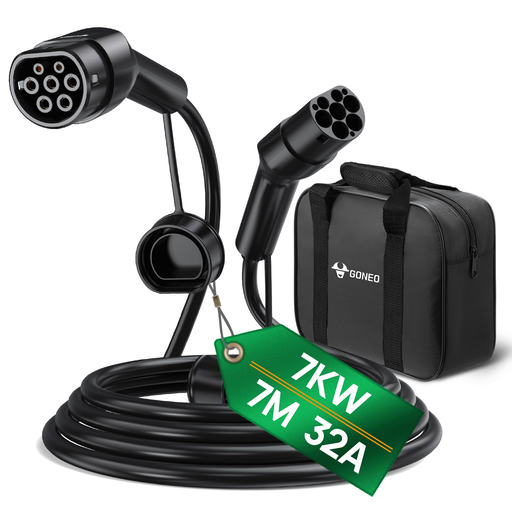
GONEO Type 2 EV Charging Cable, 7.2kW 7m

GONEO 7.2kW Type 2 EV Charging Cable

  • Why It Stands Out: This cable is a versatile workhorse, perfectly suited for the most common UK home charging setups (7kW wallboxes) and a wide range of BEVs and PHEVs. Its construction focuses on safety and longevity, with T?V certification providing peace of mind.
  • Pros:
    • Power: 7.2kW (32A, Single-Phase)
    • Length: 7 metres for excellent flexibility.
    • Safety: T?V Rheinland certified and compliant with UKCA, CE and RoHS standards.
    • Durability: IP54 weather resistance and a tough TPU cable jacket.
    • Build: Features silver-plated contacts for stable conductivity.
  • Who is it for?: EV and PHEV owners whose vehicle has an on-board charger of up to 7.4kW. It's an ideal primary or secondary cable for home and public charging.

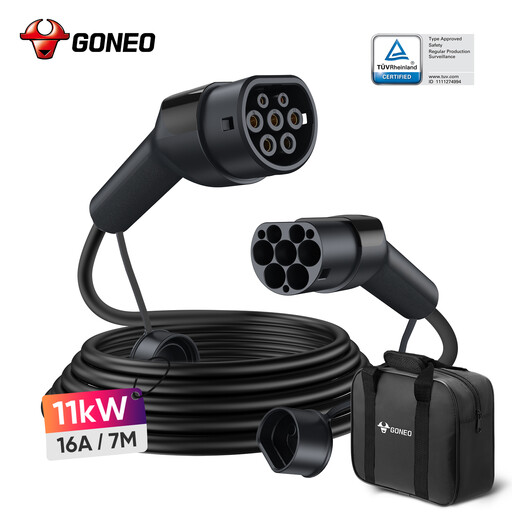
GONEO Type 2 EV Charging Cable, 11kW 7m

GONEO 11kW Type 2 EV Charging Cable

  • Why It Stands Out: As more BEVs arrive with 11kW on-board chargers, this 3 phase EV cable allows drivers to unlock faster charging speeds at compatible workplace and public charge points. It maintains the same high standards of safety and build quality as its 7.2kW counterpart.
  • Pros:
    • Power: 11kW (16A, Three-Phase)
    • Length: Practical 7-metre length.
    • Safety: Independently certified by T?V Rheinland.
    • Durability: All-weather IP54 rating and a robust handle design.
    • Performance: Enables faster charging for compatible vehicles on a 3-phase supply.
  • Who is it for?: Drivers of modern BEVs with an 11kW on-board charger. This cable is perfect for those who want to reduce their charging time at the growing number of 11kW or 22kW public stations.

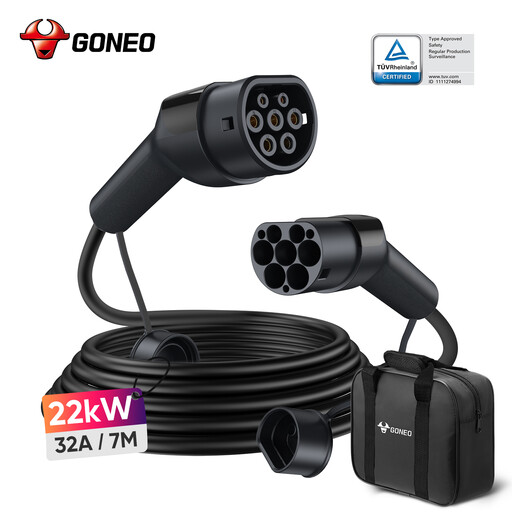
GONEO Type 2 EV Charging Cable, 22kW 7m

GONEO 22kW Type 2 EV Charging Cable

  • Why It Stands Out: This is the choice for maximum AC charging speed. For vehicles equipped with a 22kW OBC, this cable ensures you are charging as fast as possible from any compatible AC charge point, significantly cutting down waiting times.
  • Pros:
    • Power: 22kW (32A, Three-Phase) for the fastest AC charging.
    • Length: A versatile 7 metres.
    • Safety: Fully certified by T?V, with UKCA and CE compliance.
    • Durability: Built to withstand a 2-ton drive-over and operate in temperatures from -40°C to +50°C.
    • Future-Proof: A top-specification cable that will serve you well even if you upgrade to a vehicle with a faster OBC in the future.
  • Who is it for?: Owners of high-specification BEVs (like certain Renault Zoe or Audi e-tron models) with a 22kW on-board charger who want to minimise charging time at public AC stations.

Looking for Other Components or Accessories?

A quality charging cable is essential, but a full charging setup can involve other electrical components. For items like glands and connectors to ensure a weatherproof and secure installation of a home wallbox, it's important to use properly rated parts.

Explore our selection of electrical cable glands and accessories to find the components you need.

Frequently Asked Questions

What is a Type 2 to Type 2 cable? A Type 2 to Type 2 cable is the standard for AC charging across the UK and Europe. It features a Type 2 connector on both ends. One end plugs into the charging station (a home wallbox or public charging cable point) and the other plugs into the vehicle's Type 2 charging port.

Can I use a 22kW cable on my 7kW car? Yes, absolutely. It is perfectly safe. The charging cable can handle up to 22kW, but your car's on-board charger will only request the power it can handle, which is 7kW. You will not damage your car, but you also will not charge any faster than 7kW.

Is a T?V certified EV cable really necessary? While not a legal requirement for a product to be sold, a T?V certified EV cable provides a strong assurance of quality and safety. It means the product has been independently tested by a third party to meet high standards for electrical safety, durability and material quality. For a high-power device that you use regularly, this certification offers valuable peace of mind.