
24/7 Customer Support

Free returns

Same-day & Next-day Delivery

Quality Guaranteed

Unlock Your Welcome Offers: FREE Delivery | Up to 80% OFF | Free 30-day JoyPlus trial
Download the APP
Buying a Type 2 EV charging cable should be straightforward, but the product listings can make a simple decision surprisingly difficult. Terms such as 22kW, three-phase, IP54 and “universal compatibility” are useful only when they match your vehicle, charger and daily parking routine.
For UK electric vehicle and plug-in hybrid owners, the most common purchasing mistakes are choosing a cable that exceeds the car’s onboard charging capability, selecting the wrong connector standard, or buying a length that is awkward to store and use. This guide explains the specifications that matter and highlights suitable options for different driving patterns.
A 22kW EV charging cable does not make every vehicle charge at 22kW. The actual charging speed is limited by the lowest-rated part of the system: the vehicle’s onboard charger, the charging point and the cable.
Many home installations in the UK use single-phase supply, while some commercial or specially configured properties support three-phase charging. A vehicle with a 7.2kW onboard charger will not charge at 22kW simply because a 22kW cable is connected.
A Type 2 to Type 2 cable is generally used with compatible AC charging points. CCS2 vehicles use a Type 2-shaped upper connection for AC charging, but rapid DC charging uses the additional lower contacts on the fixed charger connector. A detachable AC cable should not be assumed to replace a CCS2 rapid-charging lead.
Check your vehicle handbook and the socket at your usual charging locations. The supplied GONEO models are described as compatible with Type 2 and CCS2 electric vehicles and plug-in hybrids, but they exclude J1772, CCS1 and CHAdeMO systems, as well as certain older vehicle models.
A 10m EV cable offers more flexibility when the charging point is not beside the vehicle, but it is heavier and takes more space in the boot. A 5m EV cable is easier to handle and store, although it may not reach a wallbox positioned towards the front or rear of the parking bay.
Measure the distance between the charging socket and the car’s inlet, then allow enough slack for safe positioning without leaving the cable across a pedestrian route.
The cable’s power rating should align with the vehicle’s onboard charger:
A single-phase EV cable may be appropriate for a domestic wallbox, while a three-phase EV cable can suit compatible workplace, commercial or higher-capacity installations. Always verify the vehicle’s maximum AC input rather than relying on the charger’s advertised output.
A Mode 3 charging cable connects an electric vehicle to an AC charging station or wallbox, with the charging control equipment integrated into the charging installation. This differs from a portable lead with an in-line control box.
For everyday use, look for securely moulded connectors, clear current ratings and a cable designed for repeated plugging and unplugging. The GONEO range specifies silver-plated contacts, ultrasonic welding and an ergonomic handle. These are objective construction details, but they do not remove the need to inspect the cable regularly for cuts, crushed sections or heat damage.
Outdoor charging exposes a cable to rain, grit, cold temperatures and accidental impact. The listed GONEO cables have an IP54 rating, a stated operating range of -40°C to +50°C, a TPU outer jacket and a protective cap. The product information also states that the cable has been tested for more than 20,000 bends and that the connector can withstand a 1-metre drop and a 2-tonne vehicle drive-over.
These ratings describe product features and test claims supplied for the product. They do not mean the cable should be deliberately driven over or left in standing water. Keep the connectors capped, avoid sharp bends and store the lead in its carry bag when not in use.
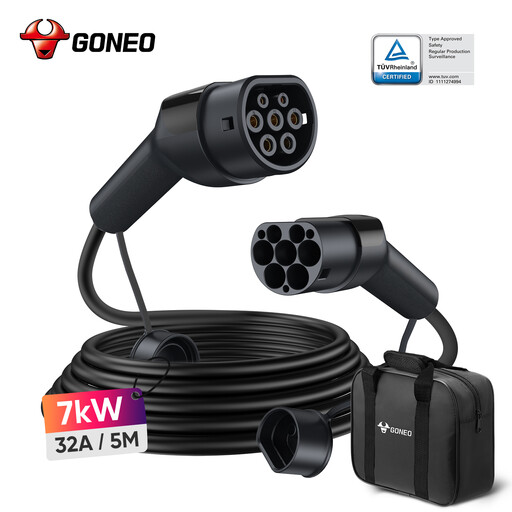
Why This Fits Their Persona: A practical starting point for owners with a 6–7.68kW onboard charger who normally park close to a home wallbox or public post.
The 5m length avoids paying for unnecessary cable while the 7.2kW single-phase rating avoids choosing a three-phase specification that the vehicle may not use.
32A single-phase design, TPU jacket, IP54 rating, protective cap and carry bag.
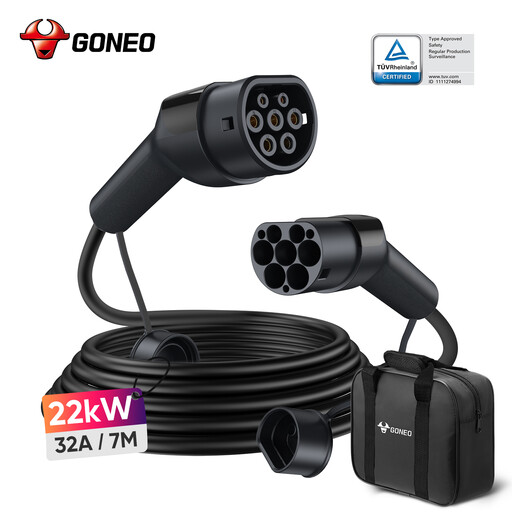
Why This Fits Their Persona: Suitable for drivers who want a longer, robust lead for varied home, workplace and public charging locations.
The 7m length balances reach and storage, while the stated 32A three-phase specification makes its intended 22kW use clear.
TÜV Rheinland safety certification is stated by the product listing, alongside CE, UKCA, RoHS, ISO and IEC compliance claims.
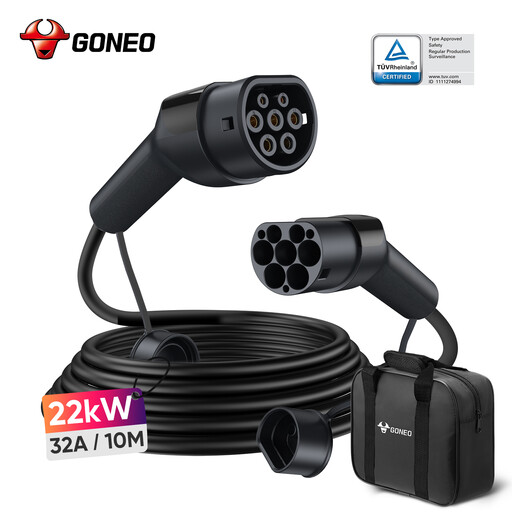
Why This Fits Their Persona: Designed for drivers who regularly encounter offset charging posts, awkward parking layouts or multiple charging locations.
The 10m reach tackles difficult parking positions, while the carry bag helps contain the extra cable during transport.
32A three-phase rating, IP54 protection, TPU outer jacket and stated resistance to more than 20,000 bends.
We have compiled a complete, real-time list of products that fully satisfy these strict selection criteria and UK safety regulations.
Yes, provided the connectors and charging station are compatible, but the vehicle will normally limit charging to its onboard AC capacity. Check the handbook before purchase, as a 22kW cable does not increase the car’s maximum charging rate.
A 5m EV cable is usually easier to lift and store when the socket is close to the vehicle. A 7m cable provides more flexibility at public charging bays and driveways. Choose 10m only when the additional reach solves a known parking problem.
Disconnect it by the handle rather than pulling the cable, keep the contacts dry and replace the protective caps after use. Check for cuts, flattened sections, loose connector housings or unusual warmth. Do not use a damaged cable, and follow the charging point and vehicle manufacturer’s instructions.