
24/7 Customer Support

Free returns

Same-day & Next-day Delivery

Quality Guaranteed

Unlock Your Welcome Offers: FREE Delivery | Up to 80% OFF | Free 30-day JoyPlus trial
Download the APP
As an electric vehicle owner in the UK, you are already part of the future of driving. However, navigating the accessories market can be a challenge. One of the most common questions we see is about choosing the right Type 2 EV charging cable. With different power ratings, lengths and safety standards to consider, it is easy to feel overwhelmed.
As the Joybuy Product Recommendation Officer, my role is to provide clear, practical advice to help you select the correct equipment for your vehicle. This guide will walk you through the key factors to consider and present some of our top recommendations for 2026, ensuring you can charge safely and efficiently.
Selecting the correct cable is not just about convenience; it is about matching the equipment to your vehicle's capabilities and your daily routine. Here are the three most important factors to consider.
Every electric vehicle has an On-Board Charger (OBC) that converts AC power from a charging station into DC power to charge the battery. The OBC has a maximum power rating, and your charging speed is limited by this, or by the power output of the charging station—whichever is lower.
To charge at the fastest possible AC speed, your cable's power rating should match or exceed your car's OBC rating.
You can safely use a higher-rated cable (e.g., a 22kW cable) on a car with a lower-rated OBC (e.g., 7.2kW), but it will not charge any faster.
Cable length is a practical consideration that directly impacts usability.
An electric car charger cable UK buyers should prioritise is one with verifiable safety certifications. Look for the UKCA (UK Conformity Assessed) mark, which indicates compliance with British standards, and T?V certification, a rigorous independent German safety standard.
These cables are known as Mode 3 charging cables, which are the standard for connecting an EV to a dedicated wallbox or public AC charger. A quality Type 2 to Type 2 cable will feature a durable, weather-resistant TPU (Thermoplastic Polyurethane) jacket and an IP rating (like IP54) for protection against dust and water splashes, ensuring reliable performance in all conditions.
Based on these criteria, here are our recommendations that balance performance, safety and practicality for UK drivers.
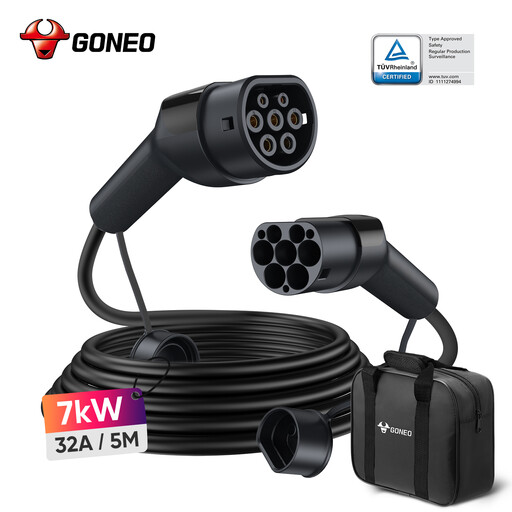
Why It Stands Out: This cable is the ideal workhorse for daily charging. Its 7.2kW rating perfectly matches the majority of home wallboxes and the OBCs of many popular BEVs and almost all PHEVs in the UK.
Pros:
Who is it for? This is an excellent choice for PHEV owners and BEV drivers who primarily charge overnight at home with a 7kW wallbox. The 5m length is perfect for a garage or dedicated driveway parking spot.
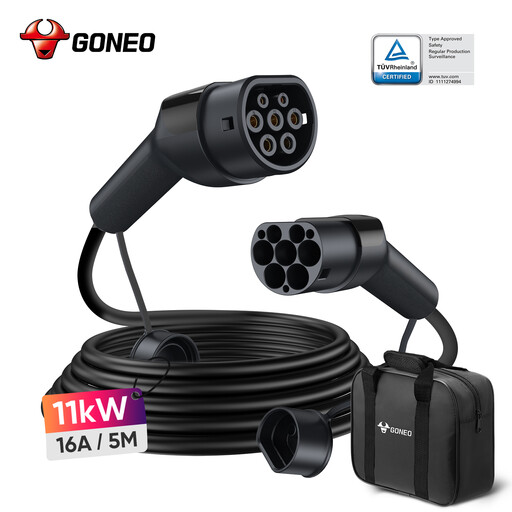
Why It Stands Out: As more BEVs come equipped with 11kW on-board chargers, this cable hits the sweet spot for faster charging without being excessive. It provides a noticeable reduction in charging time compared to a 7.2kW cable for compatible vehicles.
Pros:
Who is it for? This is the perfect cable for owners of modern BEVs (such as many Tesla, Audi, and VW models) with an 11kW OBC. The 5m length is well-suited for home use or public chargers where parking is straightforward.
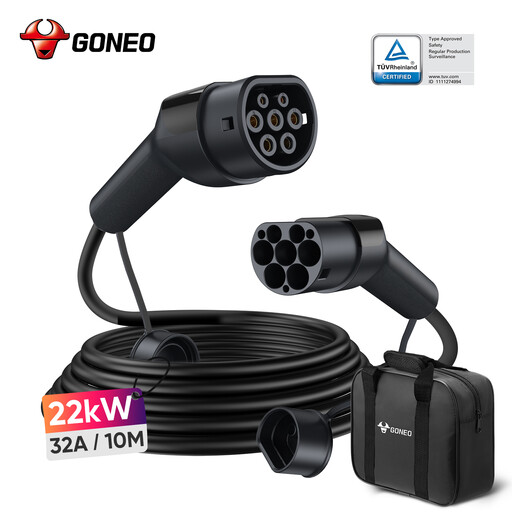
Why It Stands Out: This cable offers the ultimate combination of power and flexibility. The 22kW rating ensures you can take full advantage of the fastest public AC chargers, while the generous 10m length removes any stress about reaching the charge port.
Pros:
Who is it for? This cable is suited for drivers of high-performance BEVs with a 22kW OBC who want the fastest possible AC charging and maximum convenience at public stations. It is the go-to option for those who never want to worry about cable length again.
The cables featured here are Mode 3 charging cables designed for connecting to AC wallboxes and public chargers, which covers the vast majority of charging needs. However, if your journeys often require rapid charging or you are exploring other charging technologies, you may need different solutions.
Explore our wider collection of EV charging accessories to find the right equipment for every situation.
Yes, you can. It is completely safe. Your vehicle's on-board charger will only draw the maximum power it can handle (7.2kW in this case). Using a higher-rated cable will not damage your car or the charging station, but it will not make it charge any faster.
A Mode 3 charging cable, like the ones recommended in this article, is a dedicated cable for connecting your vehicle to a purpose-built EV charging station (a wallbox at home or a public charger). A Mode 2 cable is an occasional-use cable that plugs into a standard 3-pin domestic socket and has an in-cable control box (ICCB). For regular, faster, and safer charging, a Mode 3 cable with a proper wallbox is the recommended setup.
These certifications are critical. They signify that the product has been independently tested to meet stringent safety, quality and performance standards. The UKCA mark is a legal requirement to sell many products in Great Britain, while T?V is a globally respected mark of quality assurance. Choosing a certified cable provides peace of mind that you are using a product that is safe, reliable and built to last.