
24/7 Customer Support

Free returns

Same-day & Next-day Delivery

Quality Guaranteed

Unlock Your Welcome Offers: FREE Delivery | Up to 80% OFF | Free 30-day JoyPlus trial
Download the APP
A Type 2 EV charging cable is a practical spare for many electric car and plug-in hybrid owners in the UK. It can connect a compatible vehicle to a public AC charging point or a suitable home charging unit when a tethered cable is not available.
However, choosing one by price, length or a “fast charging” label alone can lead to an expensive mismatch. Before buying, check the connector, your vehicle’s on-board charger and the way you normally park. A cable that is technically compatible may still be inconvenient if it is too short, unnecessarily heavy or unable to support your car’s charging limit.
A 22kW EV charging cable does not make every vehicle charge at 22kW. The actual rate is limited by the car’s on-board charger (OBC), the charging point and the available electrical supply.
For example, a vehicle with a 7.2kW single-phase OBC will not charge at 11kW or 22kW simply because a higher-rated cable is connected. The cable rating provides capacity; it does not upgrade the vehicle or charging station.
Most modern European-market electric cars use a Type 2 connection for AC charging. A vehicle with a CCS2 inlet also accepts the upper Type 2 section for AC charging, but a Type 2-to-Type 2 cable is not a DC rapid-charging cable.
Check the socket on your vehicle and the charger before ordering. Type 2 cables are not suitable for J1772, CCS1 or CHAdeMO connections. Some older vehicles may also require a different connector arrangement.
A 5m EV charging cable is easier to coil and store, but may not reach when the charging point is positioned behind or to the side of the car. A 7m EV charging cable offers more flexibility at public bays, while a 10m EV charging cable can help with awkward driveway or parking layouts.
Longer cables are generally heavier and take up more boot space. Do not select extra length unless your regular charging locations justify it.
Your first step is to check the vehicle handbook or manufacturer specification for the OBC input. Common options include:
A single-phase EV cable is suitable for compatible single-phase charging arrangements, while an 11kW or 22kW cable normally uses three-phase wiring. A three-phase cable can be physically compatible with some lower-rated setups, but it will not increase the car’s maximum charging speed.
Look for a Type 2 to Type 2 charging cable when both the charge point and vehicle use Type 2 AC connectors. For a vehicle described as CCS2-compatible, confirm that the cable is intended for the AC Type 2 portion of the inlet rather than assuming it supports CCS2 DC rapid charging.
The supplied GONEO listings state compatibility with Type 2 and CCS2 electric vehicles and plug-in hybrids, including Tesla, Audi, BMW, Mercedes-Benz, Volkswagen, Hyundai and Kia models. They also list exclusions for J1772, CCS1 and CHAdeMO. Always cross-check your exact model, particularly if it is an older import or uses a non-European charging system.
A cable used outdoors should have a clearly stated ingress rating. The GONEO cables listed here are specified as IP54, indicating protection against limited dust ingress and water splashes. This is not a reason to leave connectors submerged or exposed unnecessarily; keep the protective cap fitted when the cable is disconnected.
The product information also lists TÜV Rheinland certification and compliance markings including CE, UKCA, RoHS, ISO and IEC standards. Treat these as product specifications to verify on the listing, packaging and documentation. Check that the cable is undamaged before every use, and do not use it if the plug, pins or insulation show signs of overheating, cracking or deformation.
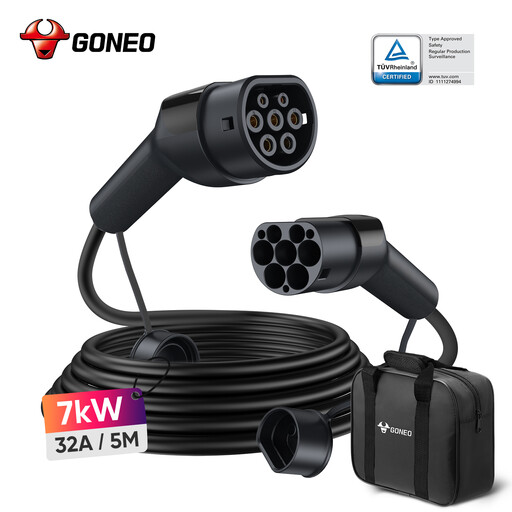
Why This Fits Their Persona: A practical choice for drivers whose home or public charging position is close to the vehicle and whose OBC accepts around 6–7.68kW on single phase.
Its stated 7.2kW, 32A and single-phase specification makes the intended use clearer than a generic fast-charging description.
5m length, Type 2-to-Type 2 design and carry bag; the listing specifies IP54 protection and a TPU jacket.
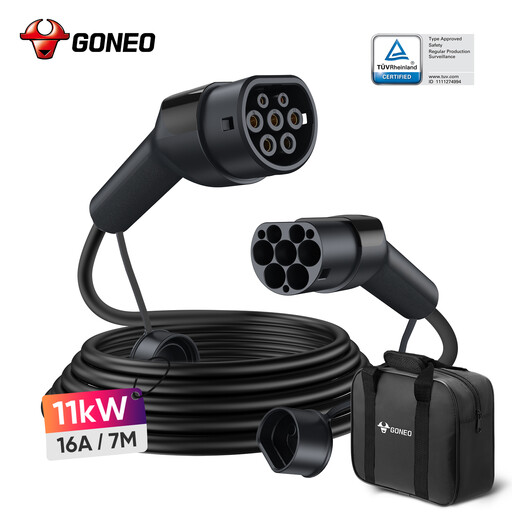
Why This Fits Their Persona: Suitable for owners who regularly use public three-phase AC points and want extra reach for varied UK parking bays.
The 11kW and 16A three-phase ratings help buyers distinguish it from a 7.2kW single-phase cable.
7m reach, carry bag, ergonomic handles, protective caps and stated IP54 resistance.
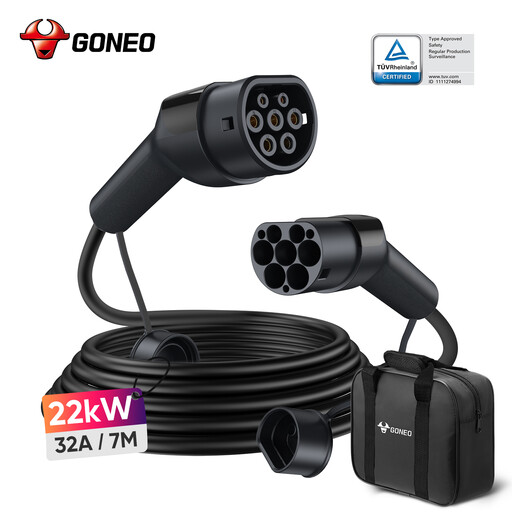
Why This Fits Their Persona: Designed for vehicles and charging points that support 22kW AC, with 7m flexibility for frequent public or workplace charging.
It states the 22kW, 32A and three-phase configuration directly, while reminding buyers to confirm the car’s OBC before purchase.
7m length, carry bag, TPU jacket, stated 20,000-plus bend testing and IP54 rating.
We have compiled a complete, real-time list of products that fully satisfy these strict selection criteria and UK safety regulations.
A suitable cable can remain useful for a long time if it is handled correctly. Coil it loosely rather than folding it sharply, keep the connectors off wet ground and use the supplied carry bag where provided. Do not drag the plug by the cable, place heavy objects on it or drive over it. Although the listed GONEO products specify resistance to bending and impact, these figures are product claims and do not make careless handling advisable.
Before connecting, inspect the pins and housing. Stop using the cable if you notice heat damage, unusual discolouration or a loose connection. Charging performance also depends on the station, vehicle settings, ambient temperature and electricity supply, so running-cost differences usually come from the tariff and charging rate rather than the cable itself.
It can be, provided the plug-in hybrid has a Type 2 AC inlet and the cable’s current and phase configuration are compatible. Many plug-in hybrids accept less power than a 7.2kW, 11kW or 22kW cable, so check the vehicle specification first. A higher-rated cable will not increase the PHEV’s onboard charging limit.
Choose 5m for a straightforward home or public-bay connection. Choose 7m if charging points are often offset from your vehicle. Consider 10m only when you regularly face difficult parking layouts, as the extra cable adds weight and storage volume.
A standard Type 2-to-Type 2 cable is intended for AC charging. It does not replace a CCS2 DC rapid-charging connection or convert a Type 2-only vehicle into a rapid-charging vehicle. Check the charge point and vehicle inlet before use.