Students setting up a shared kitchen
If fridge space is scarce on move-in day, individual UHT cartons offer a way to keep unopened milk in a cupboard, provided the pack permits it. Each carton needs its own storage plan after opening.


Choose six 1-litre UHT skimmed-milk cartons if you need unopened milk outside a crowded shared fridge and expect to use the pack over time; follow each carton’s instructions once opened. A large fresh bottle needs fridge space and a realistic plan to finish it by its use-by date, while a filtered bottle may suit an uncertain routine if its stated storage life meets your needs.
If fridge space is scarce on move-in day, individual UHT cartons offer a way to keep unopened milk in a cupboard, provided the pack permits it. Each carton needs its own storage plan after opening.
If you do not yet know how quickly the household will use milk, compare the use-by date and instructions after opening. For its 2-litre filtered skimmed milk, Arla states a storage life of up to three weeks unopened and seven days opened at 0–5°C; follow the date on the bottle you buy.
Skimmed milk is still cow’s milk. The NHS identifies dairy foods as sources of protein and calcium, but anyone checking dietary suitability should read the ingredients and allergen information on the particular pack.
Decide where unopened milk will go, then choose a quantity your household can store and use according to the label.
Consider when: Several people will use milk, but the shared fridge has little space for unopened stock.
Trade-off: Six litres needs carrying and cupboard space, and an opened carton must be refrigerated as directed.
Consider when: Fridge space and the household’s rate of use are predictable.
Trade-off: The whole bottle occupies fridge space and must be used within its labelled period.
Consider when: You want chilled milk but are less certain how quickly it will be used.
Trade-off: It still needs refrigeration; Arla’s stated storage periods apply to its Cravendale 2-litre bottle under the specified conditions, not to every filtered milk.
| Priority | What to check | Your needs |
|---|---|---|
| Unopened storage | Read the unopened-carton storage directions. Check that you have a suitable cool, dry place if choosing a cupboard-storable UHT pack. | I need to keep reserve milk out of a crowded shared fridge until a carton is opened. |
| Use after opening | Check the stated period after opening and the required fridge temperature. Sainsbury’s directs buyers to refrigerate its 6 × 1-litre UHT milk and use an opened carton within three days; Arla states seven days at 0–5°C for its Cravendale 2-litre filtered bottle. | Our first-week routine is uncertain, so I want a container size we can finish within its own instructions. |
| Pack size | Compare six separate 1-litre cartons with a single large bottle, including the space needed to carry and store them. Confirm the quantity on the listing. | Will housemates share a six-carton supply, or would a smaller purchase make more sense while we settle in? |
| Dietary suitability | Read the ingredients, allergen declaration and nutrition information for the exact product. Skimmed cow’s milk still contains milk. | I want skimmed milk, but I also need to check that the ingredients suit everyone who will drink it. |
Unopened UHT storage directions do not apply once a carton is opened. Sainsbury’s instructs buyers to refrigerate its opened carton and use it within three days.
Open one carton at a time and mark its opening date if several people use the shared kitchen.
Skimmed cow’s milk is still a milk-containing product. Lactose intolerance and a milk allergy are different considerations.
Read the ingredient and allergen information on each product rather than relying on the word “skimmed”.
The Food Standards Agency says a use-by date is a valid guide only when the food’s storage instructions are followed, including refrigeration at 5°C or below where required.
Check the shared fridge temperature and follow the particular carton or bottle’s directions before and after opening.
These brand references illustrate pack and storage choices; check the particular product listing and label before buying.
Sainsbury’s lists a 6 × 1-litre long-life skimmed-milk pack.
Tesco lists both a 6 × 1-litre UHT skimmed pack and a 2.272-litre fresh skimmed bottle.
The Waitrose Essential range includes a 6 × 1-litre long-life skimmed-milk listing.
Arla’s 2-litre filtered skimmed milk is a chilled-bottle alternative to a UHT multipack.
Arla describes B.O.B skimmed milk as enriched with milk protein.
M&S describes fresh skimmed milk in sizes from one pint to four pints and a filtered chilled-milk option.
These Morrisons UHT listings offer a choice between six separate 1-litre cartons for a shared supply and a single 1-litre carton for a smaller initial purchase. Check each product’s label for storage directions.
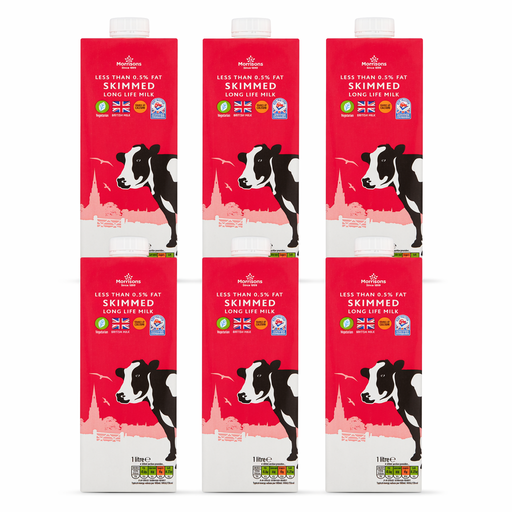 Image unavailable
Six separate 1-litre cartons are an option if several housemates expect to use the milk over time. Check the pack’s directions for unopened storage, then refrigerate opened milk and follow its stated period for use.
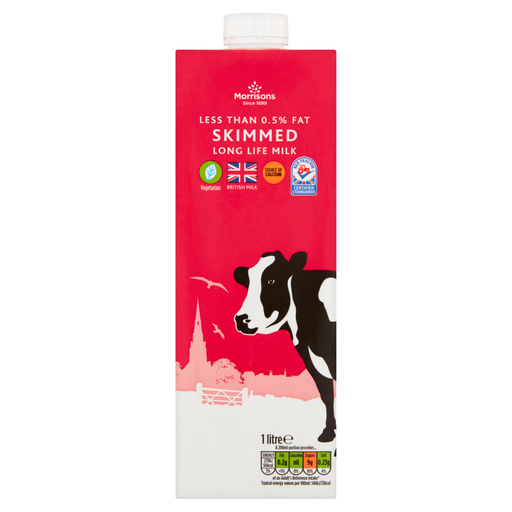 Image unavailable
One 1-litre carton is a smaller starting quantity while a new household works out its milk use; this listing does not identify a six-carton bundle. Check the carton’s storage and after-opening instructions.
Only if the pack’s storage directions permit the conditions there. Sainsbury’s directs buyers to keep its 6 × 1-litre skimmed UHT pack in a cool, dry place; once a carton is opened, it must be refrigerated and used within three days.
It could if you want chilled milk and can meet the product’s storage conditions. Arla states that its Cravendale 2-litre skimmed bottle lasts up to three weeks unopened and seven days after opening at 0–5°C; follow the date and directions on the bottle you buy.
Yes. The NHS identifies dairy foods as sources of protein and calcium and says skimmed milk retains important nutritional benefits while being lower in fat. Read the nutrition panel for values specific to your chosen product.
No: removing fat does not remove the milk ingredient. Check the allergen declaration for the exact product; lactose intolerance is a different condition from a milk allergy.