Who this choice affects

UI designers short of mouse space

If a keyboard takes up too much of a narrow desk, a compact layout may let you position the mouse closer. Logitech makes this point about the form factor of its MX Keys Mini; check the dimensions of any model against your own workspace.

Designers who rely on shortcuts

If layers, components and prototype commands are part of your daily work, check whether a compact keyboard retains the keys you use or lets you remap them. Keychron lists remapping and macro controls for its K3 Max.

People typing for long sessions

Keyboard shape matters alongside mouse position and the rest of the workstation. A curved or split layout may be worth considering, but it can occupy more desk space than a straight compact board.

What matters when choosing

Compact office-style keyboard

Choose it when: mouse space and a familiar straight layout matter more than extensive key customisation.

Allow for: missing number-pad keys or navigation commands moved to secondary key combinations.

75% programmable mechanical keyboard

Choose it when: you will configure keys or macros for repeated design commands while keeping a compact layout.

Allow for: setup time and a typing feel that depends on the selected switch variant.

Curved or split ergonomic keyboard

Choose it when: assessing hand and wrist position matters more to you than achieving the smallest footprint.

Allow for: a potentially wider board and time to get used to its key arrangement.

Concern What to check Who this matters to
Mouse space and key access Compare the board’s width with your usable desk space, then inspect its arrow, navigation and number-pad keys. If I need room to move the mouse, I still need the keys I use beside it. Around 42% of consumers put that balance first.
Shortcuts and device switching Check remapping support on your computer and how the keyboard connects to each device you use. Moving between design commands or devices makes control over my keyboard workflow the priority; around 33% of consumers put this need first.
Long-session comfort Measure the full footprint, including any wrist support, and consider keyboard and mouse placement together. When I type for long stretches, I want to assess hand position without crowding the desk. This is the primary concern for around 25% of consumers.

Mistakes to avoid

  • Choosing the smallest layout without checking its keys

    A missing number pad or relocated navigation command may interrupt a workflow built around measurements and shortcuts.

    List your frequently used keys, then inspect the exact layout and key combinations before choosing a compact size.

    Frequent numeric entry may call for a separate keypad, which also needs desk space.

  • Expecting a keyboard alone to resolve discomfort

    The Health and Safety Executive treats keyboard use as part of the wider display-screen workstation, not as an isolated equipment choice.

    Check mouse reach, desk and screen setup, and opportunities for breaks. If you use display-screen equipment intensively at work or experience discomfort, raise the need for a workstation assessment through your employer.

  • Assuming an ergonomic shape saves space

    A curved or split board may have a wider body or integrated wrist support, even when it has no number pad.

    Compare its complete footprint with the usable width of your desk and the space your mouse needs.

  • Overlooking the change to a split or curved layout

    PCMag UK notes that building typing muscle memory on an ergonomic layout can take weeks.

    If you need familiar key positions immediately, consider a conventional compact layout. Otherwise, allow time to adapt and check the seller’s applicable return terms before ordering.

Brands to consider

Logitech

Its MX Keys Mini and ERGO K860 illustrate different approaches: a compact straight keyboard and a full-size split ergonomic keyboard.

  • Logitech describes the MX Keys Mini as compact enough to place the mouse closer and lists programmable keys.
  • The ERGO K860’s full-size split format and integrated wrist support warrant a footprint check when desk width is limited.

Keychron

The K3 Max UK-ISO is relevant if you want a compact mechanical layout with configurable keys.

  • Keychron lists a 75% layout, QMK/VIA remapping, low-profile hot-swappable switches and wired, Bluetooth and 2.4 GHz connections for the K3 Max range.
  • Check that the particular layout and switch variant you select match your typing habits and shortcut setup.

Kensington

Its compact multi-device keyboard and curved KB675 TKL offer distinct office-style and ergonomic routes.

  • Kensington lists switching among up to three devices for its compact K75502 keyboard; its KB675 has a curved TKL layout.
  • Kensington describes both as designed for small-to-average-sized hands, so check fit and dimensions if you need more room for your hands.

Compact keyboards on Joybuy

These 75% and 65% keyboards are options for prioritising desk space. Compare each listed layout and connection with your shortcut habits; an ergonomic keyboard may be a different choice if its shape matters more than a minimal footprint.

HyperX Alloy Rise 75 Wireless Keyboard UK

HyperX Alloy Rise 75 Wireless Keyboard UK

Consider this compact option if you want to leave more desk room for the mouse while using a wireless keyboard.

Check the physical UK key arrangement and full footprint against your shortcut needs and usable desk width.

View on Joybuy
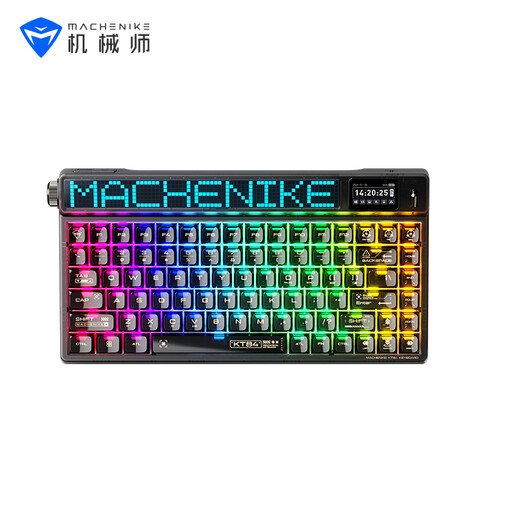
MACHENIKE KT84-B84W 75% Tri-Mode Mechanical Keyboard, US QWERTY, Gateron White Switch, Black

MACHENIKE KT84-B84W 75% Tri-Mode Mechanical Keyboard, US QWERTY, Gateron White Switch, Black

The 75% format is worth considering where desk width is tight and you want a mechanical keyboard with connection choices.

This variant is listed with a US QWERTY layout and Gateron White switches. Check the physical keys, computer compatibility and footprint before ordering.

View on Joybuy

AULA F75 75% Tri-Mode Mechanical Keyboard, US QWERTY

AULA F75 75% Tri-Mode Mechanical Keyboard, US QWERTY

Consider its compact layout if mouse space is your main constraint and you prefer a mechanical keyboard.

The listed connections are wired, Bluetooth and 2.4 GHz; the title specifies US QWERTY. Check key positions, operating-system compatibility and dimensions for your setup.

View on Joybuy
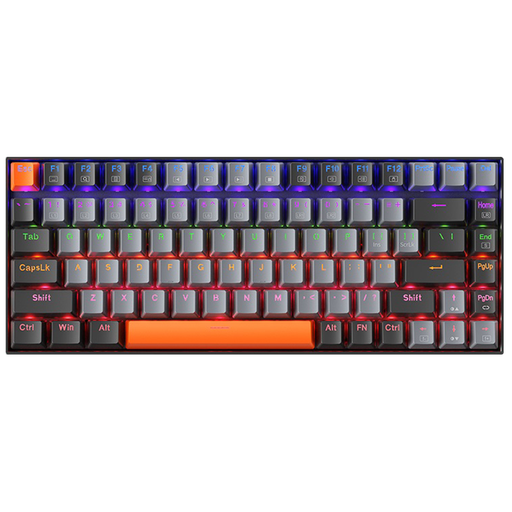
MACHENIKE K500A-B84 75% Wired Keyboard, US QWERTY, Red Switch, Light Gray

MACHENIKE K500A-B84 75% Wired Keyboard, US QWERTY, Red Switch, Light Gray

This compact wired option suits a desk where you can accommodate a cable alongside the mouse.

The listed variant has a US QWERTY layout and Red switches. Check its key positions and complete footprint before choosing it for UI-design shortcuts.

View on Joybuy

ASUS ROG Falchion Ace HFX 65 Analog Keyboard, UK Layout

ASUS ROG Falchion Ace HFX 65 Analog Keyboard, UK Layout

Consider this 65% option if preserving mouse space and choosing a UK-layout keyboard are priorities.

Check which commands need secondary key combinations and whether its wired connection and computer compatibility suit your workstation.

View on Joybuy

Common questions

Should I choose a compact or full-size keyboard for UI design on a small desk?

Choose a compact layout if making room for the mouse is your first priority, provided it retains the keys your workflow needs. Check the number pad and navigation keys in particular; Kensington notes that many compact keyboards omit a dedicated number pad.

Can a 75% mechanical keyboard handle UI-design shortcuts?

Yes, if its available keys and configuration options fit your commands. Keychron lists QMK/VIA remapping and macros for the K3 Max, but those features should not be assumed for every 75% keyboard; check the exact model and variant.

Is a UK-ISO layout necessary?

Choose UK-ISO if its physical key arrangement and legends match how you type. Check the exact variant rather than assuming every keyboard sold under a model name uses the same layout.

Does UK workplace guidance require a particular ergonomic keyboard?

No particular keyboard model is prescribed in the Health and Safety Executive guidance cited here. For employees who use display-screen equipment daily as part of normal work for continuous periods of an hour or more, employers must assess the workstation and reduce risks, considering the work and the individual’s needs.

What should I check after setting up a new keyboard?

Check its position together with your mouse rather than treating either device in isolation. Health and Safety Executive guidance says space in front of the keyboard can help you rest your hands and wrists when you are not typing.