Start with a keyboard whose physical layout and key access suit the way you write, run and navigate unit tests. A programmable mechanical board makes sense if remapping is central to your workflow; a low-profile or multi-device board may fit a shared desk, while a split design is worth considering if you prefer its hand position. For long sessions, assess the keyboard as part of the whole workstation rather than expecting its shape alone to resolve discomfort.
Who needs which keyboard?
Shortcut-heavy test writers
If you move repeatedly between an editor, terminal and test results, accessible navigation keys and the ability to remap commands may matter more than a thin profile. Keychron lists key and macro remapping for the V6 Max, but check whether you can use the configuration tools in your own setup.
All-day desk developers
For long typing sessions, consider whether the keyboard fits a comfortable position alongside your screen and pointing device. The Health and Safety Executive advises assessing the whole display-screen workstation; an ergonomic keyboard is only one part of that setup.
Hybrid and shared-space coders
If you change devices or share a workspace, connection options, desk footprint and key feel can take priority over extensive customisation. Check the exact model and operating-system support before relying on device switching or programmable functions.
What matters when choosing?
Choose the physical layout and keys you need for navigation first, then decide which comfort, connection and customisation features fit your desk and devices.
| Concern |
What to check |
Who this matters to |
| Shortcuts and test-running |
Check the physical UK layout, access to navigation keys and whether the remapping you want works with your operating system and workplace software rules. |
If I repeatedly run tests and inspect failures, I want the commands and keys I use most within easy reach. Shortcut access could be the primary concern for around 40% of consumers. |
| Comfort during long sessions |
Consider the board’s shape and position within the whole workstation; the Health and Safety Executive advises placing the keyboard just below elbow height. |
When I spend long periods typing, I want a keyboard position and shape I can work with throughout the day. For roughly 30% of consumers, sustained-session comfort might come first. |
| Shared-desk typing |
Compare key type, physical profile and connection; confirm that the layout and any required port suit your desk. |
If I work near other people, I would rather have a straightforward board whose feel and setup suit that space than pay attention to extensive customisation. This may be the leading need for around 20% of consumers. |
| Devices and desk space |
Check device and operating-system compatibility, then decide which dedicated keys you can give up for a smaller layout. |
When I alternate between machines on a small desk, switching devices and keeping space clear matter most. Around 10% of consumers might put that flexibility first. |
Buying mistakes to avoid
-
Assuming every ISO keyboard has a UK layout
ISO describes a physical layout family, not one set of national key legends. An ISO variant may still differ from the UK layout you expect for symbols used in code.
Check the exact UK-ISO option, product title and photos rather than relying on an unqualified ISO label.
-
Changing the keyboard but not the workstation
A split shape or wrist support cannot address screen placement, keyboard height or the rest of a display-screen setup on its own. The Health and Safety Executive advises considering posture and the wider workstation.
Position the keyboard appropriately with the screen and pointing device, and seek a workplace display-screen equipment assessment where applicable.
-
Assuming programmable keys work the same on every system
Basic typing and optional key configuration can have different software requirements. Logitech distinguishes basic functions from software-dependent configuration on some operating systems.
Confirm that the particular shortcut feature works on your operating system and that your workplace permits any required software.
-
Choosing a wired keyboard without checking the connection
The CHERRY KC 6000 SLIM uses USB-A, so its cable and connector must fit your computer or dock.
Check the available port and where the cable will run across your desk.
A computer with only USB-C ports may require a suitable adapter or dock.
Brands to consider for these keyboard styles
Keychron
Keychron offers UK-ISO mechanical keyboard options for buyers interested in layout and switch choices.
- The V6 Max product page lists a full-size UK-ISO option, QMK/VIA remapping, hot-swappable MX-style switches, 2.4 GHz wireless and Bluetooth 5.1.
- Those features are specific to the V6 Max options described by Keychron. Confirm the chosen layout and switch variant rather than assuming they apply to every model.
Logitech
Logitech’s MX Keys S and ERGO K860 illustrate different approaches: low-profile multi-device typing and a split keyboard shape.
- Logitech lists illumination, programmable keys and device switching for MX Keys S; it describes a split keyframe and wrist support for ERGO K860.
- Check software support for the functions you want. A split keyboard does not replace an appropriate workstation setup.
CHERRY
The CHERRY KC 6000 SLIM is a wired, full-size scissor-key option for a fixed desk.
- CHERRY lists a slim format, scissor mechanism, status LEDs and extra keys for this model.
- The KC 6000 SLIM requires USB-A and is listed without illumination, anti-ghosting or internal memory.
Joybuy keyboards for writing unit tests
These keyboards offer split, compact and full-size layouts for different unit-test-writing setups. Check each model’s physical layout, key access and configuration requirements against the devices you use.
 No image available
HP 960 Ergonomic Split Wireless Keyboard with Padded Wrist Rest
Consider this split keyboard if you prefer that shape for longer typing sessions while retaining a wireless desk setup.
Its title specifies a padded wrist rest. Check the physical key layout for your UK setup and confirm that any key customisation works with your operating system and workplace software rules.
View on Joybuy
 No image available
AULA F75 75% Wireless Mechanical Keyboard, US Layout
The 75% format is an option if desk space matters but you still want a mechanical keyboard.
The title lists hot-swappable switches, PBT keycaps and wired, Bluetooth and 2.4 GHz connections. It specifies a US QWERTY layout, so compare its physical keys with your UK setup; check remapping support separately if shortcuts are your reason for buying.
View on Joybuy
 No image available
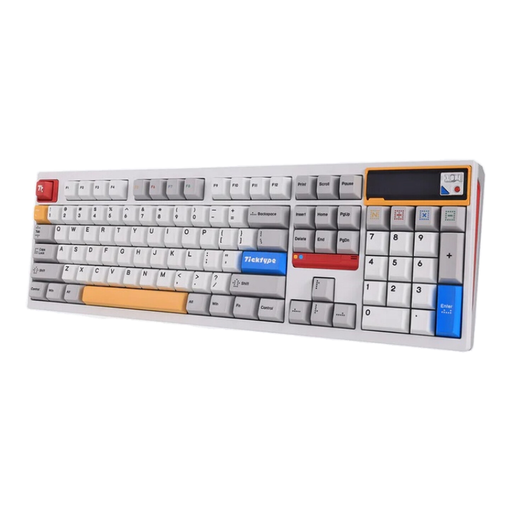
Ticktype DP104 108-Key Mechanical Keyboard, Powder White, Silent Tactile Switches
Choose a full-size format if you want a numpad and room for the complete key set at a fixed desk.
The title specifies a US layout, hot-swappable switches, tri-mode connectivity and pre-installed silent tactile switches. Check the US key positions against your UK software layout and confirm remapping support if programmable test commands matter to you.
View on Joybuy
 No image available
Rapoo E9050L 78-Key Wireless Membrane Keyboard, White, US Layout
This slim, compact option suits a desk where switching between devices matters more than keeping a full-size key set.
The title lists 2.4 GHz and Bluetooth connections and support for four devices. It specifies a US QWERTY layout; check both the physical key positions and the dedicated keys you use when navigating code.
View on Joybuy
 No image available
Razer Huntsman V3 Pro Mini 60% Analog Optical Keyboard
A 60% layout may fit a small desk, but consider how often you need arrow keys while moving through tests and terminal output.
Check whether its layered arrow access suits your workflow. Confirm the physical layout for your UK setup and the operating-system and workplace requirements for any software customisation you intend to use.
View on Joybuy
Frequently asked questions
Do I need a UK-ISO keyboard for writing unit tests?
A UK-ISO keyboard is a sensible choice if you use a UK software layout and want the physical legends and key positions to match it. Check the exact national variant: an ISO label alone does not establish that it is UK-ISO.
Is a mechanical keyboard necessary for unit-test writing?
No. Its switch choice and remapping options matter most if you plan to use them; a low-profile or scissor-key board can instead suit a simpler desk setup. Compare the actual keys and configuration features you need, not the keyboard category alone.
Will a split keyboard resolve discomfort from coding?
A split keyboard cannot address the whole workstation on its own. The Health and Safety Executive advises considering keyboard position and the wider display-screen setup; its guidance also calls for employers to assess workstations where staff use display-screen equipment daily for continuous periods of an hour or more as part of normal work.
What should I do with an old electronic keyboard?
Check the collection or take-back options offered by your local authority or retailer. UK government guidance places electrical and electronic equipment within the waste electrical and electronic equipment framework, which is intended to support recovery, reuse and recycling.


