Who these monitors suit

Colour-critical render reviewers

If you inspect materials, lighting and colour relationships, compare the colour modes and calibration information for the exact model. Dell and BenQ publish different colour specifications for their named creator monitors; screen size alone cannot settle this choice.

Standing-desk 3D multitaskers

If your viewport, render and reference tools stay open as the desk moves, check both the window layout and whether the stand or a compatible mount can position the screen at seated and standing heights. The Health and Safety Executive advises placing the top of a screen level with the eyes and the display about an arm’s length away as a standard arrangement.

Compact-workspace creators

If you want a wide layout for creative applications but have limited desk depth, a 34-inch 3440 × 1440 model such as the BenQ PD3420Q or Dell U3425WE offers a smaller format than a 39.7-inch 5K2K screen. Check whether its vertical pixel space is enough for the render preview you use.

What matters when choosing

39.7-inch 5K2K ultrawide

Choose it when: A 5120 × 2160 canvas would help you inspect a render while keeping the viewport and references visible.

Allow for: A larger screen footprint, plus a check that your computer can drive the resolution through the intended connection.

34-inch 3440 × 1440 ultrawide

Choose it when: You want a render preview beside your tools but need a smaller screen on the desk.

Allow for: Less vertical pixel space and less room for fine-detail inspection than 5120 × 2160.

Concern What to check Who this matters to
Render colour Check the exact model’s relevant colour-space mode and calibration documentation; gamut coverage alone does not establish accuracy for your workflow. If I am judging materials and lighting, I need to know which colour mode and accuracy claims apply to the screen I will use. Around 40% of consumers would put colour-managed checking first.
Pixel workspace Compare native resolution and screen size, particularly the vertical space available for your render preview. Keeping the render, viewport and references visible matters more to me than simply having a wide panel. For around 30% of consumers, pixel workspace would be the primary need.
Standing-desk fit Measure seated and standing eye heights and desk depth; check stand travel or the VESA pattern, monitor weight and arm capacity. I need to move between sitting and standing without leaving the screen too low or too close. Positioning would come first for around 20% of consumers.
Laptop connection Match the computer’s video output and charging needs to the monitor’s exact USB-C or Thunderbolt specification. If I move my laptop with the desk setup, a simpler cable arrangement matters, but it must work with my computer. Around 10% of consumers would make connection convenience their first concern.

Buying pitfalls

  • Choosing by the word “ultrawide” alone

    A 34-inch 3440 × 1440 screen and a 39.7-inch 5120 × 2160 screen leave different amounts of room for a render and its surrounding tools.

    Sketch the windows you normally keep open, then compare native resolution and physical screen size rather than relying on the aspect-ratio label.

  • Assuming any adjustable stand will reach standing eye height

    The Health and Safety Executive’s standard positioning guidance puts the screen top level with the eyes and the display about an arm’s length away. A stand that works while seated may not reach the position you need when standing.

    Measure both desk positions and check stand travel. If considering an arm, match its load rating and mounting arrangement to the monitor and desk.

    A compatible arm or desk mount may be needed if the included stand cannot provide the required position.

  • Treating wide colour gamut as proof of accurate render colour

    Colour specifications apply to particular models and modes. A gamut figure by itself does not tell you whether the display is set up for your delivery colour space.

    Identify your delivery colour space, then check the monitor’s relevant mode, calibration documentation and any equipment your workflow requires.

    LG states that a hardware calibrator is not included with its 40WP95CP-W; workflows requiring one may need a separate device.

  • Expecting one cable to suit every laptop

    Monitor ports and power delivery vary, while the computer must support the intended display connection. Dell specifies USB-C power delivery up to 90 W for the U4025QW; LG specifies Thunderbolt 4 and charging up to 96 W for the 40WP95CP-W.

    Check your computer’s supported external-display resolution and refresh rate, port standard and charging requirement against the exact monitor.

Brands and model lines to consider

Dell

Dell’s UltraSharp range includes a 39.7-inch 5K2K curved monitor and a smaller 34-inch 3440 × 1440 option relevant to this desk setup.

  • Dell specifies 5120 × 2160 at 120 Hz, 99% DCI-P3, 100% sRGB and average Delta E below 2 for the U4025QW, alongside height, tilt and swivel adjustment.
  • The U4025QW takes more desk space than Dell’s 34-inch U3425WE; check the chosen model’s connection requirements and physical fit rather than transferring specifications between them.

BenQ

BenQ’s PD3420Q is a 34-inch creator-oriented ultrawide, while the PD3225U is a non-ultrawide 4K alternative if a taller 16:9 layout matters more.

  • BenQ specifies 3440 × 1440, 100% sRGB, 100% Rec.709, 98% P3, a calibration report, 150 mm stand-height adjustment and 100 × 100 mm VESA mounting for the PD3420Q.
  • The PD3420Q is specified at 60 Hz and has less vertical pixel space than a 5120 × 2160 ultrawide. Its colour claims remain specifications for this model, not a substitute for checking your working mode.

LG

LG’s 40WP95CP-W is a 39.7-inch 5120 × 2160 ultrawide for buyers considering a high-resolution workspace with Thunderbolt 4.

  • LG specifies 98% DCI-P3 coverage, Thunderbolt 4, daisy-chain support and charging up to 96 W for the 40WP95CP-W.
  • LG says a hardware calibrator is not included. Check whether your colour workflow needs one and whether your computer supports the intended connection.

Joybuy ultrawides for render-review setups

These ultrawides offer 34-inch and 49-inch screen formats for checking a render alongside other windows. Compare their exact colour information and seated-to-standing positioning before choosing; a 49-inch 5120 × 1440 layout is not the same as the 39.7-inch 5120 × 2160 option discussed above.

Acer Predator X49X curved ultrawide monitor

Acer Predator X49X 49-inch curved QD-OLED monitor

Consider this 49-inch screen if a very wide render-and-tools layout is your priority and your desk can accommodate it.

The product name specifies a 32:9 QD-OLED display, 1800R curve, Double Quad HD resolution, 240 Hz refresh rate and HDMI, DisplayPort and USB-C connections.

Check the applicable colour mode and calibration documentation, as well as the stand’s adjustment range and any proposed mount’s capacity.

Joybuy

LG UltraGear 34GX900A-B OLED monitor

LG UltraGear 34GX900A-B 34-inch OLED monitor

This 34-inch ultrawide suits a render-and-tools layout when you prefer a smaller format than a 49-inch screen.

The product name specifies OLED, WQHD resolution and a 240 Hz refresh rate.

Check its colour modes, calibration information and stand travel for your setup. The product listing warns about OLED burn-in with extended static content and advises using its screen-protection features.

Joybuy

Philips Evnia 6000 34M2C6500 ultrawide monitor

Philips Evnia 6000 34M2C6500 34-inch monitor

This 34-inch ultrawide is an option for keeping a render and supporting windows side by side.

The product name specifies 3440 × 1440 resolution, height, swivel and tilt adjustment, and refresh rates of 175 Hz via DisplayPort or 100 Hz via HDMI.

Check the colour specifications needed for your render workflow and measure whether the stand’s adjustment range suits both desk heights.

Joybuy

CRUA 49-inch curved ultrawide monitor

CRUA 49-inch curved 5120 × 1440 monitor

Consider this 32:9 screen if horizontal room for a render and multiple tool windows matters more than the vertical resolution of a 5K2K display.

The product name specifies 5120 × 1440 resolution, a 165 Hz refresh rate, a VA panel and 75 × 75 mm VESA mounting.

Confirm the included stand’s height adjustment before ordering: the listing’s descriptions differ on this point. Check desk depth, mount capacity and the colour information required for your work.

Joybuy
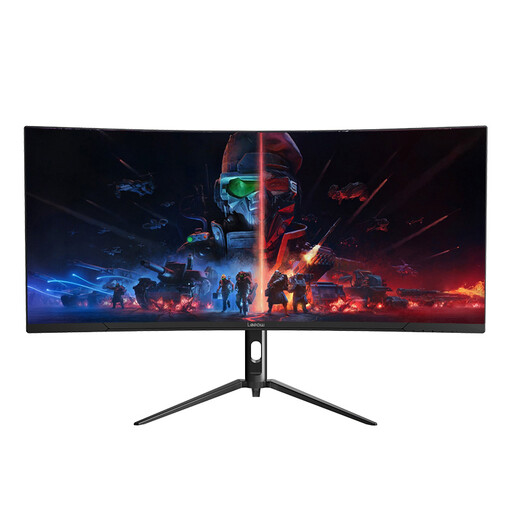
Lepow HC-SJ34MZ5 curved ultrawide monitor

Lepow HC-SJ34MZ5 34-inch curved ultrawide monitor

This 34-inch model provides a smaller ultrawide format for viewing a render beside other windows.

The product name specifies 3440 × 1440 resolution and a 165 Hz refresh rate.

Check its colour modes and calibration information if you assess render colour, and confirm how it can be positioned at seated and standing heights.

Joybuy

Frequently asked questions

How should I position an ultrawide at a standing desk?

Use the desk height, monitor stand or a compatible arm to place the screen appropriately in both seated and standing positions. The Health and Safety Executive’s standard guidance puts the top of the screen level with your eyes and the display about an arm’s length away; account for your task and individual needs.

Will one USB-C or Thunderbolt cable run the monitor and charge my laptop?

Only if the computer and monitor support the required video connection and charging arrangement. Dell specifies USB-C DisplayPort Alt Mode and power delivery up to 90 W for the U4025QW, while LG specifies Thunderbolt 4 and charging up to 96 W for the 40WP95CP-W; check your computer’s output and power requirements against the chosen model.

Can I put a 34-inch ultrawide on a monitor arm?

Yes, if the exact monitor’s mounting pattern and weight match the arm’s capacity and the desk can support its mounting method. BenQ specifies a 100 × 100 mm VESA mount and a 6.9 kg monitor-only weight for the PD3420Q; another 34-inch model may have different requirements.

Is a hardware calibrator included with a colour-focused ultrawide?

Not necessarily. LG states that a hardware calibrator is not included with its 40WP95CP-W, so check the exact monitor’s box contents and whether your workflow calls for separate calibration equipment.

When is a workplace screen assessment required in the UK?

The Health and Safety Executive says employers must carry out a workstation assessment for workers who use display screen equipment daily as part of normal work, continuously for an hour or more. The assessment considers the whole workstation, including equipment, furniture, working conditions, the job and any special user requirements.