What matters when choosing
Start with the layout colleagues need to see at once, then check how they will maintain colour settings, connect their computers and adjust the shared workstation.
Around 40 inches, 5K2K
Consider it when: A large edit or timeline needs to remain visible beside reference material; Dell’s U4025QW and LG’s 40U990A-W are both specified at 5120 × 2160 by their manufacturers.
Trade-off: The larger screen needs a suitable desk and viewing position, while colour decisions still depend on the office’s profiling workflow.
34-inch creative ultrawide
Consider it when: A smaller shared desk needs an ultrawide layout and peripheral sharing; BenQ lists KVM switching and a factory calibration report for its PD3420Q.
Trade-off: The PD3420Q’s stated 3440 × 1440 resolution leaves less vertical room than the cited 5K2K screens.
32-inch 4K alternative
Consider it when: Reviewing one colour-critical image or frame matters more than keeping several wide panels visible; BenQ’s PD3225U is a 3840 × 2160 example with stated calibration features.
Trade-off: Its conventional 16:9 format does not provide a continuous ultrawide canvas.
| Concern | What to check | Who this matters to |
|---|
| Reliable colour decisions |
Match the display mode to the intended output and plan how the monitor profile will be kept accurate. Adobe notes that document and output profiles also affect colour interpretation. |
If I am approving edits across applications and outputs, I need colleagues to judge the same intended colours rather than rely on a vivid display. Around 42% of consumers put dependable colour management first. |
| Shared-computer handover |
Check each host’s video output, the cable, the monitor’s KVM arrangement and whether its power delivery meets the laptop’s requirement. |
When colleagues take turns at one desk, I want to change computers without repeatedly moving shared peripherals. Roughly 33% of consumers make a smooth handover their primary concern. |
| Workspace and positioning |
Compare the real edit-and-reference layout at 3440 × 1440 and 5120 × 2160, then measure desk space and check adjustment or mounting options. |
If the display dominates our shared desk, I need enough room for the work without making each handover awkward. About 25% of consumers place workstation fit and usable canvas first. |
Joybuy product choices
These choices include a 34-inch ultrawide for a smaller shared desk, a 49-inch ultrawide for a particularly wide layout and a 32-inch 4K alternative when colour-reference work matters more than a continuous ultrawide canvas.
 No image available
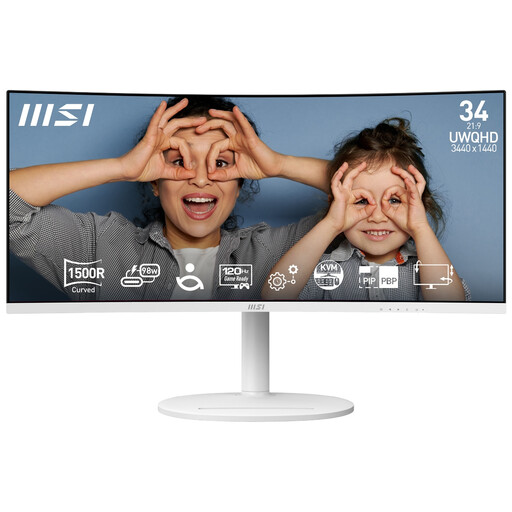
Modern MD342CQPW 34-inch curved monitor, white
Consider this size if the shared desk needs an ultrawide layout but has limited room for a larger display.
The product title specifies 3440 × 1440 resolution, 120 Hz and a 1500R curve. Before using it to approve colour edits or share a laptop connection, confirm the required colour mode, profiling method and host compatibility.
View on Joybuy
 No image available
ASUS ProArt Display PA32UCG-K 32-inch 4K monitor
This is a 4K alternative for reviewing a colour-critical image or frame when a continuous ultrawide workspace is not essential.
The product title specifies IPS Mini LED, 120 Hz and hardware calibration, and advertises Delta E below 1. Treat the colour figure as a listing claim rather than an independent measurement; confirm the required colour modes and connection behaviour for the team’s computers. Its 16:9 layout will not provide an ultrawide canvas.
View on Joybuy
 No image available
Acer X Predator X49X 49-inch curved QD-OLED ultrawide
Its wide format may suit a desk that needs several windows visible together, provided the screen fits the workstation.
The product title specifies a 32:9 format, 1800R curve and 240 Hz. Confirm colour-mode and profiling requirements for the exact X49X variant before using it for colour approval, and check the available desk space and each host connection.
View on Joybuy
Questions about shared colour-editing desks
Is a wide-gamut ultrawide enough for dependable colour comparison?
No: use a display mode appropriate to the intended output and maintain an accurate monitor profile. Adobe explains that monitor, document and output profiles all matter to how colour is interpreted, so a gamut figure alone cannot establish what colleagues will see in the finished work.
Does a shared office need a hardware calibrator?
A hardware calibrator is worth considering when the team needs a repeatable way to maintain its colour setup, but it is not established as a universal requirement for every office. Decide how the chosen monitor will be profiled, check that it supports the intended method and agree which settings colleagues will use for review.
What should a UK employer check when installing a shared monitor?
Include the shared display in the workplace display screen equipment assessment. The UK Health and Safety Executive says employers must assess relevant workstations and reduce risks, and its guidance addresses hot-desking; check positioning and adjustability for the people using the desk.
Will one USB-C cable work with every colleague’s laptop?
Not automatically: video output, data, charging and cable capability must suit each laptop and the monitor’s ports. Dell UK lists up to 140 W EPR power delivery for the U4025QW, while BenQ UK lists 65 W USB-C Power Delivery for the PD3420Q; neither figure establishes compatibility with a particular host.
How should an office plan for the monitor’s end of life?
Arrange an appropriate collection or recycling route through the workplace facilities team, seller or waste contractor. UK government guidance describes waste electrical and electronic equipment rules as a way to reduce electrical waste; the practical arrangements should be settled for the office’s equipment before disposal.


