For colour edits beside a bright window, choose an ultrawide with documented support for the colour space you deliver in, then assess its screen surface and your desk position together. An anti-glare coating or a higher stated brightness cannot replace moving the screen out of direct window reflections and controlling daylight with blinds or curtains, as the Health and Safety Executive advises. Treat manufacturer colour figures as shortlisting information, not a guarantee of accuracy from the particular unit on your desk.
Who this choice matters to
Colour-critical photo and video editors
If you compare edits for sRGB, Rec.709 or P3 delivery, look for documented colour-space support, suitable modes and calibration information. Extra desk space alone does not establish whether a display suits your output.
Window-side home-office creators
If daylight falls across your editing desk, consider screen placement and window coverings alongside an anti-glare surface. The Health and Safety Executive advises arranging screens to avoid glare and bright reflections.
Laptop-based multitask editors
If you want room for a timeline, tools and reference images, an ultrawide may suit the layout. Check the laptop's video connection and charging requirements before relying on a monitor's USB-C or Thunderbolt port.
What to check before choosing
Set the desk and daylight conditions first, then match colour modes to your delivery work; consider workspace and laptop connections after those requirements are clear.
| Concern |
What to check |
Who this matters to |
| Window glare |
Check the screen's position relative to the window and whether you can adjust blinds or curtains; consider an anti-glare or matte surface. |
If a bright reflection crosses my edits, I need to control the light before judging subtle differences. Around 27% of consumers put glare control first. |
| Colour reliability |
Match documented gamut and colour modes to sRGB, Rec.709 or P3 delivery as appropriate; check the available calibration information. |
When I compare versions for a defined output space, I need the display set up for that space rather than relying on a wide-gamut claim alone. Colour reliability comes first for roughly 33% of consumers. |
| Workspace and connections |
Check resolution and aspect ratio, then confirm video-port compatibility and whether the monitor's power delivery meets your laptop's requirements. |
I want my timeline and reference image visible together without giving up a workable laptop connection. For about 20% of consumers, workspace and connectivity are the primary need. |
| Feature fit |
Decide whether you need P3 delivery, docking or a higher refresh rate; check stand adjustment for your desk layout. |
If my final work is mainly in sRGB or Rec.709, I would rather prioritise the relevant colour mode and a desk setup I can adjust. Feature fit leads the decision for around 20% of consumers. |
Buying mistakes to avoid
-
Expecting brightness to solve window glare
Even a screen with anti-glare treatment can show reflections that interfere with colour comparison. A brightness rating does not tell you how a direct window reflection will look at your desk.
Position the display so it does not directly face the window or another bright light, then adjust blinds or curtains before evaluating edits. This follows the Health and Safety Executive's glare-control guidance.
-
Choosing the largest gamut figure without checking the output space
A P3 coverage figure does not, by itself, tell you whether the monitor is set appropriately for sRGB web work or Rec.709 video.
List the colour spaces you actually deliver in and check the exact model's corresponding modes and documented coverage.
-
Assuming USB-C will replace the laptop charger
A monitor's power-delivery rating does not establish that your laptop accepts charging and video through the intended connection, or that it receives enough power for your use.
Check the laptop and cable requirements against the monitor's video connection and stated power delivery. BenQ lists 65 W for the PD3420Q, Dell 90 W for the U3425WE, and ASUS and LG 96 W for the PA34VCNV and 34WP85C-B respectively.
-
Treating an HDR label as proof of SDR editing accuracy
HDR capability and the colour mode used for standard dynamic range edits answer different questions. A refresh-rate or screen-size specification does not settle colour accuracy either.
For final SDR comparisons, check the relevant colour mode, calibration documentation and your colour-managed workflow. Assess HDR separately if you deliver HDR work.
Relevant brands and model lines
These manufacturer-described models illustrate different specifications to check; their stated colour figures are not measurements of the particular unit you may receive.
BenQ
BenQ positions the 34-inch PD3420Q IPS ultrawide for creative work. Its UK specifications list 100% sRGB and Rec.709 coverage, 98% P3 coverage, a matte coating and a factory calibration report.
- Dedicated colour modes and the calibration report give editors documentation to check against their delivery space; the model also lists USB-C 65 W power delivery.
- BenQ lists 350 nits typical brightness and 60 Hz. Neither the brightness figure nor the matte coating removes the need to control direct window reflections.
ASUS ProArt
ASUS lists the curved 34.1-inch PA34VCNV IPS display with anti-glare treatment, 100% sRGB coverage, Calman verification and a stated colour error below Delta E 2.
- Its documented colour features and USB-C 96 W power delivery make it relevant to editors who also connect a compatible laptop.
- ASUS lists 300 cd/m² typical brightness and 60 Hz. Control daylight at a window-side desk rather than treating those specifications as a reflection-handling test.
Dell UltraSharp
Dell's U3425WE is a curved 34.14-inch IPS Black ultrawide with anti-glare treatment, a Thunderbolt hub and 90 W power delivery. Dell lists 3440 × 1440 resolution at 120 Hz.
- Dell states 100% sRGB and BT.709 coverage, 98% Display P3 and DCI-P3 coverage, and average Delta E below 2 for this model.
- Confirm your computer's Thunderbolt or USB-C capabilities and use the colour mode suited to your output. Dell's colour figures do not establish accuracy in your lighting conditions.
LG UltraWide
LG lists the curved 34-inch 34WP85C-B IPS ultrawide with anti-glare treatment, typical DCI-P3 coverage of 95%, height adjustment and USB-C 96 W power delivery.
- Its stated colour-calibrated status and laptop connection features are worth checking for a mixed editing and desk-work setup.
- LG lists 300 cd/m² typical brightness. Keep direct window reflections out of the viewing area when making final colour comparisons.
Ultrawides to consider on Joybuy
These two ultrawides offer different screen formats for arranging edits and reference images. Check their colour modes against your delivery work and plan the desk position around the window; neither product listing alone settles how a particular screen will perform in your room.
 No image available
Acer X Predator X49X 49-inch curved QD-OLED monitor
Consider its broad 32:9 format if you want substantial horizontal room for editing windows and references. Check that its colour modes suit your output before relying on it for final comparisons.
The product name specifies a 49-inch QD-OLED panel, 1800R curve, Double Quad HD resolution, 240 Hz refresh rate, HDMI, DisplayPort and USB-C.
For a window-side desk, arrange the screen to avoid direct reflections and control daylight before judging colours.
View on Joybuy
 No image available
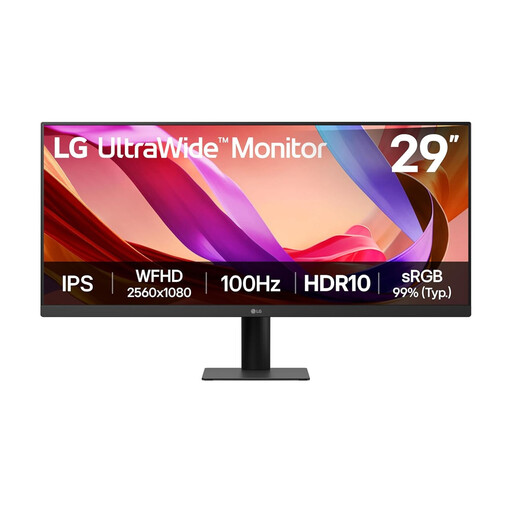
LG UltraWide 29U511A 29-inch IPS monitor
Consider this 29-inch ultrawide if you want a horizontal workspace for placing edits side by side. If documented colour accuracy matters to your work, check the calibration information for the exact model.
The product name specifies an IPS panel, UWFHD 1080p resolution, 100 Hz refresh rate, HDMI and DisplayPort.
Position the screen to avoid direct window reflections before making final colour judgements.
View on Joybuy
Common questions
Will an anti-glare ultrawide solve colour-editing problems beside a bright window?
No: an anti-glare surface does not remove strong direct reflections. The Health and Safety Executive advises arranging the screen so it does not directly face a window or bright light, and adjusting curtains or blinds to reduce intrusive daylight.
Do web and standard SDR video edits need a wide-gamut ultrawide?
Not necessarily. Check for a suitable sRGB mode for web work or Rec.709 support for standard SDR video, alongside documented coverage and your colour-managed workflow. P3 coverage becomes relevant when your production and review work actually uses a P3 colour space.
Can one USB-C cable drive an ultrawide and charge my laptop?
Yes, if the monitor, cable and laptop support the required video and charging functions, and the monitor can supply the power your laptop needs. The BenQ PD3420Q, Dell U3425WE, ASUS PA34VCNV and LG 34WP85C-B have manufacturer-stated power-delivery ratings from 65 W to 96 W; check compatibility for the exact pairing you intend to use.
What should I do with an old monitor when replacing it?
Use a suitable electrical-equipment recycling route rather than ordinary waste. GOV.UK explains that the UK's waste electrical and electronic equipment framework aims to reduce electrical equipment going to landfill; check which monitor-collection options your local authority offers.


