What matters when choosing
Start with what the desk must let people do: share connected devices, inspect artwork detail, make colour decisions or adjust the screen between users. Then compare the exact model’s features against that primary need.
| Concern |
What to check |
Who this matters to |
| Colour confidence |
Check the declared colour-space coverage and whether calibration information suits the intended output. A gamut figure alone does not establish a match to another screen or print. |
I need artwork colours to be a dependable reference, so the display’s stated colour space must fit the files and applications I use. Around 31% of consumers put colour confidence first. |
| Shared-device workflow |
Confirm video inputs and check KVM for peripheral switching, PBP/PIP for simultaneous sources, and power delivery against the laptop’s charging requirement. |
If two computers use this desk, I want to know whether I can see both sources and change keyboard-and-mouse control without rearranging cables. Roughly 31% of consumers make shared-device use their primary concern. |
| Artwork detail and canvas |
Compare native resolutions, then check computer output, cable compatibility and how the screen will fit at the intended viewing distance. |
I keep references beside my working file and want enough detail to inspect them without repeatedly zooming. For around 23% of consumers, usable artwork detail comes first. |
| Desk fit and adjustment |
Measure the available width, depth and stand footprint; check adjustment or mounting options and plan for reflections. |
Different people need to position the display at the same desk, and a screen that crowds the space would make that harder. Approximately 15% of consumers prioritise desk fit and positioning. |
Brands to consider
These examples show features available on particular creative-oriented ultrawides, not features shared by every monitor from each brand.
BenQ
The PD3420Q is worth examining when artwork reference and two-computer control matter at the same desk.
- BenQ UK lists a 3440 × 1440 IPS panel, 100% sRGB and Rec.709 coverage, 98% P3 coverage, KVM, PIP/PBP and 65W USB-C power delivery for the PD3420Q.
- Check the connected laptop’s charging needs and the required input arrangement; these PD3420Q specifications do not describe every BenQ ultrawide.
Dell
The U3425WE provides a hub-oriented option for a desk that needs screen adjustment and more than one visible source.
- Dell UK lists 3440 × 1440 resolution, 90W power delivery, height, swivel and tilt adjustment, and picture-by-picture and picture-in-picture modes for the U3425WE.
- PBP/PIP does not establish that a shared keyboard and mouse can switch between computers; confirm that requirement for the exact setup.
ASUS ProArt
The PA348CGV is a colour-oriented candidate for keeping artwork beside applications on a connected laptop.
- ASUS lists 3440 × 1440 IPS, 98% DCI-P3 and 100% sRGB/Rec.709 coverage, Calman verification, Delta E < 2 and 90W USB-C power delivery for the PA348CGV.
- ASUS’s model-specific colour claims should be assessed against the intended workflow; check shared-device switching separately if it is required.
LG UltraFine
The 40U990A-W offers a higher-resolution route when seeing finer artwork detail is the main reason to move beyond a 34-inch canvas.
- LG UK specifies a 40-inch 5120 × 2160 Nano IPS Black display and Thunderbolt 5 for the 40U990A-W.
- Measure the desk and confirm that the computer and connection support the intended resolution; resolution alone does not establish colour matching or device switching.
ViewSonic ColorPro
The VP3481 is an option to investigate when a compatible hardware-calibration route matters to the reference workflow.
- ViewSonic lists 3440 × 1440 resolution, 100% sRGB coverage and Delta E < 2 for the VP3481, with hardware calibration through an optional Colorbration Kit.
- The calibration kit is optional, and the VP3481 has a VA rather than an IPS panel. Check the calibration process and required connections for this model.
Joybuy ultrawides for reference artwork
These 34-inch and 49-inch ultrawides offer different amounts of room for artwork and working windows. For a shared desk, check the exact switching features, colour workflow and physical fit before choosing; a wide gaming monitor is not automatically a complete two-computer or colour-managed setup.
 No image available
Acer X Predator X49X 49-inch QD-OLED ultrawide
Consider this broad display if keeping several windows visible matters more than conserving shared-desk space.
The listed variant is 32:9 with an 1800R curve and a stated 240 Hz refresh rate. Measure the desk and check that the connected computer and cable support the display mode you intend to use.
Joybuy
 No image available
LG UltraGear 34GX900A-B 34-inch OLED ultrawide
This 34-inch option suits a desk where reference artwork needs space beside a working window, provided its connections meet the shared setup’s needs.
The title specifies WQHD and 240 Hz. For artwork left on screen for extended periods, take account of the product’s OLED burn-in warning and follow its screen-protection guidance; confirm KVM or simultaneous-source modes if you need them.
Joybuy
 No image available
CRUA 49-inch curved ultrawide, 5120 × 1440
Its wide canvas may suit artwork and applications kept open together, if the desk can accommodate a 49-inch screen.
The listed variant is a 32:9 VA display with a 1500R curve, 165 Hz refresh rate and 75 × 75 mm VESA mounting. Check the stand configuration, desk or mount capacity, and any KVM or PBP/PIP requirement before buying; the stated gamut figure alone does not establish calibration.
Joybuy
 No image available
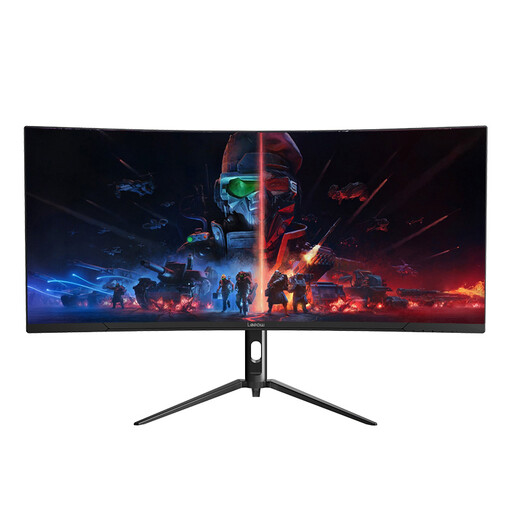
Lepow HC-SJ34MZ5 34-inch curved ultrawide
Its 34-inch format provides space to keep a reference and working window side by side, subject to the desk’s dimensions.
The title specifies 3440 × 1440 resolution and 165 Hz. If colour comparison, two-computer switching or adjustment between users is essential, confirm the relevant colour, connection and stand details for this variant.
Joybuy
Common questions
Is a 34-inch ultrawide enough for reference artwork?
A 34-inch 3440 × 1440 display can provide room for artwork beside an application when the shared desk is relatively compact. If inspecting finer detail without frequent zooming is the overriding need, compare it with a higher-resolution option such as LG’s 40-inch 5120 × 2160 40U990A-W, while checking desk fit, viewing distance and computer output.
Do two computers need both PBP and KVM?
Only if you need both functions: picture-by-picture shows video from two sources, while a KVM switch changes which computer uses a shared keyboard and mouse. BenQ lists both for the PD3420Q; Dell lists PBP/PIP for the U3425WE, so check peripheral switching separately for that setup.
What should I check before using one USB-C cable?
Confirm that the laptop can send video through the required USB-C or Thunderbolt connection, then compare its charging requirement with the monitor’s stated power delivery. For their specified models, ASUS lists 90W on the PA348CGV, BenQ lists 65W on the PD3420Q and Dell lists 90W on the U3425WE; none of those figures alone confirms two-computer switching.
When do UK display-screen-equipment rules affect a shared desk?
For employer-provided workstations, the UK Health and Safety Executive says the DSE Regulations apply to workers who use display-screen equipment daily for continuous periods of an hour or more. The workstation assessment should address the shared arrangement, including screen position and lighting; choosing a particular monitor does not replace that assessment.


