For photo work beside a bright window, start with screen placement, then look for a matte or anti-glare ultrawide with colour specifications that match your workflow. The Health and Safety Executive advises arranging the desk and screen to avoid glare or bright reflections; a screen finish or higher published brightness cannot replace control of the window light. A 34-inch 3440 × 1440 display offers room for a gallery alongside editing tools, while a 39.7-inch 5120 × 2160 option offers more canvas if your desk and computer can accommodate it, as the ASUS, BenQ and LG model specifications illustrate.
Who this setup suits
Photo editors working beside daylight
If you assess images near a window, the Health and Safety Executive’s advice on avoiding reflections makes desk position and light control part of the monitor decision. Compare the exact model’s screen finish and documented colour specifications as well.
Gallery builders needing a wide canvas
Keeping images, a browser and editing tools visible together makes screen size and resolution important. BenQ’s 34-inch PD3420Q and LG’s 39.7-inch 40WP95CP-W illustrate the choice between a smaller 3440 × 1440 workspace and a larger 5120 × 2160 one.
Laptop-first creative workstation users
If the monitor will also connect your laptop and peripherals, check the laptop’s video output and charging requirements against the monitor’s ports and power delivery. BenQ, Dell and LG document different connection features for the models discussed here.
What to prioritise
For a gallery beside a bright window, work out where the screen can sit before deciding how much colour documentation, canvas space and laptop connectivity you need.
| Concern |
What to check |
Who this matters to |
| Window reflections |
Check the exact screen finish and whether the desk position and window coverings let you avoid reflected light. The Health and Safety Executive recommends arranging the desk and screen to avoid glare or bright reflections. |
If daylight catches the screen while I check photos, I need a position where reflections do not dominate the image. Around 36% of consumers put reflection control first. |
| Colour confidence |
Match the exact model’s documented sRGB or P3 coverage and calibration information to your colour-managed apps and intended output. |
When I make colour decisions for a gallery, I want documentation that relates to my workflow rather than a gamut figure alone. Colour confidence comes first for roughly 29% of consumers. |
| Gallery canvas |
Compare resolution alongside physical size, then measure desk width and depth and check the computer’s display-output capability. |
To keep many images and editing panels in view, I may accept a larger screen that takes more desk space. Approximately 21% of consumers prioritise canvas and resolution. |
| Laptop connection |
Confirm the laptop’s USB-C or Thunderbolt video support, charging needs and required peripheral connections against the exact monitor. |
If I rely on one connection for my laptop workstation, I need video and charging that work with my computer. Laptop integration is the primary concern for around 14% of consumers. |
Buying pitfalls
-
Choosing on brightness while leaving the screen facing the window
A published brightness figure does not mean direct reflections will disappear. The Health and Safety Executive advises arranging the desk and screen to avoid glare or bright reflections.
Check where the window reflects at the times you use the desk, and position the screen away from that reflection path where possible. Then compare screen finishes and published brightness.
-
Taking wide colour coverage as a guarantee of matching output
Gamut coverage, factory-calibration information and hardware-calibration capability describe different aspects of a display. They do not, by themselves, establish that photos will match every other screen or output.
Check the exact model’s colour documentation against the software and output process you use. If you intend to calibrate the display yourself, confirm the required hardware and whether it is included.
LG states that the hardware calibrator for its 40WP95CP-W is sold separately.
-
Assuming a USB-C socket makes a one-cable desk
A monitor’s video and charging features do not establish what a particular laptop port, cable or power requirement supports.
Check the laptop’s video protocol, external-display limits and charging requirement against the monitor and cable before relying on a single connection.
-
Choosing a larger canvas without measuring the desk
LG’s 39.7-inch 5120 × 2160 option offers more screen area than the 34-inch models discussed here, but its physical size changes where the display can sit relative to the window.
Measure usable desk width and depth, check the intended viewing position and confirm that the computer can drive the chosen resolution.
Relevant brands for reference
These model-specific examples show different approaches to a photo workspace; their features should not be assumed to apply across each brand’s range.
ASUS ProArt
ASUS specifies the PA348CGV as a 34-inch 3440 × 1440 IPS ultrawide with an anti-glare surface, 350 cd/㎡ typical brightness, 100% sRGB and 98% DCI-P3 coverage.
- ASUS also states factory calibration and ΔE < 2 for this model, giving photo editors model-specific colour documentation to assess.
- Its 1440-pixel vertical resolution provides less vertical space than LG’s 2160-pixel 40WP95CP-W; its anti-glare finish does not remove the need to manage window reflections.
BenQ DesignVue
BenQ specifies the PD3420Q as a 34-inch matte IPS display at 3440 × 1440, with 100% sRGB/Rec.709, 98% P3 and a calibration report.
- Its documented matte finish, 350-nit typical brightness and USB-C connection are relevant to a daylight-facing creative desk.
- BenQ specifies this model at 60 Hz and states average ΔE ≤3; check those model-specific figures if refresh rate or a different colour-accuracy target matters to your work.
Dell UltraSharp
Dell describes the U3425WE as a 34.1-inch 3440 × 1440 curved IPS Black hub monitor with anti-glare treatment and an ambient-light sensor.
- A height-adjustable stand, hub functions and 90 W power delivery make this model worth examining for a laptop-centred desk.
- Before choosing it for colour-critical photo work, compare its exact colour and brightness specifications with the requirements of your workflow rather than relying on its hub features.
LG UltraWide
LG specifies the 40WP95CP-W as a 39.7-inch 5120 × 2160 Nano IPS ultrawide with 98% DCI-P3 coverage, ambient-light auto brightness and Thunderbolt 4.
- Its resolution and size provide a larger canvas for arranging gallery, editing and reference windows, provided the desk and computer can support it.
- LG states 300 nits typical brightness and says a hardware calibrator is sold separately. Assess window reflections and calibration needs independently of the larger canvas.
Joybuy products for this setup
These options range from two 49-inch ultrawides for a wide gallery layout to a smaller 29-inch model. Check the screen finish, colour documentation and space requirements of the exact monitor against your photo workspace.
 Image unavailable
Acer X Predator X49X 49-inch curved QD-OLED monitor
Consider this wide format if keeping a large gallery and other windows alongside it matters more than a compact desk footprint.
The named variant has a 49-inch, 32:9 QD-OLED display, an 1800R curve and a 240 Hz refresh rate. Check the exact model’s brightness and screen-finish details for your window position, and confirm that your desk or mount can accommodate it.
View on Joybuy
 Image unavailable
CRUA 49-inch 5120 × 1440 curved VA monitor
This is another option when arranging many images side by side is the main reason for choosing a 49-inch screen.
The named variant specifies a 32:9 VA panel, a 1500R curve and 165 Hz refresh rate. Its stated 120% sRGB figure does not establish colour accuracy; check the exact screen finish and calibration documentation for photo work, as well as the desk space available.
View on Joybuy
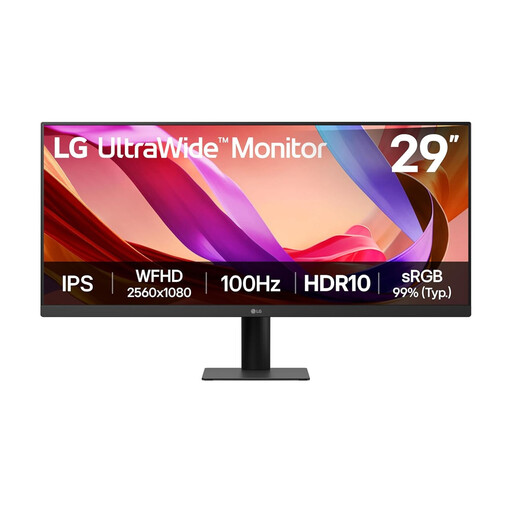 Image unavailable
LG UltraWide 29U511A 29-inch IPS monitor
Consider the smaller screen if fitting an ultrawide into the available desk space matters more than having the canvas of a 49-inch model.
The named variant is a 29-inch UWFHD 1080p IPS monitor with a 100 Hz refresh rate and DisplayPort and HDMI connections. Check its exact screen finish and colour-calibration information if you will use it to judge photos beside the window.
View on Joybuy
Common questions
Will a brighter monitor solve glare from the window?
No: a brightness specification cannot tell you whether direct reflections will be controlled at your desk. The Health and Safety Executive advises arranging the desk and screen to avoid glare or bright reflections, so assess screen position and window coverings before comparing monitors.
Should I choose a 34-inch or a 40-inch ultrawide for a photo gallery?
Choose according to the space your images and tools need, the desk you have and the resolution your computer can drive. The ASUS PA348CGV and BenQ PD3420Q are 34-inch 3440 × 1440 examples; LG’s 39.7-inch 40WP95CP-W offers 5120 × 2160 but needs a larger position on the desk.
Does factory calibration mean I will never need a calibrator?
No: factory documentation describes the model’s stated calibration, not a permanent match to every software and output workflow. If controlled colour output matters, check how your applications manage colour and what calibration method the monitor supports; LG says the hardware calibrator for its 40WP95CP-W is sold separately.
What should I check before using one USB-C or Thunderbolt cable?
Confirm that your laptop and cable support the monitor’s required video connection, that the laptop can drive its resolution and that the available charging power meets your needs. Manufacturer specifications state 65 W power delivery for the BenQ PD3420Q, 90 W for the ASUS PA348CGV and Dell U3425WE, and up to 96 W for the LG 40WP95CP-W; those figures alone do not establish compatibility with your laptop.


