Colour-conscious album proofers
If you judge photographic spreads on screen, look for colour-space and calibration information that relates to your editing and output workflow, rather than relying on a wide-gamut label alone.


Choose a 40-inch-class 5120 × 2160 ultrawide if you need to view an album spread alongside editing tools; a 34-inch 3440 × 1440 screen is an alternative when that workspace is sufficient and a smaller display suits the desk. For photographic review, check the exact model’s colour specifications and your colour-managed workflow. At a shared desk, also confirm physical fit and how each computer and its peripherals will connect.
If you judge photographic spreads on screen, look for colour-space and calibration information that relates to your editing and output workflow, rather than relying on a wide-gamut label alone.
If computers or users take turns at the desk, check their video connections, any laptop charging requirement and whether attached USB peripherals need to switch between computers.
If you want a spread and supporting tools visible together, compare a 34-inch 3440 × 1440 workspace with a 40-inch-class 5120 × 2160 workspace, then measure the available desk space.
Choose it when: A 5120 × 2160 canvas matters for viewing a spread while keeping editing controls visible; Dell’s U4025QW and LG’s 40U990A-W are model-specific examples.
Allow for: The larger screen’s desk footprint and the need to confirm that the computer and connection support the intended resolution.
Choose it when: A 3440 × 1440 canvas is sufficient and switching USB peripherals between compatible computers matters; BenQ lists a KVM switch for the PD3420Q.
Allow for: Fewer native pixels for the spread and surrounding tools than on the cited 5120 × 2160 models.
| Concern | What to check | Who this matters to |
|---|---|---|
| Spread workspace | Compare native resolution with the space your spread and tools need; check computer output and desk dimensions. | If I keep page thumbnails or editing controls beside a full spread, the usable canvas comes first. Around 42% of consumers would put workspace ahead of their other needs. |
| Colour-managed review | Check the exact model’s named colour spaces, calibration information and fit with your editing and output profiles. | When I use the display to judge photographic layouts, a gamut label alone does not tell me how it fits my workflow. For around 33% of consumers, colour review would be the primary concern. |
| Shared-desk setup | Check each computer’s video and USB-C capabilities, whether USB peripherals must switch, and clearance for the stand or mount. | If different computers use the same desk, I need the connections and screen position to work for each setup. Shared-workstation needs would come first for around 25% of consumers. |
Gamut coverage, an HDR designation and calibration support describe different things. Dell, LG and BenQ list different features for specific models; none of those labels alone establishes a match to a print.
Compare the exact monitor’s documented colour spaces and calibration options with your editing and output workflow, and maintain appropriate colour-management settings throughout.
A 34-inch 3440 × 1440 screen and a 40-inch-class 5120 × 2160 screen provide different native workspaces. Screen size also does not establish whether the stand fits the shared desk.
Check native resolution, measure usable desk width and depth, and confirm that the computer can drive the display at the resolution you intend to use.
USB-C video, laptop charging and switching attached peripherals are distinct requirements. BenQ lists DisplayPort Alt Mode, 65 W USB-C power delivery and KVM switching for the PD3420Q, subject to compatible connected devices and cables.
List each computer, its charging needs and the peripherals that must switch before deciding whether the monitor’s connections meet the workflow.
For regular workplace display-screen users, Health and Safety Executive guidance addresses workstation risk assessment and includes hot-desking. A monitor specification cannot establish suitability for every person using the desk.
Where the shared desk is a workplace workstation, consider the screen’s position and each regular user’s needs as part of the workstation assessment.
Dell’s UK-listed UltraSharp U4025QW is a 39.7-inch curved, 5120 × 2160 option for a large spread-review workspace.
LG’s UK-listed 40U990A-W is a 40-inch-class 5K2K model with Thunderbolt 5; the separately listed 40WP95CP-W has different model-specific features.
BenQ’s PD3420Q is a 34-inch 3440 × 1440 creator-monitor option with documented colour features and KVM switching.
These options include two 49-inch 32:9 screens and a 34-inch ultrawide. Their formats differ from the 40-inch-class 5120 × 2160 route, so compare the space available for your spread, the screen’s fit on the desk and the colour-management requirements before choosing.
 No image available
Consider its 32:9 format if you want a very wide layout for a spread and adjacent material, and have room for a 49-inch screen.
The listed variant has a curved QD-OLED display, an 1800R curve and 240 Hz refresh rate. Check its native workspace against your page layout, and confirm the colour workflow and device-switching arrangement you need.
 No image available
Its wide, relatively shallow 5120 × 1440 workspace may suit a side-by-side layout if it gives your spread enough vertical room and fits the desk.
The listed variant has a 165 Hz VA panel, two HDMI 2.1 inputs and two DisplayPort 1.4 inputs. Confirm the colour-space and calibration features your review requires, along with any need to switch USB peripherals.
 No image available
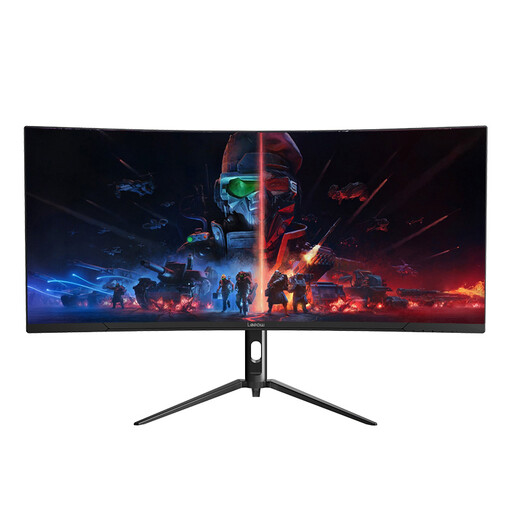
Consider this 21:9 option if a 34-inch, 3440 × 1440 workspace leaves enough room for your spread and editing tools.
The listed variant has a 165 Hz refresh rate. For colour-managed review or a shared-computer setup, check the required colour specifications, connections and peripheral-switching behaviour before buying.
Choose by the native workspace your spread and tools require, then check desk fit. Dell UK and LG UK list 5120 × 2160 models in the 40-inch class, while BenQ lists the 34-inch PD3420Q at 3440 × 1440; diagonal size alone does not describe how much layout space you can use.
Check both computers’ video outputs and decide whether their USB peripherals need to switch with the display input. BenQ lists KVM switching, USB-C DisplayPort Alt Mode and 65 W USB-C power delivery for the PD3420Q, but the intended functions still require compatible devices and cables.
For workers who regularly use display-screen equipment as a significant part of their normal work, Health and Safety Executive guidance calls for employers to assess workstation risks and includes hot-desking. Consider the whole workstation and each regular user’s needs; choosing a larger monitor does not replace that assessment.
Arrange an appropriate electrical-equipment collection route rather than treating the monitor as ordinary rubbish. Ask the seller about take-back arrangements and check the collection options available to you; GOV.UK publishes waste electrical and electronic equipment guidance for manufacturers, importers and distributors, including retailers.