Who this setup suits

Timeline-first video reviewers

If you keep a long timeline open beside a preview, bins or notes, an ultrawide lets you arrange those areas without a bezel between them. You still need to decide whether an adjacent window can replace a physically separate screen.

Colour-conscious creative reviewers

If you assess footage or graphics against a defined delivery colour space, look beyond screen size and an HDR label. Check the exact model’s colour modes and how it fits your calibration and colour-management workflow.

Laptop-based dual-workspace users

If one cable is meant to connect your laptop to the editing workspace, check video output, the required resolution and refresh rate, and charging separately. Apple Support notes that external-display support varies by Mac model; other computers also require a model-specific check.

What matters when choosing

40-inch 5120 × 2160 ultrawide

Choose it when: the timeline, preview and companion work area all need space on one continuous desktop.

Accept: a larger screen and a more demanding computer-and-connection check than for a 34-inch 3440 × 1440 setup.

34-inch 3440 × 1440 ultrawide

Choose it when: you want a continuous timeline beside other windows but do not need as much vertical workspace.

Accept: more competition for space between the preview, timeline tracks and controls.

Two separate displays

Choose them when: the second application needs a separate screen, position or orientation.

Accept: a bezel between work areas and the need to check support for both external displays.

Concern What to check Who this matters to
Editing space Compare native resolution and usable desk dimensions; decide whether the second area must be a separate display. I want the timeline, preview and another work area visible without constantly rearranging windows. Around 42% of consumers put that workspace need first.
Colour review Match the exact model’s sRGB, Rec.709 or P3 modes and calibration options to the delivery workflow. When judging footage against a delivery colour space, I need more than a wide-gamut label. For around 33% of consumers, dependable colour review is the primary concern.
Laptop connection Check the computer’s display limits, the port and cable’s supported mode, and whether monitor charging meets the laptop’s needs. I need my laptop to show the intended workspace through the connection I plan to use, with charging if required. Connection and charging come first for around 25% of consumers.

Buying pitfalls

  • Assuming any USB-C port will run a 5K2K screen

    A connection alone does not establish that the computer, cable and monitor can use your intended resolution, refresh rate and charging arrangement.

    Check the exact computer’s external-display specification alongside the monitor input and the cable or dock specification. Dell’s connectivity guidance also makes device compatibility relevant to Thunderbolt display features.

    Your planned setup may require a compatible cable, dock or adapter.

  • Treating wide gamut or HDR as a colour-accuracy guarantee

    Colour-space coverage, HDR capability and calibration describe different things; none alone establishes that a monitor matches your editing and delivery workflow.

    Check the model’s documented colour modes against the footage and delivery standard, then decide how you will calibrate and profile the display.

    Repeatable colour review may require calibration equipment or professional calibration.

  • Measuring only the screen diagonal

    An ultrawide also needs sufficient desk depth, stand clearance and support for its weight. Those requirements matter particularly if you plan to use a monitor arm.

    Measure usable desk width and depth, then check the exact monitor’s dimensions, stand footprint, weight and mounting specification.

  • Replacing two independently positioned screens with one panel

    An ultrawide removes the bezel between adjacent windows, but its work areas cannot be positioned or oriented independently like two physical displays.

    Decide whether the second application only needs room beside the timeline or needs a screen of its own before choosing the layout.

Relevant brands to consider

Dell UltraSharp

The Dell UltraSharp U4025QW is a 39.7-inch 5120 × 2160 example for a continuous timeline and second work area.

  • Dell UK lists a 120 Hz maximum refresh rate for this model; its specifications also identify colour-space coverage and an adjustable stand.
  • Check the exact computer, connection and desk fit before relying on its native display mode. U4025QW specifications do not describe every UltraSharp model.

LG UltraFine

The LG UltraFine 40U990A-W is another 40-inch 5120 × 2160 route for keeping video work on one screen.

  • LG UK lists a 5120 × 2160 Nano IPS Black panel for the 40U990A-W, along with Thunderbolt 5.
  • Confirm your computer’s supported output mode and the colour-management requirements of the footage; resolution alone does not settle either question.

BenQ DesignVue

The BenQ DesignVue PD3420Q represents the more compact 34-inch 3440 × 1440 creative-monitor route.

  • BenQ UK lists 100% sRGB and Rec.709 coverage, 98% P3 coverage, KVM switching and picture-by-picture for the PD3420Q.
  • Its 1440-pixel vertical resolution leaves less pixel space for a preview and controls than a 5120 × 2160 screen; assess colour modes within your own workflow.

Ultrawide monitors on Joybuy

These models offer a continuous screen for a video timeline and adjacent windows. The selection includes 34-inch ultrawides and wider 49-inch screens; the 49-inch models listed here have 1440 vertical pixels, so they are not substitutes for the vertical workspace of a 5120 × 2160 display.

Acer X Predator X49X curved ultrawide monitor

Acer X Predator X49X 49-inch curved QD-OLED monitor

Consider its broad, continuous screen if horizontal room for a timeline and adjacent windows is the priority. The product title specifies a 32:9 format and 240 Hz refresh rate; check the exact native output mode with your computer and allow for the 49-inch screen’s desk and mounting requirements.

Joybuy

LG UltraGear 34GX900A-B OLED monitor

LG UltraGear 34GX900A-B 34-inch OLED monitor

This 34-inch WQHD model suits a continuous timeline beside companion windows when a larger 40-inch workspace is unnecessary. Its product title specifies 240 Hz; confirm your computer’s supported mode, and check LG’s OLED screen-care guidance if static timeline controls will stay visible for long periods.

Joybuy

Lenovo R34w-30 34-inch ultrawide monitor

Lenovo R34w-30 34-inch UWQHD monitor

Its 34-inch ultrawide format is an option for placing a video timeline beside another application. Check its exact input modes against your computer, and confirm the colour mode and calibration approach if you will judge footage for a particular delivery standard.

Joybuy

CRUA 49-inch curved ultrawide monitor

CRUA 49-inch curved 5120 × 1440 monitor

The 32:9 screen offers a wide continuous area for a timeline and other windows, while its 1440-pixel height is lower than that of a 5120 × 2160 display. The product title specifies 165 Hz, HDMI 2.1 and DisplayPort 1.4; verify your computer’s supported mode and the desk or mount’s capacity.

Joybuy
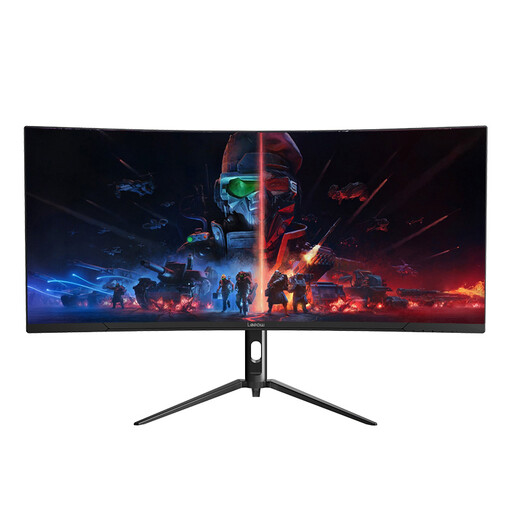
Lepow HC-SJ34MZ5 curved ultrawide monitor

Lepow HC-SJ34MZ5 34-inch curved monitor

This 3440 × 1440 ultrawide is a one-screen option for a timeline with adjacent application windows. The product title specifies 165 Hz; check the supported connection mode and the colour-management features you need before using it for footage review.

Joybuy

Frequently asked questions

Can one ultrawide replace two monitors for video review?

It can replace their adjacent work areas if you want a timeline and another application on one continuous desktop. It cannot give those areas independent physical positions or orientations, so keep two displays when that separation is part of your workflow.

Will a USB-C laptop run and charge from a 5K2K ultrawide?

Only if the particular laptop, monitor connection and cable support the display mode you need, and the monitor’s power delivery meets the laptop’s charging requirement. Check the laptop maker’s external-display limits and USB-C video capability rather than relying on the connector shape; Apple Support notes that Mac external-display support varies by model.

Do I need a wide-gamut screen to review an editing timeline?

Not merely to view or arrange the timeline. For colour-sensitive review, match the monitor’s documented sRGB, Rec.709 or wider-gamut modes to your footage, delivery target and colour-managed software workflow; a gamut figure alone does not establish accuracy.

How do I arrange the second work area?

On one ultrawide, arrange the timeline and companion windows side by side; Microsoft Support describes Snap for arranging windows in Windows. If you choose two physical displays, use an extended desktop rather than mirroring when each screen needs different content; Apple Support documents that option for Mac.