For checking detailed maps, start with native resolution rather than diagonal size: a 5120 × 2160 5K2K screen gives you more vertical pixels than a 5120 × 1440 Dual QHD screen. A 49-inch 32:9 model makes more sense when the physical breadth of a side-by-side map and dashboard layout matters more; whichever format you choose, check your computer’s display output and the space available on your desk.
Who these monitors suit
Fine-detail map reviewers
If you inspect dense labels, boundaries, contours or imagery, vertical map space may matter more than the screen’s diagonal measurement. The 5120 × 2160 format listed by Dell UK and LG UK is a useful starting point when comparing the area available for a map and its tools.
Multi-window GIS and dashboard users
If a map stays open beside layers, a browser or a dashboard, decide whether you need more map height or a broader physical layout. Samsung UK describes its 49-inch G91F as a 32:9 screen and lists Picture-by-Picture for viewing separate inputs.
Laptop-centred desk workers
If you want the monitor to connect a laptop, charge it and handle desk peripherals, check the exact input and your laptop’s supported display mode. Dell UK lists USB-C DisplayPort Alt Mode and up to 90 W power delivery for the U4025QW; the Lenovo ThinkVision P40WD-40 listing specifies Thunderbolt 4 and up to 140 W.
What matters when choosing
Choose the screen format around your main task, then check whether your computer and desk can accommodate it.
40-inch 5K2K
Choose it when: Map height, labels and room for vertically arranged tools take priority; the Dell and LG 5K2K models listed for the UK have 5120 × 2160 native resolution.
Account for: A large screen and a 5120 × 2160 display mode that your computer and chosen connection must support.
49-inch 32:9 Dual QHD
Choose it when: You mainly want a broad physical layout for a map beside dashboards or other windows; Samsung UK lists its G91F at 5120 × 1440.
Account for: Its 1,440 vertical pixels provide less map height than 5K2K’s 2,160, and the screen needs ample desk space.
| Concern |
What to check |
Who this matters to |
| Map detail and height |
Compare native vertical resolution and check that your computer can output the chosen mode. |
If small labels and stacked map tools are central to my work, I need enough vertical canvas to inspect them comfortably. Around 37% of consumers put map detail and height first. |
| Laptop connection |
Match the laptop’s display output to the monitor input and cable; check the required charging wattage separately. |
For a laptop-based desk, I want the display connection and charging arrangement to work with my computer. Roughly 27% of consumers make laptop connectivity their primary concern. |
| Side-by-side work |
Compare aspect ratio and native resolution, rather than diagonal size alone, for your intended window layout. |
When a dashboard or reference window must stay beside my map, I value a broad layout over extra map height. Around 18% of consumers prioritise this side-by-side workflow. |
| Desk fit and position |
Measure desk width, depth and stand footprint; check the available height adjustment or mounting option. |
On a desk with limited space, I need to place a large screen at a comfortable distance without twisting to use it. Approximately 18% of consumers put desk fit and positioning first. |
Buying pitfalls
-
Choosing by diagonal size alone
A physically wider screen does not necessarily give a map more height. LG UK lists its 5K2K model at 5120 × 2160, while Samsung UK lists the 49-inch G91F at 5120 × 1440.
Compare both dimensions of the native resolution, then decide whether map height or the physical breadth of your window layout is more important.
-
Assuming any USB-C connection will do
Display output and laptop charging depend on the particular monitor input and computer. Dell UK specifies USB-C DisplayPort Alt Mode and up to 90 W power delivery for the U4025QW; Thunderbolt 4 and up to 140 W are listed for the Lenovo P40WD-40.
Check the laptop, monitor port and cable together for your intended resolution, refresh rate and charging requirement.
-
Overlooking the desk setup
A large curved screen needs enough space to sit at a sensible viewing distance. The Health and Safety Executive advises placing a screen directly in front of you, about an arm’s length away, with its top around eye level.
Measure desk depth and width, the stand footprint and any mounting requirements before ordering.
If the supplied stand cannot achieve that position, a suitable monitor arm or a change to the workstation may be needed.
-
Letting gaming specifications decide a map-work purchase
Refresh rate, HDR and response-time figures describe different attributes from native resolution, usable map height and desk fit. They do not establish which monitor will suit detailed map inspection.
Set your requirements for resolution, connection and placement first; consider gaming features separately if you also plan to use them.
Relevant brands to consider
Dell
The UltraSharp U4025QW is a 5K2K option for map-focused workstations that also need a USB-C hub.
- Dell UK lists a 39.7-inch IPS Black panel, 5120 × 2160 at 120 Hz, stand adjustment, USB-C DisplayPort Alt Mode and up to 90 W power delivery.
- Check that your computer and chosen connection support the native display mode.
LG
The UltraFine 40U990A-W offers a 5K2K format for buyers prioritising a wide, high-resolution canvas.
- LG UK lists a 40-inch 5120 × 2160 Nano IPS Black display and Thunderbolt 5.
- LG’s positioning for precision visual work is not a substitute for checking your mapping software, computer output and preferred text scale.
Lenovo
The ThinkVision P40WD-40 is a 5K2K workstation option for buyers who also need desk-hub connections.
- Listed specifications include 5120 × 2160 at 120 Hz, Thunderbolt 4, KVM switching, Ethernet and up to 140 W USB Power Delivery.
- Confirm the exact sales configuration and your computer’s connection support before choosing it.
Samsung
The Odyssey G91F illustrates the 49-inch 32:9 route for a map alongside other applications.
- Samsung UK lists a 5120 × 1440 curved display with Picture-by-Picture and Picture-in-Picture features.
- Its 1,440-pixel vertical resolution is lower than the 2,160 pixels of the 5K2K models discussed here.
Joybuy ultrawide monitors
These models offer 49-inch 32:9 and 34-inch 21:9 layouts to consider when a map needs to share the screen with other windows. Weigh their formats against your need for vertical map space and check compatibility before purchasing.
 No image available
Acer Predator X49X 49-inch curved QD-OLED monitor
Consider its broad 32:9 layout if keeping a map beside other windows matters more to you than maximising vertical map space.
- The product title specifies a 1800R curve, Double Quad HD and 240 Hz.
- Check that your computer can drive the display mode you intend to use and that the screen will fit at a suitable viewing distance.
View on Joybuy
 No image available
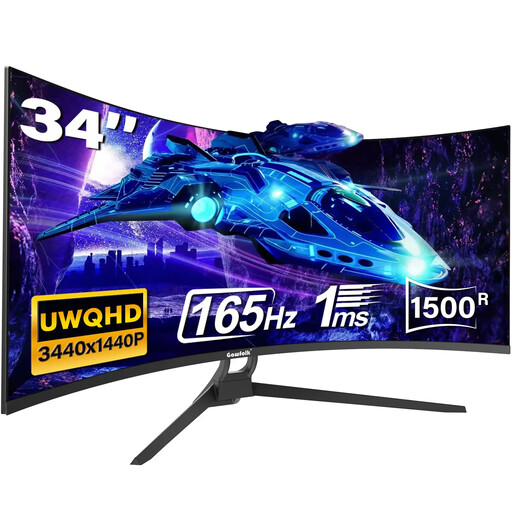
Gawfolk 34-inch UWQHD curved monitor
Consider this 21:9 format if you want an ultrawide layout for a map and another window, while comparing its native resolution with 5K2K if fine map detail is your priority.
- The product title specifies a 1500R curve and 165 Hz.
- If you need a Type-C input, confirm it for this particular monitor before ordering; also check whether its stand can achieve your preferred screen position.
View on Joybuy
Frequently asked questions
Is a 49-inch Dual QHD monitor better for detailed maps than a 40-inch 5K2K monitor?
Choose the 5K2K format when vertical map space is your priority: the models discussed here have 2,160 vertical pixels, compared with 1,440 on Samsung UK’s 49-inch Dual QHD G91F. The 32:9 format is worth considering when a broad physical layout for side-by-side applications matters more.
What connection should I check before buying a 5K2K ultrawide?
Check that your computer, monitor input and cable support the native resolution and refresh rate you intend to use. USB-C alone does not establish which display mode or charging level will work: Dell UK lists USB-C DisplayPort Alt Mode for the U4025QW, while the Lenovo P40WD-40 listing specifies Thunderbolt 4.
How much desk space does a large ultrawide need?
Measure against the dimensions and stand footprint of the specific monitor, leaving enough depth to position it comfortably. The Health and Safety Executive advises placing a screen directly in front of you, about an arm’s length away, with its top around eye level.


