
24/7 Customer Support

Free returns

Same-day & Next-day Delivery

Quality Guaranteed

Unlock Your Welcome Offers: FREE Delivery | Up to 80% OFF | Free 30-day JoyPlus trial
Download the APP
Struggling to see what’s at the back of your kitchen cabinets? Fumbling for a switch in a dark wardrobe? You are not alone. Many UK homes have corners that could do with a bit more light, but the thought of hiring an electrician for a complex wiring job can be off-putting.
This is where the modern under cabinet motion sensor light comes in. These simple, wire-free devices offer an effective and affordable way to brighten up dim spaces. As the Joybuy Product Recommendation Officer, my role is to help you navigate the options. This guide will walk you through the key features to consider and present a few recommended models that deliver on convenience and performance.
Before you choose, it helps to understand a few key features. Focusing on these will ensure you find a light that fits your space and lifestyle perfectly.
The power source is a major point of difference. While some battery operated under cabinet lights use disposable AA or AAA batteries, many newer models feature a built-in rechargeable battery.
Rechargeable under cabinet lighting typically uses a standard USB-C port, meaning you can charge it with the same cable you use for your phone or tablet. This approach is often more cost-effective over time and reduces battery waste. A single charge can last for weeks or even months, depending on how frequently the light is activated.
Ease of installation is the main appeal of these lights. Most operate on a simple two-part system: a thin mounting strip and the light unit itself.
This combination means no drills, no screws and no damage to your surfaces, making it an ideal solution for renters and homeowners alike.
Consider where you need light. A small, 20cm light might be perfect for a single cupboard or a deep drawer. For a standard motion activated wardrobe light, a 30cm or 50cm model might provide better coverage. If you want to illuminate a long kitchen counter, you could place several lights side-by-side for a seamless effect. The goal is to match the light's length to the area you want to illuminate.
Here are a few motion sensor lights that stand out for their design, features and practicality.
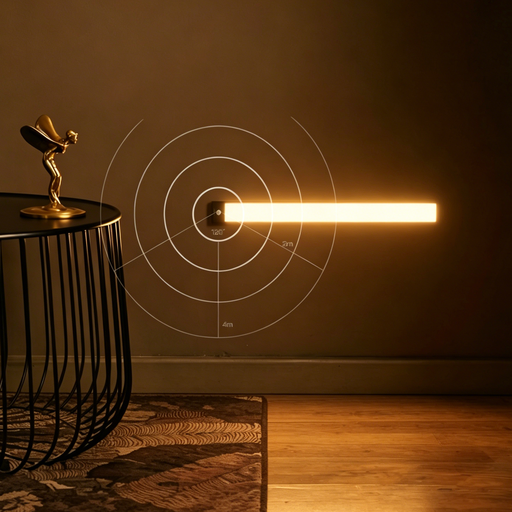
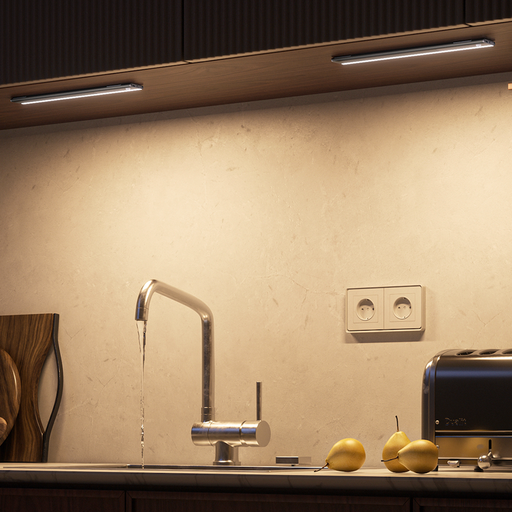
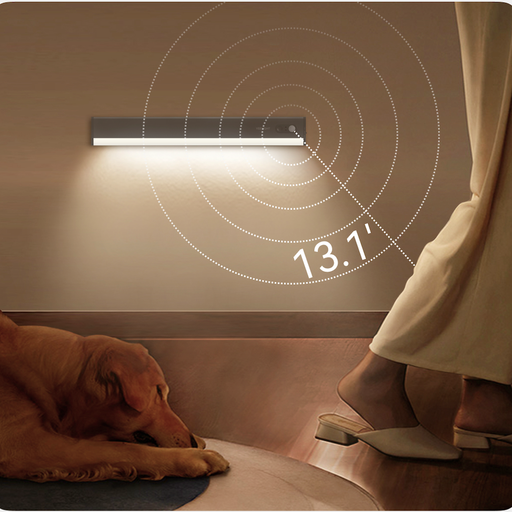
These motion-activated strip lights are a fantastic solution for adding light without complication. However, they are just one type of lighting. If you are considering different styles, such as ceiling fixtures, wall sconces or decorative lamps for your corridors and entryways, other options may be more suitable.
To see a wider variety of fixtures, you can explore our full range of hallway lighting.
Most of these lights use a Passive Infrared (PIR) sensor. This sensor detects the infrared energy (body heat) emitted by people moving within its detection range. When you walk past, it triggers the light to turn on. To save power, a built-in light sensor usually keeps the light from activating during the day or when the room is already bright.
This depends heavily on usage. If placed in a high-traffic area like a main hallway, you might need to recharge it every few weeks. In a rarely opened closet, a single charge could last for several months. Most models will provide weeks of use under typical conditions (activating a few times per day) when left in "Auto" mode.
Yes, absolutely. The primary benefit of these lights is their tool-free installation. They come with a mounting plate that has a strong adhesive backing. You simply peel and stick this plate onto the desired surface. The light bar itself then attaches to the plate magnetically, making it easy to remove for charging and re-attach afterwards.