
24/7 Customer Support

Free returns

Same-day & Next-day Delivery

Quality Guaranteed

Unlock Your Welcome Offers: FREE Delivery | Up to 80% OFF | Free 30-day JoyPlus trial
Download the APP
An under counter fridge can solve a difficult space problem in a kitchen, utility room, office or studio flat. However, compact appliances are not automatically simple purchases. A model may fit beneath a worktop but still be unsuitable because of its door swing, ventilation needs, storage layout or installation method.
Before comparing prices, watch for these common buying pitfalls.
A built-under fridge is designed to sit beneath a worktop and may be concealed behind a matching furniture door. A freestanding under counter fridge has its own finished exterior and should not normally be enclosed tightly inside kitchen cabinetry.
Some integrated models also use sliding or fixed hinges, so the cabinet door must be compatible. Always check the installation diagram, required niche size and door-fixing system rather than relying on the phrase “under counter”.
The stated height is important, but it is not the only measurement that matters. Check:
A standard-looking 60 cm gap may not accommodate every under-counter refrigerator. For example, the Bosch KUR21VFE0G measures 820 x 598 x 548 mm, while the Comfee RCD92 models measure 827 x 445 x 470 mm.
The advertised litre figure may include shelves, door balconies, drawers and cooler compartments. A fridge with a smaller total capacity can still be practical if its interior is well organised, while a larger model may waste space through an awkward layout.
Check whether you need a pure larder fridge, a compact fridge with an icebox or a model with a separate cooler zone. An icebox is useful for limited frozen storage, but it is not a substitute for a full freezer.
Choose a freestanding under counter fridge if you want flexible placement, a visible finished cabinet and easier relocation. This can suit renters, students, offices and secondary kitchens.
Choose an integrated under counter fridge when you want a consistent fitted-kitchen appearance. Confirm the furniture-door dimensions, hinge style and ventilation requirements before ordering. Built-under appliances generally sit directly on the floor below the worktop, whereas some integrated appliances are fitted inside a cabinet housing.
For one person, an office or occasional drinks storage, around 80–100 litres may be sufficient. Couples and small households may prefer approximately 120–140 litres, while heavy fresh-food users may need more.
Useful storage features include:
A tall integrated larder fridge is a different category from an under-worktop appliance. Models such as the Midea MDRE423FGE01D and Bosch KIR81NSE0G are approximately 177 cm tall and require tall cabinet housing.
Current UK appliances use the A to G energy label, with E-rated fridge models commonly available in this category. The label should be used to compare annual energy consumption in kWh, not just the letter rating. Your actual running cost depends on the appliance, electricity tariff, room temperature, usage and ventilation.
Noise is measured in decibels, written as dB(A). A rating around 35–40 dB(A) may be more suitable for open-plan kitchens, bedrooms or offices than a louder appliance.
Also check the defrost system. Static fridges may require manual defrosting, while auto-defrost or frost-free designs can reduce maintenance. Follow the supplied instructions, keep ventilation openings clear and connect the appliance to a correctly earthed UK socket.
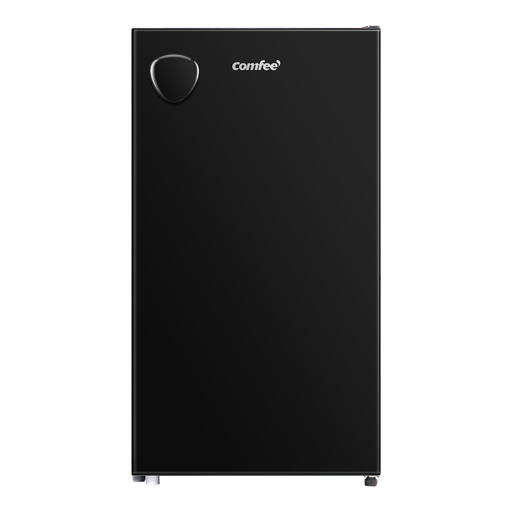
Why This Fits Their Persona: Its compact 445 mm width suits rented rooms, home offices, bedrooms and studio flats where a full-sized appliance would take up too much space.
The freestanding format avoids the need for a matching cabinet door, while its reversible door and adjustable feet help with practical placement.
88-litre capacity, removable glass shelves, interior light and a dedicated cooler zone.

Why This Fits Their Persona: It suits homeowners creating a fitted kitchen appearance while prioritising organised fresh-food storage beneath the worktop.
Its specified built-under format, recessed plinth ventilation and 820 mm height make installation planning clearer than choosing a generic compact fridge.
134-litre capacity, 35 dB noise rating, adjustable safety-glass shelves and a MultiBox XXL drawer.

Why This Fits Their Persona: The 170-litre fresh-food capacity is suitable for larger households, frequent shoppers, utility rooms or homes needing a secondary larder fridge.
Its clear larder-fridge specification avoids paying for an icebox when the priority is additional chilled storage.
170-litre net capacity, three fixed glass shelves, a large crisper drawer and reversible door.
We have compiled a complete, real-time list of products that fully satisfy these strict selection criteria and UK safety regulations.
No. Confirm the appliance height, width, depth, ventilation clearance and door-opening space first. Integrated models also need compatible cabinetry and furniture-door fittings. A freestanding model should not be enclosed without following the manufacturer’s installation instructions.
Lifespan varies according to construction, usage, ventilation, cleaning and maintenance. Keeping the condenser and ventilation areas clear, avoiding overloading and checking the door seal can support efficient operation. Always follow the manufacturer’s care instructions and warranty terms.
The E rating provides a standardised comparison, but it does not give a fixed household cost. Check the annual kWh figure on the energy label and multiply it by your electricity tariff for an approximate yearly running cost. A correctly levelled appliance with clear ventilation may also operate more efficiently than one installed in a cramped space.