
24/7 Customer Support

Free returns

Same-day & Next-day Delivery

Quality Guaranteed

Unlock Your Welcome Offers: FREE Delivery | Up to 80% OFF | Free 30-day JoyPlus trial
Download the APP
By Joybuy Product Recommendation Officer
An under desk treadmill can make it easier to increase daily movement without travelling to a gym. For people working from home, living in a flat, or looking for low-impact exercise, a walking pad treadmill offers a practical way to walk while working, watching television or completing short fitness sessions.
However, product listings can make similar machines appear more capable than they are. A compact frame may not provide enough walking space, a “quiet” motor may still be noticeable in a shared room, and an advertised incline may be manual rather than motorised. Checking the specifications carefully helps prevent an unsuitable purchase.
A slim treadmill is convenient for storage, but the running belt may also be shorter or narrower. This can feel restrictive, particularly for taller users or anyone walking at a quicker pace. Check the usable belt dimensions, not only the overall product size.
Also measure the space around your desk. A treadmill for home office use needs sufficient clearance behind and beside the belt, as well as room to step off safely.
Noise can come from the motor, belt movement, footwear and the floor beneath the machine. A product described as quiet may still transmit vibration through laminate flooring or floors in flats.
Look for a stated noise level where available, but also consider using a protective mat and placing the machine on a stable, level surface. For video calls, a lower walking speed is generally more practical than trying to walk quickly while typing.
A treadmill with incline may sound attractive, but check whether the incline is manual or automatic. Similarly, a treadmill with remote control is useful for adjusting speed from a desk, but it does not replace a safety key, suitable clearance or careful positioning.
Think about your main use first: light walking during meetings, daily step tracking, brisk exercise or occasional jogging. A higher top speed is not necessarily useful if the machine will remain under a desk.
For a compact treadmill for home use, compare both the walking surface and the external dimensions. A slim unit may fit beneath a sofa or standing desk, while a model with handles may require more floor space when set up.
For example, the Lichico under-desk walking treadmill measures 120 x 50 x 10.5 cm and has a listed 130 kg maximum capacity. This makes its footprint relevant where space is limited, but buyers should still confirm that the belt dimensions suit their stride.
Never rely on appearance when judging capacity. Check the manufacturer’s stated maximum user weight and leave a sensible margin rather than operating at the limit. The Lichico model above uses a steel frame and rubber belt, while other models may use alloy steel or additional support structures.
The capacity should also reflect how the treadmill will be used. Regular brisk walking creates different demands from occasional slow walking, and jogging usually requires a more substantial frame and longer running surface.
A typical electric walking treadmill designed for desk use may have a moderate speed range. The CITYSPORTS PRO, for instance, is listed at 1–6 km/h, with an LED display, remote control and cushioned belt. This range is suited to walking rather than fast running.
Cushioning can make the surface feel more comfortable, but descriptions such as “joint protection” should not be interpreted as a medical guarantee. Check the construction details instead, such as belt layers, shock absorbers and rubber pads. Users with specific health concerns should seek suitable professional advice before starting a new exercise routine.
Incline adds intensity but can affect stability and desk posture. If you want a treadmill with incline, confirm the incline percentage, adjustment method and whether the feature is compatible with under-desk use.
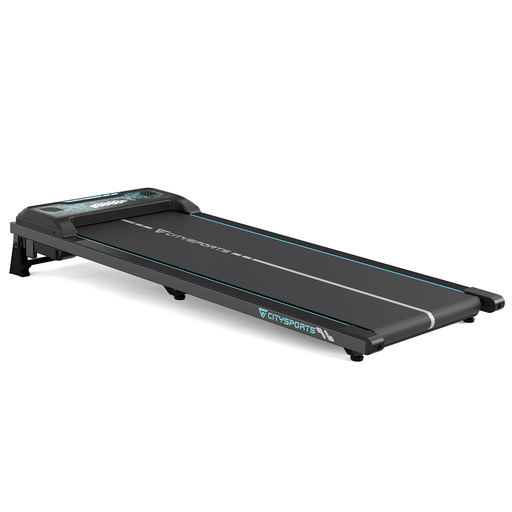
Why This Fits Their Persona: A straightforward option for beginners who want an electric walking treadmill for home or office use without assembly. Its 1–6 km/h range supports everyday walking and step-count routines.
The listing states the speed range, 120 kg maximum capacity, remote control and cushioned belt, making the core limitations easier to check before purchase.
No assembly is listed; transport wheels, an LED display, remote control and a safety key are included features.
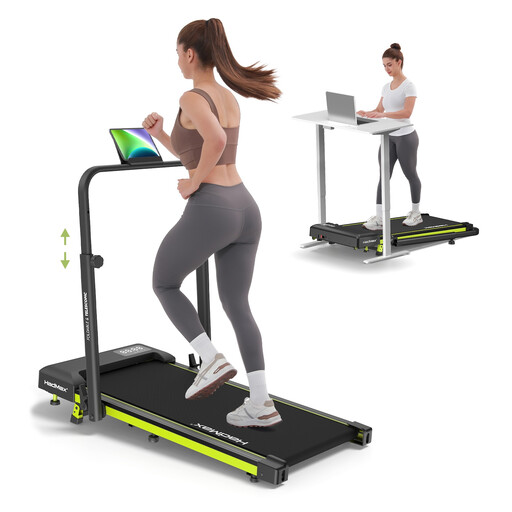
Why This Fits Their Persona: Suitable for users who want more support than a flat walking pad provides, particularly in a home gym or office where balance and posture are priorities.
The listing identifies a 45 dB operating figure, a 300 lb capacity and a folding handrail, rather than relying only on general “quiet” or “portable” wording.
It includes a 35.4 x 15.7-inch running area, adjustable two-level handrail, 7-layer belt and front transport wheels.
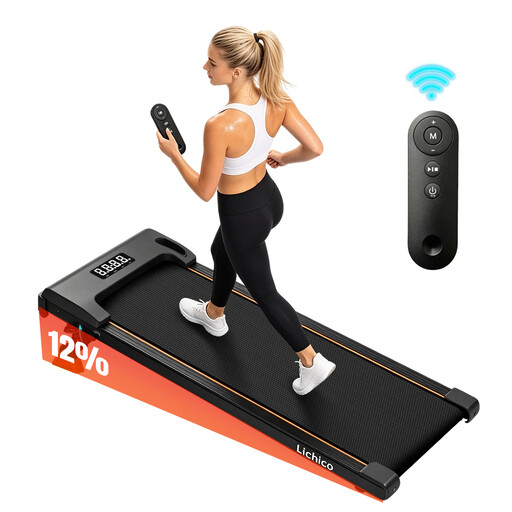
Why This Fits Their Persona: A match for users who want to add incline work to indoor walking and have a listed 130 kg capacity for regular home exercise.
Its product title specifies a 9% incline and 130 kg capacity, helping buyers focus on measurable requirements rather than vague intensity claims.
The listed features include remote control operation, an incline function and under-desk walking format.
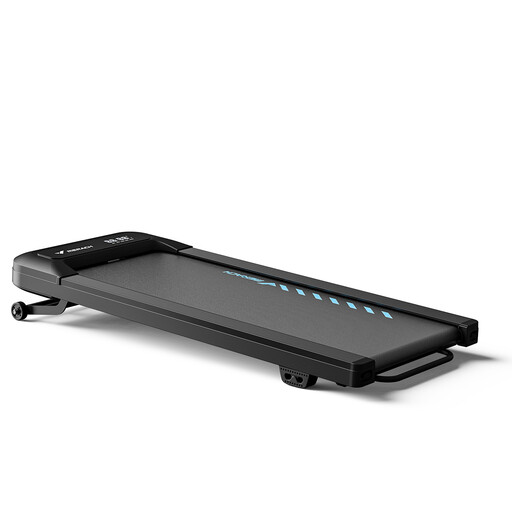
Why This Fits Their Persona: Designed for home-office users who want a quiet treadmill with remote control, incline adjustment and app-connected tracking options.
The listing gives a stated noise level under 45 dB and identifies the incline as automatic, rather than leaving the adjustment method unclear.
It has a 1–6 km/h speed range, 9% automatic incline, 5-layer anti-slip belt, transport wheels and listed dimensions of 124 x 53 x 16.5 cm.
We have compiled a complete, real-time list of products that fully satisfy these strict selection criteria and UK safety regulations.
Place the machine on a flat, stable surface and keep the safety area specified in the user manual clear. Keep children and pets away, use suitable trainers, and do not exceed the stated weight capacity. A remote control should be stored where it can be reached quickly, while a safety key should be used whenever supplied.
Running costs depend on motor power, session length and electricity tariffs. To estimate electricity use, multiply the treadmill’s power consumption in kilowatts by the hours used, then multiply by your tariff. Walking at a lower speed may use less electricity than faster exercise, but the exact figure varies by user weight, incline and motor load.
Clean the belt regularly, check alignment and tension, inspect the power cable and lubricate the belt according to the manual. These steps can help maintain smooth operation and identify wear before it becomes a larger problem.
It can be suitable for light walking while completing tasks that do not require precise mouse control or frequent movement. Begin at a slow speed and ensure the desk height allows a comfortable posture. Avoid walking during tasks that demand full concentration or stable footing.
Lifespan depends on build quality, user weight, frequency of use, belt maintenance and storage conditions. Following the manual, keeping the belt clean and avoiding operation above the stated capacity can support reliable use. Check the warranty and after-sales information before ordering.
They are generally used for short, low-speed sessions, so electricity consumption depends on the model’s motor and your usage pattern. The product’s wattage or power information provides a more useful basis for estimating cost than the speed rating alone.