Small-kitchen leftover planners
If the appliance bay is narrow, check the fridge’s depth and door swing as carefully as its width. The Beko UL4482, for example, is listed by Beko at 47.5 cm wide and 50 cm deep, with a reversible door.


Measure the available width, height, depth and door-opening space before choosing an undercounter fridge for cooked vegetables. A narrow freestanding model suits a tight bay, while a wider model can give containers more room; an integrated fridge is an option only if the cabinet and hinge arrangement match. Whichever format fits, check that you can keep the main fridge compartment at 5°C or below for chilled food, following the practical temperature target in GOV.UK guidance for food businesses.
If the appliance bay is narrow, check the fridge’s depth and door swing as carefully as its width. The Beko UL4482, for example, is listed by Beko at 47.5 cm wide and 50 cm deep, with a reversible door.
Several portions of cooked vegetables need shelf space that works for the containers you use. Capacity matters alongside the shelf layout: Bosch lists 134 L for the KTR15NWEAG, while Hotpoint lists 128 L for the H55R1 112W UK.
An integrated replacement has to suit the existing cabinet opening and furniture door, not merely fit beneath the worktop. Hotpoint identifies the HBUL011.UK as a built-in model with a fixed hinge.
Decide whether the fridge must fit a narrow freestanding space, a wider freestanding space or an existing fitted cabinet; then assess how your containers will fit inside.
Choose when: A narrow standalone appliance is needed. Beko lists the UL4482 at 47.5 cm wide and 50 cm deep.
Trade-off: Its listed 88 L fresh-food capacity leaves less container space than the wider Beko, Hotpoint and Bosch examples discussed here.
Choose when: The measured bay accommodates a wider fridge and several leftover containers need space. Hotpoint lists 128 L for the H55R1 112W UK; Bosch lists 134 L for the KTR15NWEAG.
Trade-off: The larger listed capacities come in cabinets that require more width and depth than the slimline Beko example. Check each model’s full dimensions and clearances.
Choose when: A suitable fitted cabinet and furniture door are already part of the kitchen. Hotpoint lists the fixed-hinge HBUL011.UK at 59.7 cm wide, 81.9 cm high and 54.5 cm deep.
Trade-off: The cabinet opening, ventilation arrangement and hinge system must match the installation instructions; an under-worktop space alone does not establish compatibility.
| Concern | What to check | Who this matters to |
|---|---|---|
| Footprint and access | Measure the bay’s width, height and depth, then allow for the manufacturer’s clearances and the open-door path. | If I cannot open the fridge without obstructing the kitchen, extra internal space will not solve the problem. Around 46% of consumers put physical fit and access first. |
| Container space | Compare chilled capacity and shelf adjustment, then check whether your lidded containers fit the proposed layout. | Batch-cooked portions need room where I can see and reach them rather than stack them awkwardly. Container capacity and organisation come first for around 36% of consumers. |
| Chilled-storage routine | Check how to set and monitor the main fridge compartment at 5°C or below, and whether its interior is practical to keep organised and clean. | When I store cooked vegetables, I want a cold-storage routine I can manage consistently, not a drawer feature presented as a safety guarantee. Around 18% of consumers prioritise that everyday routine. |
A fridge can fit between cabinets but project too far into the room or clash with another door. Beko lists the UL4482 at 50 cm deep, whereas Bosch lists the KTR15NWEAG at 58 cm deep.
Measure depth and height as well as width, then check the model’s ventilation clearances and door-opening path.
The integrated Hotpoint HBUL011.UK uses a fixed hinge; a freestanding fridge has a different installation arrangement. Similar-looking exterior dimensions do not establish that either will work with an existing furniture door.
Check the cabinet niche, ventilation requirements and hinge system against the installation instructions before ordering.
A mismatch can also mean arranging installation work or changing the cabinet.
A drawer can help organise fresh produce, but it does not replace properly chilled storage for cooked dishes. GOV.UK guidance for food businesses recommends setting the fridge to 5°C or below.
Use the main chilled compartment for cooked vegetables, keep the storage routine manageable and follow appropriate cooling, hygiene and food-date guidance.
An energy class on its own does not show how much electricity a particular fridge is listed to use annually or how much chilled space it provides.
Compare the energy label’s annual kWh figure alongside capacity for fridges of a similar type and suitable size.
Beko’s UL4482 is a reference point for a narrow freestanding larder fridge: Beko lists it at 47.5 cm wide, 50 cm deep and 88 L fresh-food capacity.
Bosch’s freestanding KTR15NWEAG offers a listed 134 L chilled capacity in a cabinet measuring 56 cm wide and 58 cm deep.
Hotpoint provides examples of both installation routes: the freestanding H55R1 112W UK has a listed 128 L capacity, while the integrated HBUL011.UK is intended for a compatible fitted cabinet.
These fridges cover narrow freestanding, standard-width freestanding and integrated built-under choices. Match the installation type and your measured space first, then check the main compartment’s temperature controls before relying on a model for cooked-food storage.
 No image available
Consider this built-under model for an existing fitted space where an integrated fridge is needed.
Check the cabinet niche, ventilation and door-hinge requirements before ordering. Confirm that its temperature controls can keep the main compartment at 5°C or below for cooked leftovers.
 No image available
Consider this 88 L freestanding model when the available under-worktop space is narrow and the door-opening direction matters.
The product name identifies a reversible door, removable glass shelves and an adjustable thermostat. Use the main fridge area for cooked vegetables: the listing describes the cooler zone as suitable for short-term cooling only and warns against keeping items there for more than two hours. Check that the main compartment can be maintained at 5°C or below.
 No image available
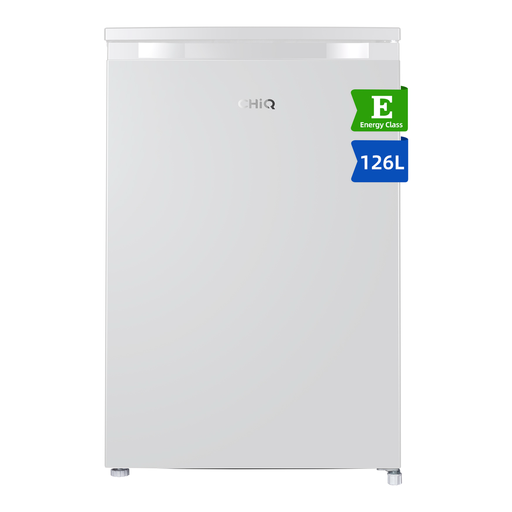
Consider this freestanding model if a 55 cm-wide fridge fits and you need to organise several containers of cooked vegetables.
Its product name lists 126 L capacity. Check the full installation dimensions, door-opening space and usable temperature range before choosing it for the measured bay.
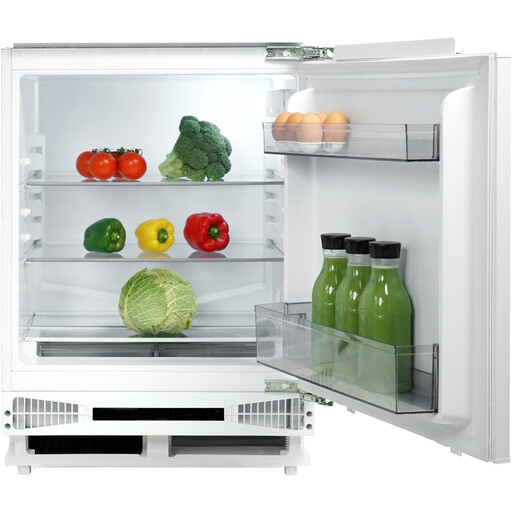 No image available
Consider this 95 L integrated model when replacing a fridge in a compatible built-under cabinet.
The product name identifies an icebox. Manual defrost is specified, so allow for that upkeep. Check the cabinet niche and hinge arrangement, and confirm the main fridge compartment’s usable temperature range for cooked leftovers.
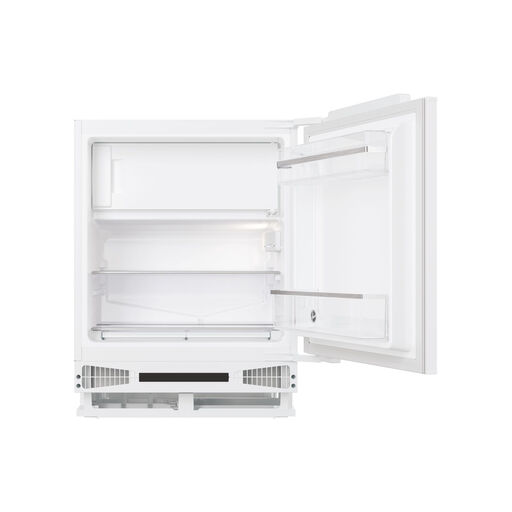 No image available
Consider this integrated model if the existing fitted cabinet can accommodate its installation and furniture-door arrangement.
The product name identifies an icebox. The listing states that the appliance is not frost-free. Check the niche, ventilation and hinge requirements, as well as whether the main fridge compartment can be kept at 5°C or below.
Aim to keep the main fridge compartment at 5°C or below. GOV.UK gives this setting in its chilling guidance for food businesses; it is a useful practical target, not a claim about a specific legal requirement for domestic fridges. Check how the model’s temperature controls can be set and monitored.
No. An integrated fridge also needs to match the cabinet opening, ventilation arrangement and furniture-door hinges. Hotpoint lists the HBUL011.UK as a fixed-hinge built-in model measuring 59.7 cm wide, 81.9 cm high and 54.5 cm deep; check its installation instructions against your cabinet.
Compare the annual kWh figures on their energy labels alongside chilled capacity and installation type. An energy-class letter alone leaves out those differences, which matter when choosing a fridge that fits your space.
No. A drawer helps with organisation, while Low Frost is a manufacturer-described maintenance feature; neither replaces appropriate cooling, chilled storage, hygiene and food-date practices. For cooked vegetables, check the main compartment’s temperature rather than treating a feature name as a food-safety guarantee.