
24/7 Customer Support

Free returns

Same-day & Next-day Delivery

Quality Guaranteed

Unlock Your Welcome Offers: FREE Delivery | Up to 80% OFF | Free 30-day JoyPlus trial
Download the APP
An under counter fridge can solve a genuine space problem, but the wrong model may leave you with inadequate storage, awkward door access or higher running costs than expected. This is especially relevant in UK flats, student accommodation, offices and kitchens where every centimetre matters.
Before choosing a compact fridge, look beyond headline capacity and promotional language. Three common buying traps deserve attention.
“Under counter” does not always mean built-in. A freestanding under counter fridge needs clearance for ventilation and may not fit beneath a low worktop. Check the appliance’s full width, depth and height, including feet, hinges and handle.
Many models are around 82–85cm high, but kitchen worktops and cabinet gaps vary. Measure the available space carefully and leave the ventilation clearance specified in the product instructions.
A larder fridge or freezerless fridge is designed for fresh food and chilled drinks. Some compact models include a small cooler box, but this is not necessarily a freezer compartment. For example, the Comfee 88L models specify that their cooler zone is intended for short-term cooling only and should not hold items for over two hours.
Portable thermoelectric mini fridges are different again. They can cool below room temperature but cannot freeze, making them more suitable for drinks, snacks or skincare than weekly grocery storage.
The UK energy label provides a useful comparison, but actual electricity use depends on room temperature, thermostat settings, ventilation, loading and how often the door is opened. Several products in this guide have an E energy efficiency class. That is an objective label rating, not a guarantee of a particular annual bill.
Where available, compare the stated annual energy consumption in kWh and multiply it by your electricity tariff to estimate the cost. This gives a more practical indication than relying on phrases such as “energy saving”.
Capacity should match how you shop and how many people use the fridge.
Capacity is only part of the decision. Adjustable shelves, crisper drawers and door bins determine how much of that space is convenient to use.
Measure the gap from skirting board to worktop, then check the appliance depth against nearby cupboards and walkways. A reversible door can be particularly useful in a narrow kitchen or studio flat, allowing the hinge side to suit the room layout.
Also check whether the door opens fully without striking a wall. A recessed or removable handle may help in tight spaces, but it does not remove the need to allow opening clearance.
Noise is important when the appliance will be used as an office fridge, bedroom fridge or in an open-plan living space. The CHiQ JKR120DWE is listed at 39 dB, while several other models specify around 40 dB.
Look for a thermostat that suits your routine. A model with seven temperature settings offers more adjustment than one with three. For food organisation, consider whether you need:
Always follow the manufacturer’s instructions for safe food storage, ventilation and temperature settings.
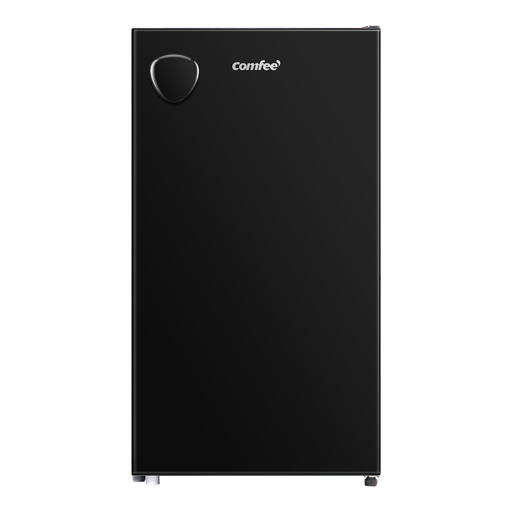
Why This Fits Their Persona: Its 88L capacity and 44.5cm width suit a single occupant, studio flat or small office needing more than a drinks cooler without taking up a full kitchen footprint.
The stated dimensions support careful gap planning, while the reversible door helps avoid awkward access. Its separate cooler zone is clearly intended for short-term cooling rather than frozen storage.
Removable glass shelves, crisper drawer, interior light, adjustable thermostat and adjustable feet.
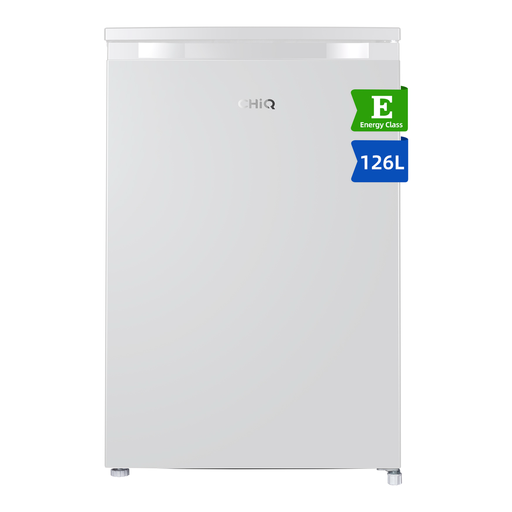
Why This Fits Their Persona: A 126L layout provides practical fresh-food storage for a couple or small household, with a low stated noise level for open-plan kitchens.
The 55cm width and 850mm height are stated clearly for installation planning. Seven temperature controls provide more adjustment than a basic mini fridge.
39 dB operation, two shelves, crisper drawer, three door bins, LED light and a two-year manufacturer warranty.

Why This Fits Their Persona: Its 170L freezerless capacity suits frequent shoppers, shared accommodation, home offices or anyone needing substantial fresh-food storage.
The product is explicitly listed as having no freezer compartment, so buyers can select it for fresh food rather than assuming freezer space is included.
Three fixed glass shelves, a large crisper drawer, reversible door, LED lighting, adjustable feet and a stated 40 dB noise level.
We have compiled a complete, real-time list of products that fully satisfy these strict selection criteria and UK safety regulations.
Place the appliance on a flat, stable surface and use the adjustable feet to level it. Keep ventilation openings clear and avoid positioning the fridge directly beside a radiator, cooker or other heat source. Do not overload shelves, as blocked airflow can affect cooling.
Allow a newly delivered compressor fridge to stand for the period specified in its instructions before switching it on, particularly if it was transported on its side. Clean the interior and door seal regularly, and unplug the appliance before maintenance.
A compact fridge can work in a bedroom if its stated noise level is acceptable and the room has adequate ventilation. A 39–40 dB model may be more suitable for quiet rooms than an unspecified model. Avoid placing it against bedding, curtains or other materials that could restrict airflow.
Lifespan varies according to construction, usage, installation and maintenance. Keeping the condenser and ventilation area clear, avoiding excessive door opening and maintaining a clean door seal can support reliable operation. Check the supplied warranty and manufacturer support details before purchasing.
A higher efficiency rating or lower stated annual kWh figure may help reduce electricity use, but your actual cost depends on the tariff and how the appliance is operated. Compare the energy label, annual consumption and capacity together rather than judging by the rating alone.