
24/7 全天候客户支持

免费退货

当日/次日达

品质保障

开启新人专享福利: 全场免邮 | 低至 2 折 | 免费试用 30 天 JoyPlus 会员
下载 Joybuy
Whether you work in a dental practice, tattoo studio, catering business, care setting, laboratory, salon or garden, disposable gloves are only useful when they match the task. Choosing by colour or price alone can lead to split gloves, poor grip, wasted boxes and inadequate protection for the materials being handled.
This guide explains how to compare Unigloves nitrile examination gloves and avoid common purchasing mistakes, with practical options for different users across the UK.
Nitrile is widely used as a latex-free alternative, but glove performance varies according to thickness, formulation, finish and certification. A lightweight glove may be suitable for routine food preparation or short tasks, while a more substantial construction may be preferable for cleaning, tattooing or laboratory work.
The phrase chemical-resistant gloves should also be treated carefully. Resistance depends on the chemical, concentration, contact time and glove construction. Always check the manufacturer’s chemical-resistance information before using gloves with disinfectants, solvents or concentrated cleaning products.
An oversized glove can catch on equipment and reduce dexterity. One that is too tight may cause discomfort, split during donning or encourage users to remove it during a task. A box of 100 is poor value if many pairs are discarded before use because the fit is unsuitable.
Check the available size range, from XS to XL where offered, and consider measuring the hand against the supplier’s sizing guide. For businesses, ordering a small quantity in two adjacent sizes can help establish the right fit before placing a larger order.
Coloured nitrile gloves can support workplace organisation, but a black, blue or violet glove is not automatically thicker, safer or more chemical-resistant than another colour. Colour is most useful for colour-coding different work areas, teams or procedures to help reduce the risk of cross-contamination.
The important checks remain the material, intended use, powder-free construction, medical or food-contact information, cuff design and relevant product standards.
Powder-free nitrile gloves avoid the loose powder found in some older disposable glove designs. This can help minimise particulate contamination and avoid powder transfer onto food, surfaces or instruments.
Latex-free disposable gloves are also a practical choice for workplaces where latex sensitivity is a concern. Nitrile conforms to the hand during use and can provide a close fit for tasks requiring dexterity, including dentistry, beauty treatments and handling small tools. Users should still stop wearing gloves if skin discomfort or an allergic reaction occurs.
For healthcare, dentistry and examination procedures, look for product information identifying the gloves as medical-grade nitrile gloves or examination gloves. The Unigloves Pearl products listed here specify medical standards and an AQL 1.5 pinhole-test level. AQL is a quality-limit measurement used in batch sampling; it is not a guarantee that every individual glove is defect-free.
For catering and food preparation, check that the specific product is stated to be suitable for food contact. The products featured below are listed as suitable for contact with all food types. Users should follow UK food-hygiene procedures, change gloves between tasks and remember that gloves do not replace proper handwashing.
A textured fingertip can help when handling wet or oily items, instruments or tools. A beaded cuff supports easier donning and can help reduce liquid rolling back towards the wrist. These features are useful for cleaning, food handling, gardening and professional services.
Touchscreen compatibility is convenient when staff need to operate a mobile or tablet without removing gloves. It does not remove the need to change gloves when moving between tasks or handling potentially contaminated items.
The following products share key features listed for the Unigloves Pearl range: powder-free, latex-free nitrile construction, a chlorinated finish, beaded cuff, textured fingertips, touchscreen compatibility and a box quantity of 100. Select the colour and size according to your workflow rather than appearance alone.
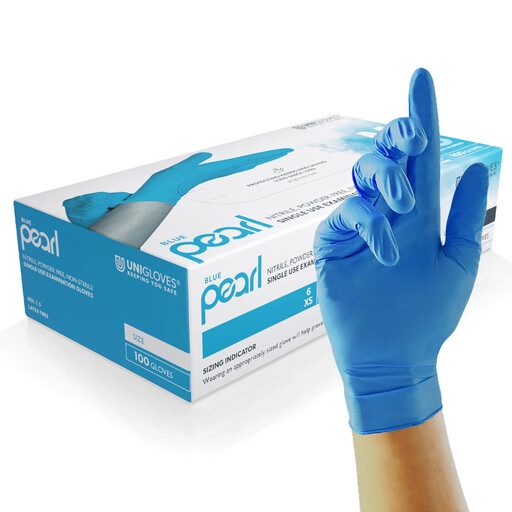
Why This Fits Their Persona: A 100-glove box is a practical starting point for home users, small catering teams, cleaners and general-purpose workplace tasks.
The medium size and clearly listed powder-free, latex-free construction help avoid buying an unsuitable generic glove based only on a low headline price.
Textured fingertips, touchscreen compatibility and beaded cuff; listed as suitable for food contact and chemical resistance.
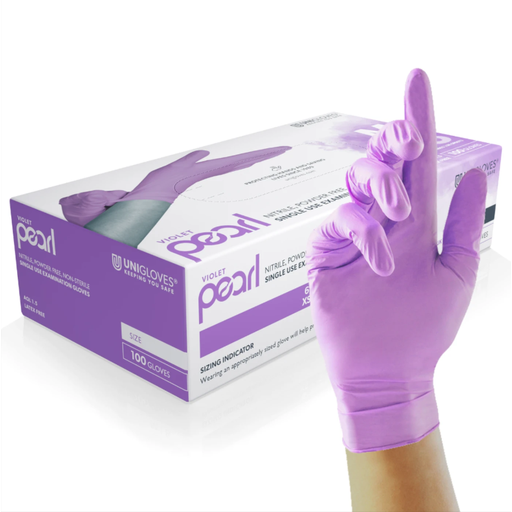
Why This Fits Their Persona: The violet colour suits professional environments seeking a clear colour-coding system, including healthcare, dentistry, salons and tattoo studios.
Its listed medical standards, AQL 1.5 classification and defined features provide more useful information than relying on colour or promotional wording alone.
Latex-free nitrile, chlorinated finish, textured grip and touchscreen use; XL sizing is available in this listing.
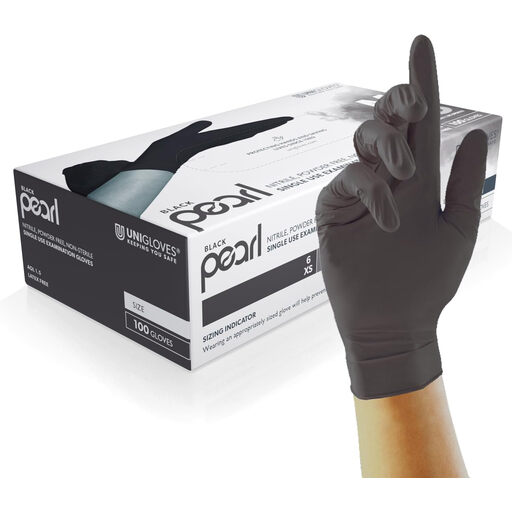
Why This Fits Their Persona: Black gloves can be useful for tattooing, piercing, beauty work, cleaning and other tasks where visible marks or residue need to be easier to identify.
The small size helps prevent loose cuffs and fingertip bunching, while the textured finish addresses the common problem of reduced grip during wet or oily tasks.
Powder-free, latex-free construction with a beaded cuff, textured fingertips and listed chemical-resistant properties.
We have compiled a complete, real-time list of products that fully satisfy these strict selection criteria and UK safety regulations.
These are single-use examination gloves. Check each glove before wearing, put it on carefully and replace it between tasks or when it becomes torn, visibly contaminated or internally damp. Do not wash or reuse disposable gloves.
For healthcare, dentistry, tattooing and food handling, follow the workplace’s infection-control or food-safety procedure. Store unopened boxes in a cool, dry place away from direct sunlight and chemicals. Shelf-life information should be checked on the product label.
The featured Unigloves Pearl listings state that the gloves are suitable for contact with all food types. Food handlers should still follow site-specific hygiene rules, change gloves between different activities and avoid using damaged gloves.
There is no universal wearing time. Replace the glove immediately if it tears, becomes contaminated, loses grip or is used for a different task. In healthcare, dentistry, tattooing and food preparation, change intervals should follow the relevant workplace procedure.
The listings describe these gloves as resistant to a wide range of chemicals, but no disposable glove protects against every substance. Check the chemical-resistance data for the exact product and chemical, consider concentration and exposure time and use additional protective measures where required.