
24/7 全天候客户支持

免费退货

当日/次日达

品质保障

开启新人专享福利: 全场免邮 | 低至 2 折 | 免费试用 30 天 JoyPlus 会员
下载 Joybuy
Disposable gloves can look similar online, yet small differences affect comfort, grip, hygiene and running costs. For healthcare professionals, dentists, tattoo artists, food handlers, cleaners, gardeners and household users, choosing Unigloves Pearl nitrile examination gloves means looking beyond colour and pack size.
The following guide explains the main buying pitfalls, the specifications worth checking and which options may suit different working routines.
Nitrile is commonly selected as a latex-free alternative, but formulation, thickness, cuff design and certification can vary between products. A glove described simply as “nitrile” may not be suitable for food handling, clinical work or contact with cleaning chemicals.
For chemical use, check the manufacturer’s resistance information and the safety data for the substance involved. No disposable glove should be treated as suitable for every chemical or exposure time.
A loose glove can reduce dexterity and catch on equipment. A glove that is too tight may be uncomfortable and more likely to split during donning. Buying a mixed selection of sizes for a team can also create unnecessary waste if one size is consistently left unused.
Measure the hand according to the seller’s size guide and consider whether the gloves will be worn for short tasks or extended periods.
Coloured gloves can support workplace organisation, but a bright colour does not automatically indicate greater durability or protection. The practical value is in colour-coding: for example, using separate colours for food preparation, cleaning areas or different treatment rooms to help reduce cross-contamination risks.
Powder-free nitrile gloves avoid the loose powder found in some older disposable gloves, which may be undesirable around food, equipment or sensitive work areas. The Unigloves Pearl range is listed as powder-free and made from nitrile rather than natural rubber latex.
This makes the gloves relevant for users seeking latex-free disposable gloves, although anyone with known skin sensitivity should stop using a product if irritation occurs and follow appropriate workplace guidance.
An AQL 1.5 rating refers to a statistical pinhole-leak performance level used for medical examination gloves. It is not a guarantee that an individual glove cannot fail, so inspect each glove before use. The Pearl product descriptions state that the gloves undergo pinhole testing and are intended for examination and multipurpose applications.
For healthcare, dentistry and tattoo work, also check that the product’s stated classification matches your workplace risk assessment. These are disposable gloves for healthcare, but they are not a replacement for hand hygiene, safe handling procedures or task-specific protective equipment.
A beaded cuff can make gloves easier to pull on and may help limit liquid rolling towards the wrist. Textured fingertips are useful when handling wet or oily tools, while touchscreen compatibility can reduce the need to remove gloves to operate a phone or tablet.
These features are particularly practical for dentists, tattoo and piercing artists, cleaners and food handlers who regularly move between physical tasks and digital records.
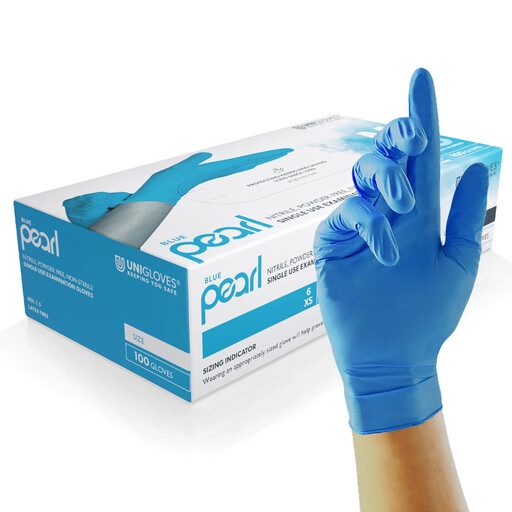
Why This Fits Their Persona: A 100-glove box provides a straightforward starting point for household cleaning, gardening, food preparation and occasional hygiene tasks in the UK.
The listing clearly specifies nitrile, powder-free construction, a box quantity of 100 and an AQL 1.5 rating, rather than relying only on a general “protective glove” description.
Powder-free and latex-free nitrile; textured fingertips and touchscreen compatibility; beaded cuff.
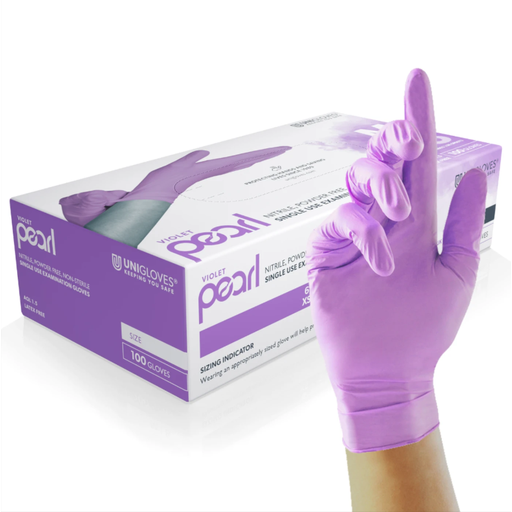
Why This Fits Their Persona: The larger size and chlorinated finish may suit users who prioritise easier donning and a more accommodating fit during longer clinical, workshop or studio sessions.
The product information identifies the size, material, powder-free construction and chlorinated finish, helping buyers compare practical specifications instead of colour alone.
AQL 1.5 examination-glove specification; textured fingertips; listed suitability for food contact and multiple professional environments.
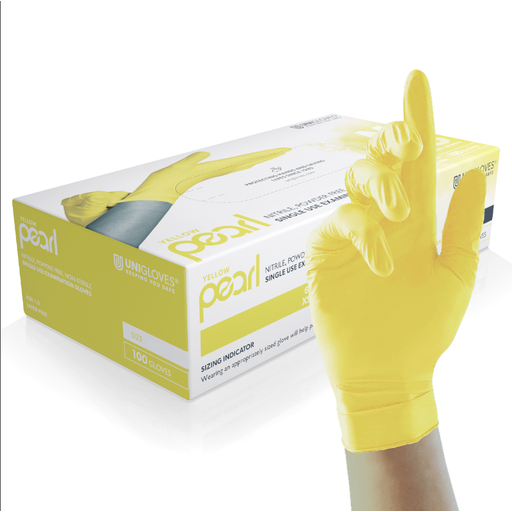
Why This Fits Their Persona: A visible yellow colour can support colour-coded routines for cleaning teams, food areas, laboratories or busy studios where task separation matters.
The colour is used for identification rather than presented as proof of performance; the listing also provides material, cuff, grip and food-contact details for a fuller comparison.
Yellow supports workplace visibility; nitrile formulation, beaded cuff and textured finish are specified for practical handling.
We have compiled a complete, real-time list of products that fully satisfy these strict selection criteria and UK safety regulations.
The listed Pearl variants are described as suitable for contact with all food types. Use them according to the product instructions and your workplace food-safety procedures. Replace gloves when damaged, visibly soiled or when changing tasks.
There is no universal wear time. Replace gloves after a task, contamination event, damage or when moving to a different activity. They are intended for single use, so the cost should be calculated by pairs used rather than by how long a box remains open.
Textured fingertips are listed as touchscreen-compatible, but responsiveness can vary with screen protectors, moisture and the device itself. Test the glove with the equipment used in your workplace before relying on it for essential records or controls.