
24/7 全天候客户支持

免费退货

当日/次日达

品质保障

开启新人专享福利: 全场免邮 | 低至 2 折 | 免费试用 30 天 JoyPlus 会员
下载 Joybuy
For healthcare teams, dentists, tattoo and piercing artists, caterers, cleaners, gardeners and laboratories, disposable gloves are a routine operating cost. Choosing by colour or low box price alone, however, can lead to poor fit, unnecessary waste and inadequate protection for the task.
Unigloves Pearl nitrile examination gloves are available in several colours and sizes, with product listings describing them as powder-free, latex-free and suitable for a range of professional and domestic uses. The important question is not simply whether a glove looks suitable, but whether its material, fit and stated standards match the work involved.
“Nitrile” describes the glove material, not a universal protection level. Resistance varies according to the chemical, concentration, contact time and glove thickness. A glove suitable for routine cleaning may not be appropriate for solvents, concentrated disinfectants or laboratory chemicals.
Before buying chemical-resistant gloves, check the manufacturer’s technical information and compare it with the substance’s safety data sheet. Replace gloves promptly if they become damaged, swollen, sticky or contaminated.
Powder-free nitrile gloves help avoid loose powder contaminating work surfaces and may be preferable for food preparation, healthcare and clean handling. They do not replace hand hygiene, surface cleaning or correct glove changes.
Gloves are single-use items. Change them between tasks, after touching contaminated surfaces and whenever their integrity is questionable. Do not wash or reuse disposable gloves.
An oversized glove can catch on equipment, while a glove that is too tight may cause discomfort and tear during donning. Fit also affects dexterity, particularly for dentistry, tattooing, piercing and laboratory work.
Check the available size carefully rather than assuming that S, M, L or XL is consistent across every manufacturer. If several people share a box, colour-coded sizes or separate boxes can make stock control simpler.
Unigloves Pearl listings specify 100% nitrile, with a latex-free formulation. Latex-free disposable gloves can be useful in workplaces where latex sensitivity is a concern, although users should stop wearing any glove if irritation or discomfort occurs.
The listed gloves have a chlorinated finish intended to make pulling them on easier. They are also powder-free, which suits many hygienic handling environments and reduces loose particulate residue.
The product information states an AQL 1.5 and describes the gloves as examination gloves. AQL is a sampling measure used in manufacturing quality control; it is not a guarantee that an individual glove cannot fail. Inspect each glove before use.
For healthcare, dental and other regulated settings, confirm that the product’s labelling, conformity information and intended classification match your organisation’s requirements. UK workplaces may need to consider applicable medical device or PPE obligations, including the relevant UKCA or CE marking arrangements shown on the product packaging and documentation.
The listings also state suitability for contact with all food types. Food businesses should still retain the supplier’s food-contact declaration and follow their own HACCP procedures. Food-safe nitrile gloves are not a substitute for separating raw and ready-to-eat food handling.
A beaded cuff can make donning easier and helps reduce liquid rolling towards the wrist. Textured fingertips are listed to improve grip in wet or oily conditions. The gloves are also described as touchscreen-compatible, which may be useful when checking a tablet, delivery screen or stock system without removing gloves.
These features are practical conveniences, not reasons to keep one pair on across multiple activities. Touching a phone or tablet can transfer contamination, so follow workplace hygiene procedures.
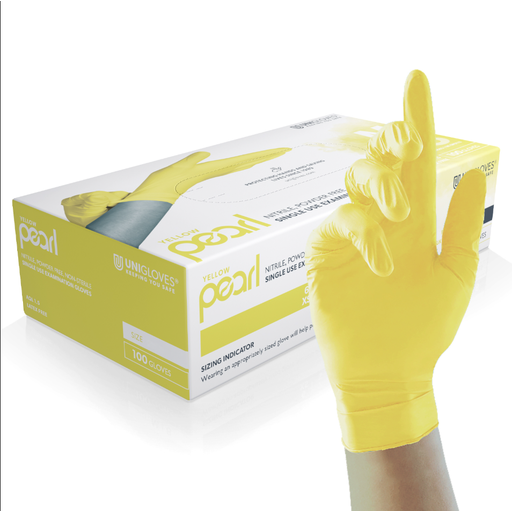
Why This Fits Their Persona: A practical medium-size option for households, small businesses and new catering or cleaning setups that need a visible colour for task separation.
The listing clearly identifies a box of 100, powder-free nitrile construction and a stated AQL 1.5, making key purchase details easier to compare than vague “professional” wording.
Latex-free, powder-free nitrile; beaded cuff; textured fingertips; touchscreen compatibility.
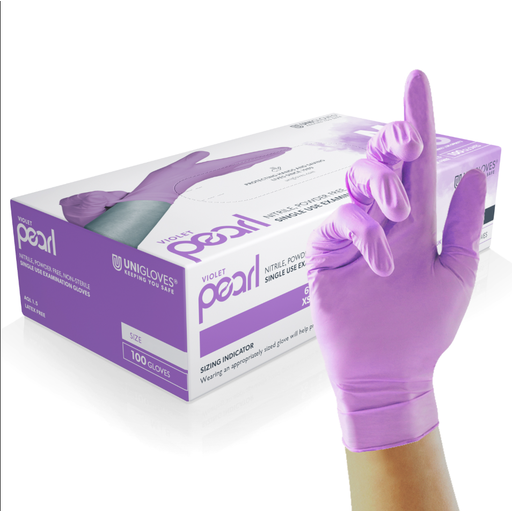
Why This Fits Their Persona: Suitable for professionals who prioritise a clearly specified glove for repeated work in dentistry, healthcare, salons or studios, subject to their workplace requirements.
The product details specify latex-free, powder-free construction and examination-glove status, while the colour can support a documented colour-coding system.
Large size; chlorinated finish; stated AQL 1.5; textured grip and beaded cuff.
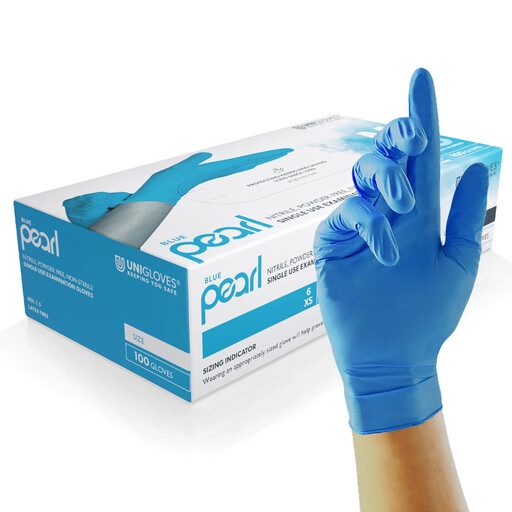
Why This Fits Their Persona: A medium-size choice for cleaning teams, gardeners, food handlers and studios needing regular glove changes and easy visual identification.
The textured finish addresses grip concerns, while the blue colour can help distinguish tasks when a workplace assigns different colours to food, cleaning or care activities.
Medium size; latex-free nitrile; touchscreen-compatible fingertips; suitable for stated food-contact applications.
We have compiled a complete, real-time list of products that fully satisfy these strict selection criteria and UK safety regulations.
The product listings state suitability for contact with all food types. Food businesses should verify the current packaging and food-contact declaration, then use the gloves within their hygiene and HACCP procedures. They should be changed whenever contamination occurs.
There is no universal wear time. Replace them when torn, visibly contaminated, internally damp, chemically affected or when changing tasks. These are single-use disposable gloves, not reusable work gloves.
They may be suitable for some cleaning products, but nitrile is not resistant to every chemical. Check the glove’s resistance information against the product label and safety data sheet. For stronger chemicals or prolonged exposure, select protection specifically rated for that substance.