What should you check before buying?
Start with how the butter will be used, then compare the exact product’s label rather than assuming that all blocks or spreadable blends have the same composition.
| Priority |
What to check |
Your needs |
| Adding energy to meals |
Check the intended use and energy per 100g. East Suffolk and North Essex NHS Foundation Trust describes food fortification as adding energy- and protein-rich foods to meals; butter is one ingredient, not the whole plan. |
If an older person has been advised to fortify meals, I want an ingredient that works with foods they already accept without crowding out protein-containing foods. |
| Salt |
Read the salt value per 100g and confirm whether the exact product is unsalted. Lurpak lists 0.01g for its Unsalted Butter block; Anchor lists 0.02g for its Unsalted Block and 1.1g for Original Spreadable. |
Where salt needs attention, I would choose by the individual label, not assume that a spreadable product has the same salt content as an unsalted block. |
| Saturated fat |
Compare saturates per 100g alongside salt. Lurpak lists 53g for its Unsalted Butter block and 35g for Spreadable Unsalted; Anchor lists 52g for its Unsalted Block and 31g for Original Spreadable. The NHS advises attention to saturated-fat intake. |
I want to understand both figures before choosing a blend: a lower listed saturates value does not tell me whether its salt content fits the person’s diet. |
| Spreading and storage |
Check whether the product is described as spreadable from the fridge and follow its storage label. Anchor says its unsalted block and spreadable butter should be refrigerated. |
For toast or sandwiches, I may need something manageable straight from the fridge rather than leaving a firm block out to soften. |
| Milk ingredients |
Check the ingredients and allergen statement on the exact pack, including blends. The Food Standards Agency identifies milk as a common ingredient in butter. |
If the person has a milk allergy, I need to check the product before using it; a different butter format is not automatically milk-free. |
Brand and product-line references
These named products illustrate differences in format and labelling; their inclusion does not indicate which products are available from Joybuy.
Lurpak
Lurpak lists both an Unsalted Butter block and a Spreadable Unsalted blend made with butter, rapeseed oil and water.
- Lurpak lists 0.01g salt per 100g for each of these named products.
- Their formulations differ. Lurpak lists 53g saturates per 100g for the block and 35g for the spreadable blend; check which format suits the intended use.
Anchor
Anchor’s named Unsalted Block and Original Spreadable provide a useful comparison between an unsalted block and a butter-and-rapeseed-oil spread.
- Anchor lists 0.02g salt per 100g for its Unsalted Block.
- Anchor Original Spreadable lists 1.1g salt per 100g. Do not treat its 31g saturates per 100g as evidence that it is an unsalted option.
Kerrygold
Kerrygold describes an Unsalted Butter and a separate butter-with-olive-oil blend, which the brand says spreads straight from the fridge.
- The two formats give shoppers a choice between a butter block and a blended spread.
- Check the current pack’s salt, saturates and ingredients when comparing either named product with another butter.
Sainsbury's
Sainsbury's SO Organic British Unsalted Butter is a named own-label block with product-specific nutrition and allergen information.
- Sainsbury's lists 745 kcal, 82.2g fat, 52.1g saturates and less than 0.01g salt per 100g for this product.
- Its label states that it contains milk. These figures should not be assumed for other Sainsbury's butters or spreads.
Joybuy product options
The Joybuy option here is butter-derived ghee for cooking, rather than a conventional butter block or fridge-spreadable blend. Consider the intended use before comparing it with the formats discussed above.
 No image available
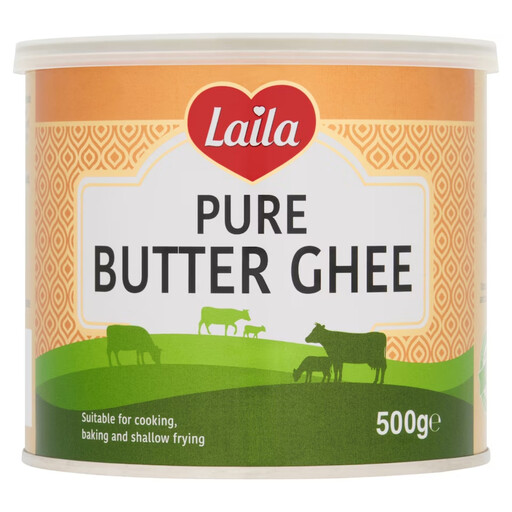
Laila Pure Butter Ghee 500G
This butter-derived ghee is a cooking option when an ingredient is wanted for meals in a Food First plan. It is not a conventional block or spreadable blend: if spreading straight from the fridge matters, check whether it suits that use before buying. Check the current pack for nutrition, storage and milk-allergen information.
View on Joybuy
Questions about choosing and using butter
Can butter help when an older person has a poor appetite?
Butter can be an ingredient in familiar foods when food fortification has been advised, but it is not a complete nutrition plan. East Suffolk and North Essex NHS Foundation Trust describes fortification as adding energy- and protein-rich foods to meals, so keep foods chosen for protein and other nutrients in the plan too.
Does spreadable butter contain less salt than a block?
Not necessarily: salt depends on the exact product, not its format. Anchor lists 1.1g salt per 100g for Original Spreadable and 0.02g for its Unsalted Block; compare the current labels when salt matters.
Does a butter-and-oil spread contain less saturated fat?
The named blends here list less saturated fat per 100g than their corresponding unsalted blocks, but that does not establish a rule for every spread. Lurpak lists 35g for Spreadable Unsalted and 53g for Unsalted Butter; Anchor lists 31g for Original Spreadable and 52g for Unsalted Block. Check salt as well as saturates.
Should butter be kept in the fridge?
Follow the exact pack’s storage instructions. GOV.UK says food labelled for refrigeration after opening should be kept at 5°C or below; Anchor instructs shoppers to refrigerate its unsalted block and spreadable butter.
Can someone with a milk allergy use butter?
Do not assume any butter or butter blend is suitable for someone with a milk allergy. The Food Standards Agency identifies milk as a common ingredient in butter, so check the exact product’s ingredient and allergen statement before use.


