
24/7 Customer Support

Free returns

Same-day & Next-day Delivery

Quality Guaranteed

Unlock Your Welcome Offers: FREE Delivery | Up to 80% OFF | Free 30-day JoyPlus trial
Download the APP
Buying an upright freezer can appear straightforward until you measure the doorway, discover the door opens against a wall or realise that the advertised capacity does not match your usable drawer space. For UK households, the right choice depends on more than price and appearance.
The most common buying traps are:
Whether you need a compact 85-litre freezer, a tall model for batch cooking or an integrated appliance behind kitchen cabinetry, compare the details below before ordering.
Capacity should reflect how you shop. An 85-litre freezer can suit one or two people, a smaller kitchen or households needing a second appliance. Larger families, meal preppers and bulk buyers may prefer 160 to 212 litres, depending on available floor and cabinet space.
Drawers and compartments also affect everyday usability. Transparent drawers make it easier to identify food without leaving the door open for too long. Shelves and flap compartments can be useful for boxes, although deep drawers are often more practical for packaged meals and frozen ingredients.
A tall upright freezer uses vertical space efficiently. Models measuring around 144cm high can provide substantially more storage than under-counter freezers while occupying a similar footprint. Before choosing, measure:
Freestanding freezers offer the simplest installation. They can be positioned in a kitchen, utility room or suitable storage area, provided the surface is level and ventilation requirements are met. Reversible-door freezers are useful where the opening direction is restricted by cabinets or walls.
Under-counter freezers are generally around worktop height. They are suitable for compact kitchens, flats, utility rooms and additional frozen storage. Do not assume that every 55cm-wide model fits every UK kitchen unit; depth, ventilation and surrounding clearance still need checking.
Integrated freezers and built-in freezers sit behind a furniture door for a coordinated kitchen appearance. Confirm the required housing niche, door-fixing system and hinge type before purchase. Sliding hinges and fixed hinges are not interchangeable in every installation, so professional fitting may be appropriate for a fitted kitchen.
Manual-defrost freezers usually require periodic ice removal. As a practical rule, defrost when ice becomes noticeably thick, following the manufacturer’s instructions. No Frost freezers circulate cooled air to reduce ice formation and can save maintenance time, but they may have different internal layouts and sound characteristics.
The UK energy label uses classes from A to G. An E-rated freezer is not automatically the cheapest appliance to run; check the stated annual energy consumption in kWh and compare like-for-like capacities. A larger freezer may use more electricity overall even when its class is similar.
Noise is measured in decibels, or dB(A). Quiet freezers rated around 35–41 dB(A) may be more suitable for open-plan homes, bedrooms nearby or utility rooms close to living areas. Compressor sounds can still vary during normal operation.
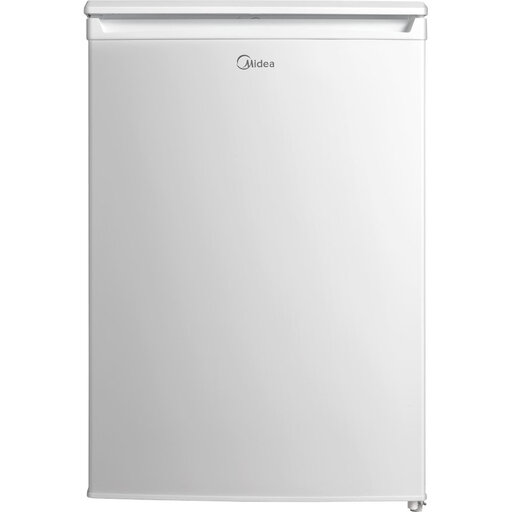
Why This Fits Their Persona: Its under-worktop format suits smaller UK kitchens, flats and households wanting extra frozen storage without committing to a tall appliance.
The listed 86-litre capacity, three transparent drawers and reversible door make the space easier to plan and install. It is a manual-defrost model, so buyers can factor maintenance into the decision.
84.5cm height, 55.3cm width, E energy class and a stated 39 dB(A) noise level.
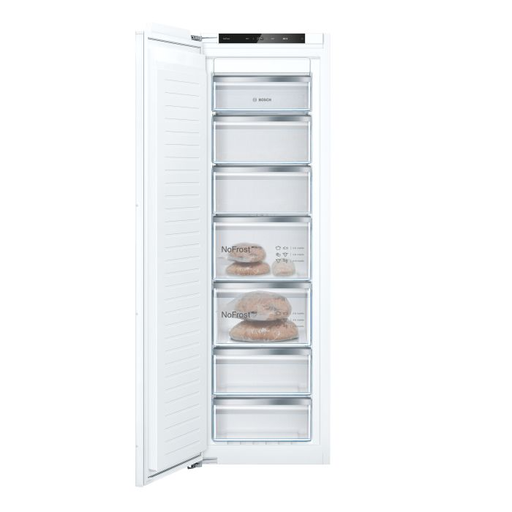
Why This Fits Their Persona: Designed for a fitted kitchen, this integrated model is suited to homeowners planning a coordinated cabinet finish and substantial daily storage.
Its stated niche dimensions and fixed-hinge design help buyers check cabinet compatibility before installation. NoFrost technology reduces the need for routine manual defrosting.
212-litre capacity, seven compartments, two BigBox drawers, E energy class and 35 dBA listed noise level.
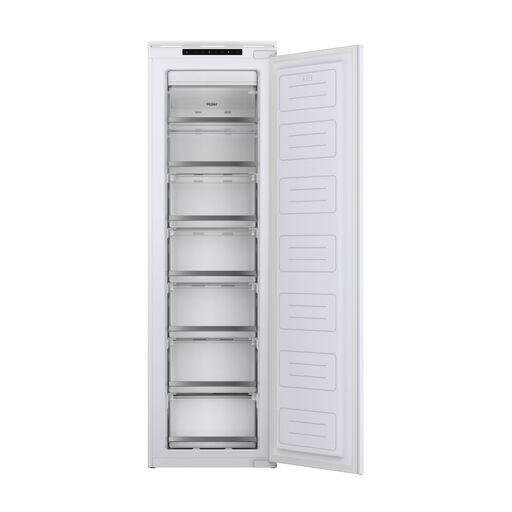
Why This Fits Their Persona: Large families, batch-cookers and bulk buyers gain dedicated freezer capacity while keeping the kitchen’s external appearance streamlined.
The 200-litre stated capacity and nine transparent drawers provide measurable storage rather than relying on exterior size alone. Total No Frost addresses the maintenance issue associated with ice build-up.
177cm height, sliding hinge, E energy class and 41 dBA listed noise level.
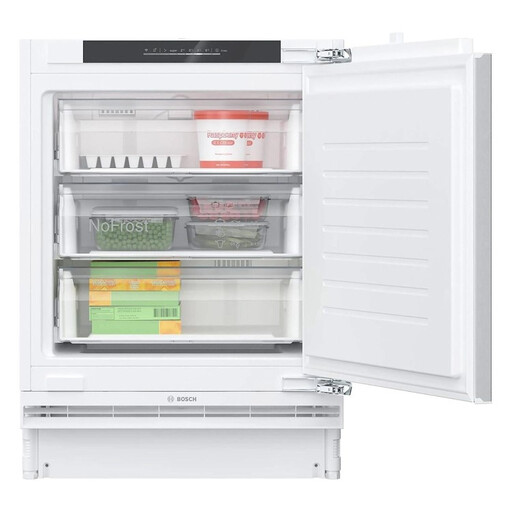
Why This Fits Their Persona: This built-under format suits homeowners replacing an under-worktop appliance while retaining a fitted-kitchen appearance.
The specified built-under installation, ventilation plinth and 820mm height help distinguish it from a standard freestanding freezer. NoFrost and a door-open alarm add practical functionality.
85-litre capacity, three transparent drawers, E energy class and 35 dB listed noise level.
We have compiled a complete, real-time list of products that fully satisfy these strict selection criteria and UK safety regulations.
Running cost depends on the appliance’s annual kWh figure, electricity tariff, capacity, room temperature and usage. Compare the energy label’s annual consumption rather than relying only on an E or F rating. Keeping the door closed, maintaining the seal and allowing adequate ventilation can support efficient operation.
Lifespan varies according to build quality, installation, usage and maintenance. Follow the manufacturer’s care instructions, keep vents unobstructed and address damaged seals promptly. Warranty length provides a defined period of cover, but it should not be treated as a guaranteed service life.
Some models may be suitable, but the permitted ambient temperature range must be checked in the product manual. Garages can become very cold in winter and hot in summer, which may affect operation. Always provide the specified clearance and keep the appliance away from damp conditions and direct heat.