
24/7 Customer Support

Free returns

Same-day & Next-day Delivery

Quality Guaranteed

Unlock Your Welcome Offers: FREE Delivery | Up to 80% OFF | Free 30-day JoyPlus trial
Download the APP
With nearly every new phone, tablet and laptop now using a USB-C port, the tangle of old, incompatible chargers in your drawer is fast becoming redundant. But finding a replacement isn't as straightforward as picking any plug off the shelf. The market is flooded with options, and it's easy to make a poor choice that either charges painfully slowly or, worse, poses a safety risk.
As the Joybuy Product Recommendation Officer, my role is to help you navigate this landscape. We'll look past the marketing noise and focus on what truly matters, helping you avoid common purchasing mistakes and find a charger that fits your needs perfectly.
Before you buy, be aware of these frequent traps that catch out many UK shoppers:
To make an informed decision, focus on these three non-negotiable specifications. Understanding them will ensure you get a charger that is both effective and safe.
Wattage is the measure of power output and directly relates to charging speed. A higher wattage generally means a faster charge, but only if your device can handle it. Here’s a simple guide:
Crucially, look for a charger that supports Power Delivery (PD). This is a modern charging standard that allows the charger and your device to communicate, negotiating the fastest possible charging speed safely. Without PD, even a high-wattage charger may default to a slow charging rate.
If you see GaN charger on a product description, it's a significant feature. Gallium Nitride is a material that is more efficient at conducting electricity than the traditional silicon used in older chargers. For you, this means:
This technology is particularly useful in a multi-port USB charger or a travel charger, where size and efficiency are paramount.
A multi-port USB charger is excellent for reducing clutter, but you must check how it distributes power. A good manufacturer will specify the output for each port when used alone and when used simultaneously. For example, a 100W dual-port charger might offer 100W from one port when used alone, but split to 65W and 30W when both are in use. Always check that the shared output still meets the needs of your most demanding device.
Based on these practical criteria, we've matched a few standout products from our catalogue to different user needs.
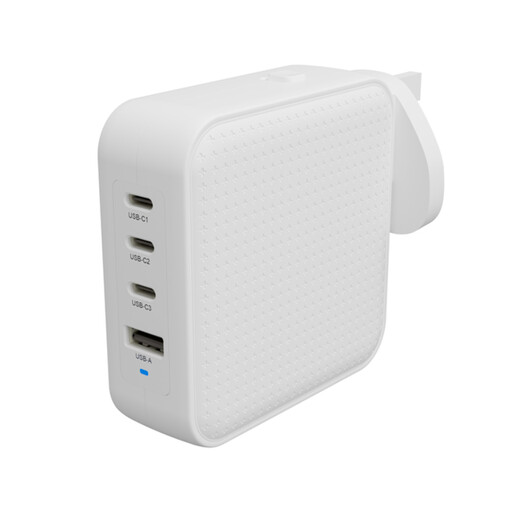
Why This Fits Their Persona: For the professional juggling a laptop, phone and tablet, this charger consolidates everything into one. Its high output can power a MacBook Pro, while the additional ports handle other gadgets. The included international plugs make it a dependable companion for UK-based frequent flyers.
It avoids the "Total Wattage" illusion by offering intelligent power allocation. It can deliver up to 100W from a single USB-C port, enough for demanding laptops and clearly specifies how power is split when multiple ports are active.
GaN Technology: Compact and efficient for its high power output.
Global-Ready: Includes UK, EU and AU adapters, making it a true travel charger.
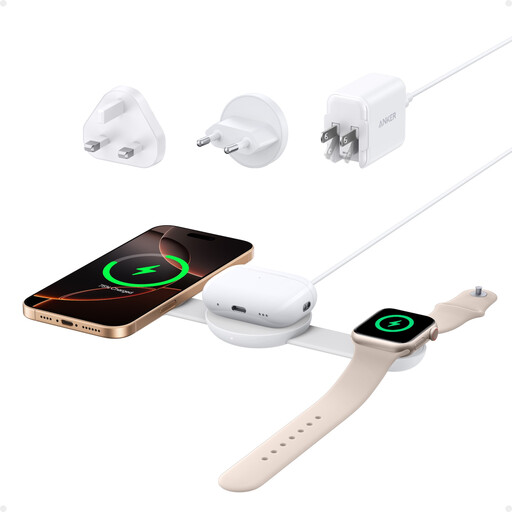
Why This Fits Their Persona: Perfect for anyone wanting to declutter their nightstand or desk. This wireless charging pad powers a phone, smartwatch and earbuds simultaneously from a single plug, eliminating the mess of multiple cables. It's a sleek and practical solution for the modern home.
It sidesteps the compatibility maze by being designed for a specific ecosystem (phone, watch and earbuds). This targeted approach ensures all devices charge efficiently without the user needing to worry about different charging standards or power outputs.
Cable-Free Convenience: Charges three devices at once with no extra wires.
Space-Saving Design: Consolidates charging into one neat, compact station.
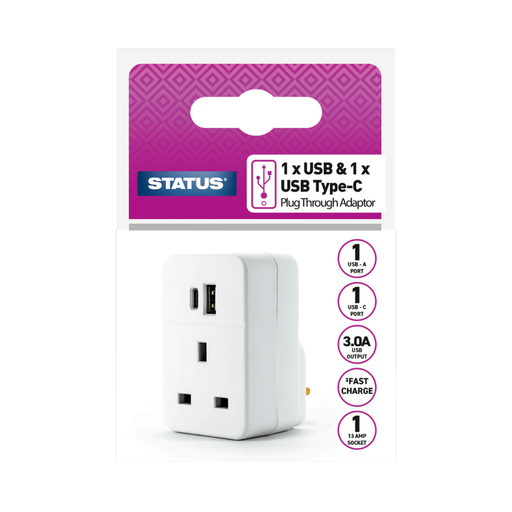
Why This Fits Their Persona: This is for the user who is frustrated by limited wall sockets in older UK homes, hotels or offices. It adds USB-A and USB-C charging ports without sacrificing the original mains socket, allowing you to power a lamp or other appliance while charging your phone and an accessory.
It directly solves a common real-world problem that many chargers create: blocking access to a precious wall socket. Its design is a practical solution for spaces where outlets are scarce, a pitfall many people only discover after purchase.
Plug-Through Design: Retains use of the mains socket.
Dual Ports: Charges both modern USB-C and older USB-A devices simultaneously.
We have compiled a complete, real-time list of products that fully satisfy these strict selection criteria and UK safety regulations.
1. Can I use a 100W USB-C charger for my phone that only needs 20W? Yes, you can. A key feature of the Power Delivery (PD) standard is that the charger and device communicate to determine the correct amount of power. The charger will only supply the maximum wattage the device can safely handle, so using a more powerful charger will not cause damage.
2. How do I know if a charger is safe to use in the UK? Always look for official safety markings on the product and its packaging. In the UK, this is the UKCA mark. The CE mark is also widely recognised as an indicator that the product meets European safety standards. Avoid chargers that have no visible safety certifications.
3. What is the difference between Power Delivery (PD) and Quick Charge (QC)? Both are fast-charging technologies, but they are developed by different organisations. Power Delivery is a more universal standard, adopted by Apple, Google and most laptop manufacturers. Quick Charge was developed by Qualcomm and is common in many Android devices. Many modern chargers support both, but PD is becoming the dominant standard for USB-C devices.