
24/7 Customer Support

Free returns

Same-day & Next-day Delivery

Quality Guaranteed

Unlock Your Welcome Offers: FREE Delivery | Up to 80% OFF | Free 30-day JoyPlus trial
Download the APP
A USB-C charger UK shoppers can rely on should do more than fit a device’s charging port. The right model needs suitable power output, a compatible charging protocol and a genuine UK plug arrangement. Choosing by appearance or a headline such as “fast charging” can leave you with slow performance, unnecessary bulk or a charger that cannot power your laptop properly.
This guide explains the specifications worth checking before buying, then matches selected chargers to practical UK household, travel and work scenarios.
USB-C describes the connector shape, not the charging speed. A USB-C wall charger may deliver 20W, 30W, 65W or considerably more. It may also use different charging protocols.
For phones and smaller tablets, a USB-C Power Delivery (PD) charger is often a useful choice because compatible devices can negotiate an appropriate power level. However, the phone, cable and charger must all support the required standard. A USB-C port alone does not guarantee rapid charging.
A 20W USB-C charger can suit many smartphones, but it is generally not designed to replace a laptop power adaptor. A USB-C laptop may require 45W, 65W, 100W or more, depending on the model and workload.
Buying an oversized charger is not automatically harmful, as compatible devices draw only the power they are designed to accept. However, selecting a 65W USB-C laptop charger for a computer that requires more may result in slow charging or battery drain while in use.
Some compact chargers are supplied with an EU plug, detachable power lead or regional adaptor rather than an integrated UK three-pin plug. Check the listing carefully if you need a USB-C charger with UK plug for standard UK wall sockets.
Also check whether a charging cable is included. The Apple 20W USB-C Power Adapter, for example, has one USB-C port but does not include a cable. You may need a USB-C to USB-C cable or USB-C to Lightning cable, depending on your device.
Use your device manufacturer’s recommended wattage as a starting point:
A higher output rating does not force excess power into a device. Charging speed is governed by the connected device, cable and supported protocol.
A fast USB-C charger should state how its output is delivered. A single-port charger may provide its full advertised wattage to one device. A multi-port USB-C charger may divide power between ports.
For instance, a dual-port 40W adaptor may provide up to 20W per port when both are in use. A four-port 140W model can offer greater flexibility, but its total output and port-by-port limits still need checking.
A GaN charger uses gallium nitride switching components rather than conventional silicon components. This design can support a compact form factor at higher power levels, although size varies between models.
Look for clearly stated protection features such as over-current, over-voltage, short-circuit and overheating protection. These do not remove the need for safe use: do not cover a charger, use damaged cables or expose it to water.
For UK use, check that the charger or supplied lead is intended for a UK socket. A proper three-pin arrangement and suitable product documentation are more useful than a generic “universal” label.
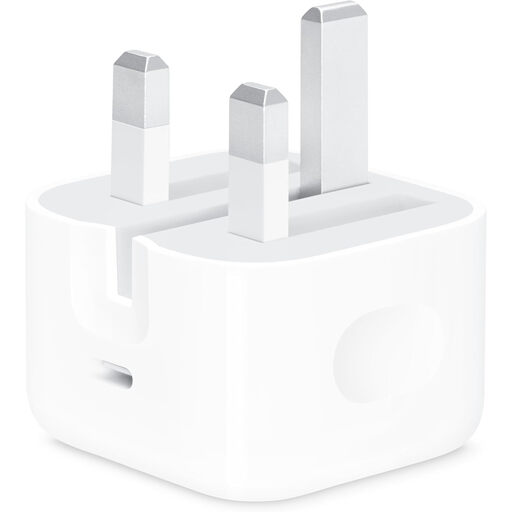
Why This Fits Their Persona: A straightforward option for iPhone and iPad owners who need one compact charger for a bedroom, office desk or occasional travel in the UK.
Its stated output is clearly defined at 20W and it has an integrated UK three-pin plug. Remember that the charging cable is sold separately.
Single USB-C port, 20W output and compact white design for simple everyday charging.

Why This Fits Their Persona: Designed for people who want a compact dual-device setup for a phone and earbuds, tablet or second handset.
The listing specifies two USB-C ports and explains the 20W + 20W total output when both are used, avoiding vague port claims.
GaN construction, two USB-C outputs and a stated 40W maximum for flexible home or office use.
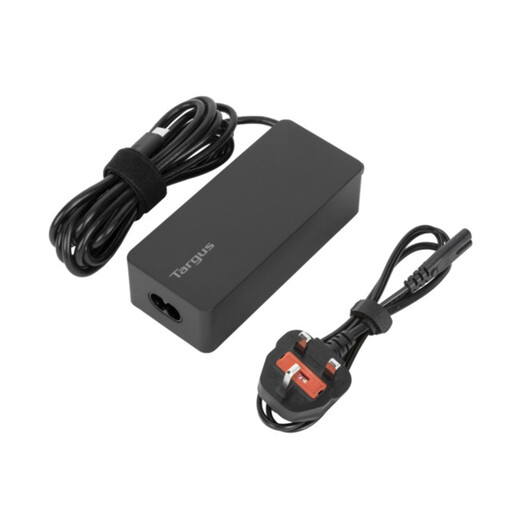
Why This Fits Their Persona: A practical choice for commuting and client visits where one adaptor may need to handle a USB-C laptop, tablet and phone.
It provides a stated 65W PD output and includes EU and UK power cords, helping avoid regional plug and laptop-wattage mismatches.
Includes a 1.8-metre cable, cable tie and protection against over-current, overheating and over-voltage.
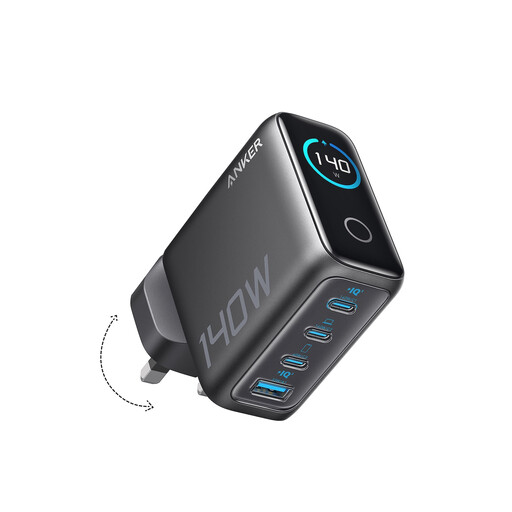
Why This Fits Their Persona: Suitable for a home office or shared workspace where several phones, tablets and USB-C computers need power from one location.
It states four charging ports and a 140W maximum, while the built-in display shows charging status, temperature and port information.
GaN technology, four-device charging and two high-output USB-C ports for compatible laptops.
We have compiled a complete, real-time list of products that fully satisfy these strict selection criteria and UK safety regulations.
A 20W USB-C charger can support fast charging on compatible iPhone models when paired with the correct cable. Charging speed may vary according to the phone, cable, battery level and usage conditions. A USB-C to Lightning cable may be required for some older devices.
Lifespan depends on construction, frequency of use, heat exposure, cable condition and handling. Replace a charger if its casing is cracked, it becomes unusually hot, makes unexpected sounds or shows signs of damage. Keeping it ventilated and unplugging it when not required can reduce avoidable wear.
The wattage printed on a charger is its possible maximum output, not a constant electricity draw. A device generally takes the power it requests. Running cost depends mainly on the device’s battery capacity, charging frequency, electricity tariff and conversion losses. A multi-port charger can also reduce the need to keep several adaptors plugged in.