
24/7 Customer Support

Free returns

Same-day & Next-day Delivery

Quality Guaranteed

Unlock Your Welcome Offers: FREE Delivery | Up to 80% OFF | Free 30-day JoyPlus trial
Download the APP
Buying among the many USB-C chargers UK shoppers see online can be confusing. A small plug may promise fast charging, several ports and laptop compatibility, yet still be unsuitable for your device or inconvenient for a UK socket.
The most common buying traps are easy to overlook:
Check your device’s supplied charger or technical specifications before selecting a fast USB-C charger.
A charger with a higher maximum output is not automatically harmful to a compatible device. USB Power Delivery negotiates an appropriate level between the charger and device. However, compatibility depends on the charging standards supported by both products.
A USB-C Power Delivery charger can adjust its output for compatible devices. This is particularly useful when charging phones, tablets and laptops from one adaptor.
For a multi-port USB-C charger, read the output table rather than relying only on the headline wattage. For example, a dual-port model may provide its full rating through one port but divide power when both ports are occupied. This matters if you want to charge a laptop and phone at the same time.
Also check whether the charger has USB-A ports for older cables. A combination USB-C and USB-A charger can be useful at home or in shared workspaces, but USB-C ports are usually the more relevant choice for newer devices.
For regular use in Britain, choose a UK plug charger with a suitable three-pin design, or confirm exactly which power cords are included. A travel charger may support 100–240V input but still require a separate plug adaptor overseas.
Safety information should include protections such as overcurrent, overvoltage, overheating and short-circuit protection where specified. Look for clear manufacturer and importer details, instructions and appropriate conformity markings for the UK market. Do not use a charger with a cracked casing, loose pins, damaged cable or unusual heat, sound or odour.
GaN chargers can be smaller and lighter than some conventional designs. Their compact size is useful for commuting and business travel, but ventilation remains important: do not cover a charger while it is operating.
The following options are organised around different usage patterns rather than one universal choice.
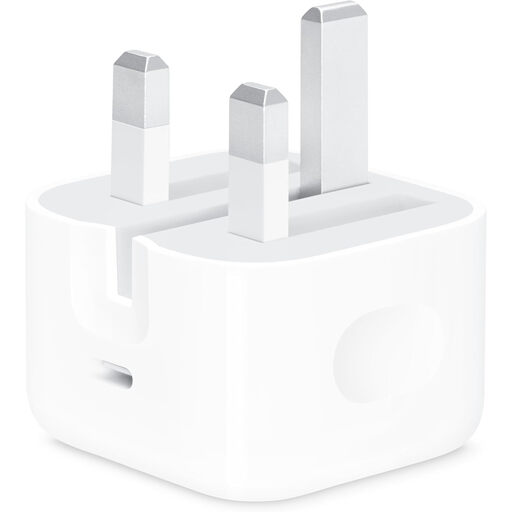
Why This Fits Their Persona: A straightforward choice for UK users who need one compact USB-C phone charger for home, study or office use.
Its maximum output is clearly stated at 20W and it uses a UK three-pin plug, avoiding confusion about an EU adaptor. A compatible cable is required and is not included.
Single USB-C port; compact design; up to 20W output for compatible devices.
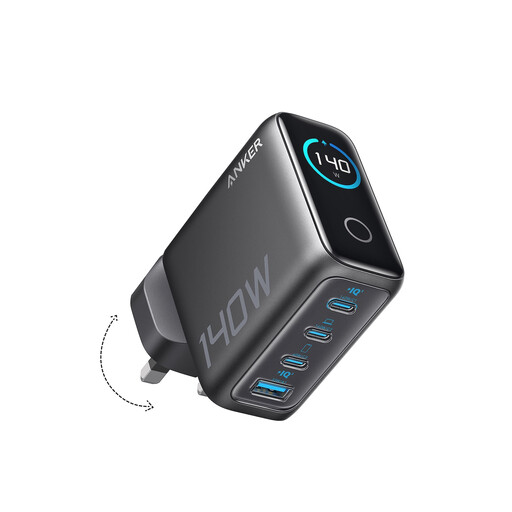
Why This Fits Their Persona: Designed for households, desks and professionals who want one high-output charger for several USB-C devices.
The four-port layout and display make port usage and charging status easier to monitor. Check the power distribution before connecting multiple high-demand devices.
Four charging ports; GaN design; stated maximum output of 140W; colour display for charging information.
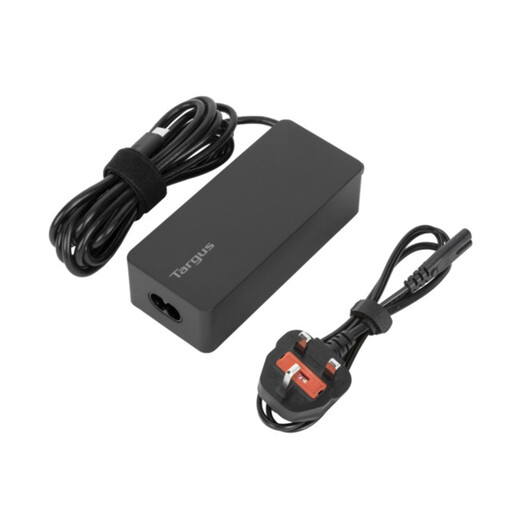
Why This Fits Their Persona: A travel-focused option for business users carrying a USB-C laptop, tablet and phone between UK and European locations.
It states 65W USB-C Power Delivery and includes both EU and UK power cords, reducing the need to buy a separate travel solution. Confirm your laptop’s required wattage.
Up to 65W output; overcurrent, overheating and overvoltage protection; 1.8-metre cable and cable tie included.
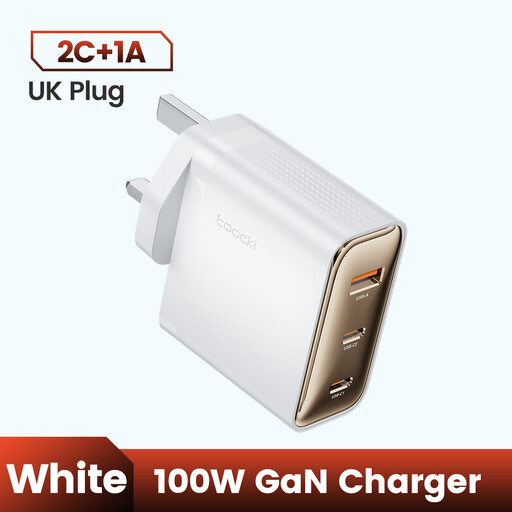
Why This Fits Their Persona: Suitable for users managing a laptop, phone, tablet and accessories from one charging point.
The specification identifies three ports and up to 100W output, making the capacity easier to compare with a laptop’s requirement. Review the per-port allocation before purchase.
Three-port configuration; 100W class output; GaN fast-charging format for multiple devices.
We have compiled a complete, real-time list of products that fully satisfy these strict selection criteria and UK safety regulations.
It can be, provided the phone and cable are compatible. The phone will normally request the power level it supports rather than automatically receiving the charger’s full 65W output. A 65W model is useful if you also charge a tablet or laptop.
The electricity used depends mainly on the connected device, charging time and charger efficiency. A higher-rated charger does not necessarily consume its maximum output continuously. Unplug the adaptor when it is not needed and avoid leaving damaged or overheating equipment in use.
Lifespan varies with build quality, heat exposure, travel and daily handling. Keep the charger dry and ventilated, use an appropriate cable and stop using it if the casing, pins or port show damage. Comparing warranty information and safety instructions before purchase can help avoid premature replacement.