
24/7 Customer Support

Free returns

Same-day & Next-day Delivery

Quality Guaranteed

Unlock Your Welcome Offers: FREE Delivery | Up to 80% OFF | Free 30-day JoyPlus trial
Download the APP
As our devices become more powerful, the humble charger has evolved from a simple accessory into a critical piece of technology. With many new phones and laptops no longer including a USB-C plug in the box, finding the right one is essential. However, the market is flooded with options, and it's easy to fall for marketing claims that don't hold up in daily use. This guide will help you navigate the common pitfalls and identify the key features that truly matter for a reliable and efficient USB-C fast charger.
As the Joybuy Product Recommendation Officer, my role is to help you understand the practical differences between products, so you can choose a charger that meets your needs without overpaying for features you don't require.
Before looking at what to buy, it's crucial to know what to avoid. Many shoppers are caught out by these common issues:
To make an informed choice, focus on these three core parameters. They are the true indicators of a charger's performance and suitability for your devices.
This is the most critical factor. A charger's power is measured in watts (W).
When considering a multi-port charger, check the specifications for how power is distributed. A good manufacturer will clearly state the maximum output for each port and how that output changes when multiple ports are active.
For a charger to "fast charge" your device, they must both support the same protocol. The most important one today is Power Delivery (PD).
Ensure any charger you consider explicitly lists PD support to guarantee compatibility with a fast charger for iPhone, MacBook, or other modern gadgets.
You will increasingly see the term GaN charger in product descriptions. GaN stands for Gallium Nitride, a material that is replacing traditional silicon in high-quality chargers.
The practical benefit of a GaN charger is simple: it can handle higher power levels in a much smaller and lighter package while generating less heat. This makes it an ideal choice for a powerful travel charger or a sleek desk setup, as it reduces clutter without compromising on performance.
Instead of a generic list, we've matched our recommendations to specific user needs. This ensures you get a charger that fits your lifestyle perfectly.
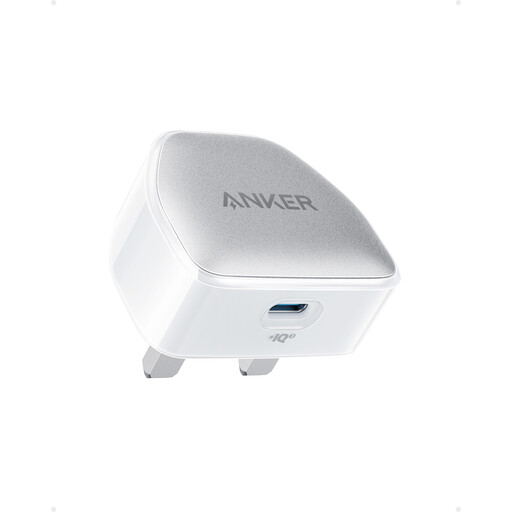
Why This Fits Their Persona: This user needs a small, reliable charger to top up their phone during the day. Its tiny form factor fits easily into a coat pocket or small bag, making it perfect for use at the office, in a café or on the train.
It avoids the "one-size-fits-all" trap by being specifically designed for phones. The 20W output is clearly stated and is ideal for fast-charging an iPhone without paying for unnecessary power.
Its primary advantage is its extremely compact size. It also features safety systems like temperature monitoring, providing peace of mind.
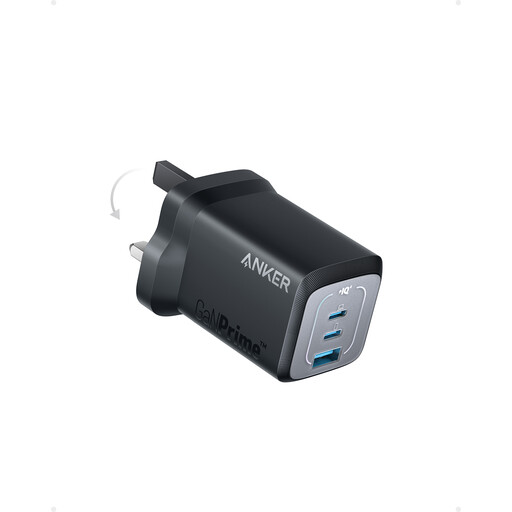
Why This Fits Their Persona: This user juggles a laptop, phone and tablet for work, whether at home, in the office or while travelling. They need a single, powerful solution to replace three separate chargers and reduce clutter in their bag.
It avoids the "shared wattage" illusion by clearly stating its capabilities: up to 67W from a single port (enough for a MacBook Air/Pro) and a combined 65W when using two ports, allowing for simultaneous laptop and phone charging.
Thanks to GaN technology, it's significantly smaller than a standard 67W laptop charger, yet offers three ports. This combination of power and portability makes it an excellent laptop charger UK travel companion.
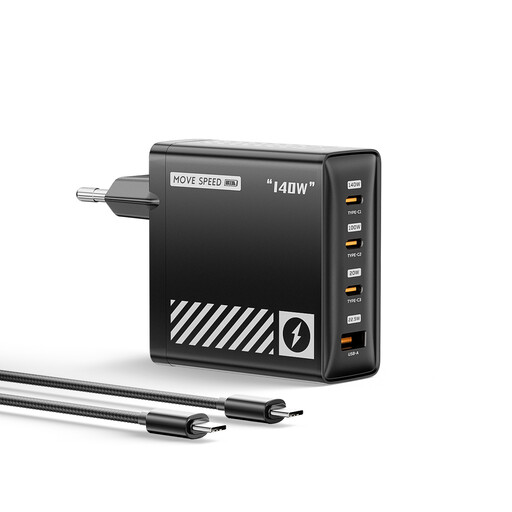
Why This Fits Their Persona: This user has a high-performance laptop (like a 16-inch MacBook Pro), a tablet, a phone and other gadgets. They demand maximum power to charge everything quickly and simultaneously, whether at their desk or on the go.
It provides a clear breakdown of its impressive power capabilities, specifying a 140W max single-port output via the PD 3.1 protocol. It also details how power is intelligently distributed across its four ports, removing any guesswork.
Its main advantage is the 140W PD 3.1 output, which can fast-charge the most demanding laptops. With four ports, it can replace an entire collection of chargers with a single, compact unit.
We have compiled a complete, real-time list of products that fully satisfy these strict selection criteria and UK safety regulations.
Here are answers to a few common questions we receive about USB-C fast chargers.
1. Is it safe to use a 65W laptop charger for my 20W phone? Yes, it is perfectly safe. Modern PD chargers are intelligent; they communicate with the connected device to determine the maximum power it can safely accept. The charger will only supply the 20W your phone requests, not the full 65W.
2. What does GaN actually mean, and is it worth the extra cost? GaN (Gallium Nitride) is a semiconductor material that is more efficient at conducting electricity than traditional silicon. For you, this means a GaN charger can be much smaller and lighter than a silicon charger of the same wattage and it runs cooler. If portability and a compact size are important to you, especially for a travel charger or a powerful multi-port charger, then GaN is definitely worth considering.
3. Do I need a special cable for my fast charger? Yes, the cable is just as important as the charger. To get the full benefit of a high-wattage charger, you need a USB-C cable that is rated to handle that power. For charging above 60W, you will typically need a cable specifically rated for 100W or higher. Using an underrated cable can result in slower charging speeds or even damage to the cable.