What matters when choosing
Start with the connections your existing laptop can provide, then decide how many desk devices you need to reconnect together.
USB-C hub
Choose it when: One external display and a few peripherals cover your desk needs, and the laptop supports the hub’s required video and charging modes.
Trade-off: A compact hub may offer fewer connections than a powered dock; its video and charging functions still depend on the host.
Powered USB-C dock
Choose it when: Displays, Ethernet and several peripherals stay connected at a permanent desk.
Trade-off: Display modes and charging remain dependent on the exact laptop and dock; Kensington specifies additional hardware conditions for some higher-resolution modes.
Thunderbolt dock
Choose it when: Your laptop has confirmed Thunderbolt or compatible USB4 support and your desk needs the dock’s particular display or high-bandwidth connections.
Trade-off: Do not assume its full display capability carries over to an ordinary USB-C host or every Mac chipset; Kensington lists different limits for its SD5760T.
Separate adapter
Choose it when: You need one missing display or network connection rather than a group of permanently connected devices.
Trade-off: Separate adapters and charging leave more cables to connect. For a Mac display adapter, Apple says its technology must match the Mac’s supported display connection.
| Concern |
What to check |
Who this matters to |
| Host and display compatibility |
Check the exact laptop’s USB-C video, Thunderbolt or USB4 support and its external-display limit against the dock’s host requirements. |
If I need an external screen, I want to know my laptop can provide the required video connection before counting sockets on a dock. Around 36% of consumers put host and display compatibility first. |
| Permanent-desk connections |
List the displays, USB devices and wired-network connection you will use together; compare their connectors with the dock’s port layout and display conditions. |
With several devices left at my desk, I want to reconnect them without repeatedly moving individual cables. For around 29% of consumers, desk expansion is the primary need. |
| Charging and software |
Compare laptop charging requirements with the dock’s stated host output, and check operating-system, driver and update requirements. |
If one connection is also meant to charge my laptop and run my work displays, dependable day-to-day operation matters more to me than extra ports. Around 21% of consumers make charging and software support their first concern. |
| Minimal expansion |
Identify the one or two connections you need regularly; compare a small hub or separate adapter with a full dock. |
When I only need one additional connection, I would rather keep the setup simple than add unused sockets. Keeping expansion to a minimum comes first for around 14% of consumers. |
Joybuy products for laptop desks
These USB-C hubs, adapters and docks offer different ways to connect an existing laptop at a home-working desk. Match each one’s named connections and charging arrangement to your laptop and the devices you use together.
 No image available
Targus USB-C Universal Dual HDMI 4K dock with 100W Power Delivery pass-through
Consider this for a desk needing two HDMI display connections and laptop charging through the dock. Its name specifies dual HDMI 4K and 100W Power Delivery pass-through; check the display modes your exact laptop can run. The listed charging arrangement requires an external 100W or higher power adaptor, so confirm whether a suitable one is included.
View on Joybuy
 No image available
V7 V7UC-U3CRJ45HDVG-BLK USB-C adapter
This adapter fits a desk where one external display and wired networking are the main additions. Its name specifies 4K HDMI, VGA, Gigabit Ethernet, 100W Power Delivery and two USB 3.0 ports. Check your laptop’s video and charging support; do not assume the HDMI and VGA outputs can drive two displays simultaneously.
View on Joybuy
 No image available
Baseus Metal Gleam Series II 10-in-1 USB-C hub, Cosmic Black
Consider this hub if your desk needs display, network and USB connections in one device. Its named connections include HDMI outputs labelled 4K at 120Hz and 4K at 60Hz, 10Gbps USB-A and USB-C ports, RJ45, SD/TF and a 100W Power Delivery input. Check the simultaneous display modes for your laptop and monitor setup; the input rating does not establish the power delivered to the laptop.
View on Joybuy
 No image available
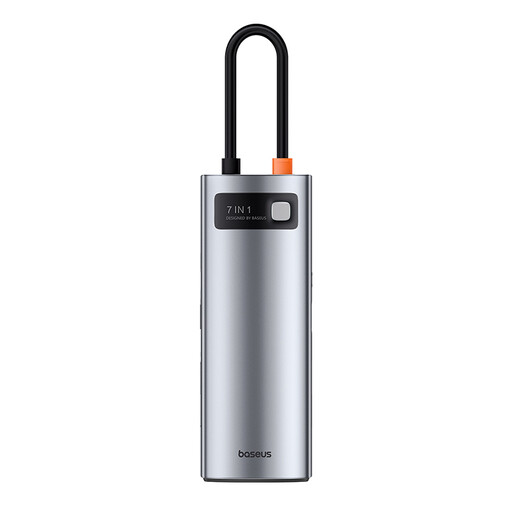
Baseus Metal Gleam Series seven-port USB-C hub, grey
This is a smaller-expansion choice if you want to reconnect a few desk peripherals through one hub. Check its exact socket layout against your monitor and accessories, and confirm the laptop’s video capability before relying on an external display. A separate power supply is needed for laptop charging.
View on Joybuy
 No image available
USB-C hub with 2 HDMI, DP, RJ45, PD and SD/TF
Consider this connection set for a desk with several display sockets and peripherals, but check the modes your laptop can use at the same time. The named ports include two HDMI, DisplayPort, two USB 3.0, two USB 2.0, RJ45, Power Delivery, SD/TF and audio. Confirm the required display resolutions and charging wattage before choosing it.
View on Joybuy
Common questions
Will any USB-C dock work fully with my USB-C laptop?
No: the connector alone does not establish which display, USB4 or charging functions the laptop supports. Microsoft documents limited USB-C functionality with some hardware and software combinations, so check the exact laptop port and dock requirements; for a Mac display adapter, Apple specifies compatible DisplayPort Alt Mode or Thunderbolt technology.
When is a USB-C hub enough for a home desk?
A hub can be enough when you need one monitor, basic USB connections and compatible pass-through charging rather than a larger set of permanent connections. Kensington specifies one HDMI 4K display at 60Hz and up to 85W pass-through for its UH1400P, provided the host supports USB-C Power Delivery and DisplayPort Alt Mode.
Can a dock give every MacBook two extended monitors?
No: check the exact MacBook and dock technology together. Kensington states that base M1/M2 MacBook models support only one external display through its SD5760T; Plugable describes additional display scenarios for its DisplayLink-based UD-6950PDH, but says a driver is required for full functionality and HDCP is unsupported.
What should I check if a dock’s display, charging or Ethernet connection is unreliable?
Start with the laptop port, cable and the dock’s stated host requirements, then check for applicable laptop and dock updates. Microsoft documents limited display and charging functionality among USB-C connection problems; Dell recommends system and dock updates and notes that monitor limits depend on the model.


