
24/7 Customer Support

Free returns

Same-day & Next-day Delivery

Quality Guaranteed

Unlock Your Welcome Offers: FREE Delivery | Up to 80% OFF | Free 30-day JoyPlus trial
Download the APP
A USB car cooling fan can improve airflow during warm commutes, road trips and camping stops, but choosing one based only on phrases such as “powerful wind” or “quiet motor” can lead to disappointment. The right model needs to suit your vehicle, mounting position, power source and the number of people who need airflow.
Before buying, consider these common pitfalls.
A high RPM figure does not automatically mean the fan will cool a whole vehicle. Small personal fans may be suitable for one passenger, while a dashboard car fan with a wider blade design may distribute air more effectively. Look for practical features such as three speed settings, adjustable direction and a stable mounting system rather than relying on vague airflow claims.
A portable car fan can become distracting if it slips across the dashboard or vibrates against the windscreen. Suction cups generally need a smooth, clean surface to work properly. Dust, textured dashboards and heat-softened surfaces can reduce grip.
A windscreen-mounted car fan should also be positioned so that it does not obstruct the driver’s view, instruments, controls or access to airbags. Always check the installation area before use and adjust it while the vehicle is stationary.
“USB-powered” can describe several different arrangements. Some fans connect directly to a USB-A port, while others rely on a USB car charger, power bank or rechargeable battery. A vehicle with only USB-C ports may need a suitable adapter. For longer journeys, check whether the fan can run continuously from the vehicle supply or whether it depends on battery capacity.
A 360-degree adjustable car fan allows the airflow to be directed towards the driver, front passenger or rear seating area. This is more useful than a fixed fan, particularly in family cars and larger vehicles.
Check whether the product uses:
A suction cup car fan should be installed on a clean, smooth surface. Press the base firmly into position and check that it remains secure before driving.
A 3-speed car fan gives you low, medium and high settings for different conditions. Low speed may be more suitable for quiet commuting, while higher settings can help move air through a warm cabin.
Five-blade designs are commonly used in compact vehicle fans and may offer a smoother stream of air than a basic low-blade layout. However, the number of blades alone does not establish cooling performance. Fan size, motor design, grille shape and positioning also matter.
A low-noise car fan is preferable when navigating traffic, listening to music or travelling with children. Product descriptions may provide a noise figure, but sound perception also depends on the speed setting, mounting surface and cabin acoustics.
For USB-powered vehicle fans, check:
Keep fingers, loose cables and other objects away from rotating blades. Do not use a damaged cable, and disconnect the fan before cleaning. A car fan helps circulate air but does not replace the vehicle’s heating, ventilation and air-conditioning system.
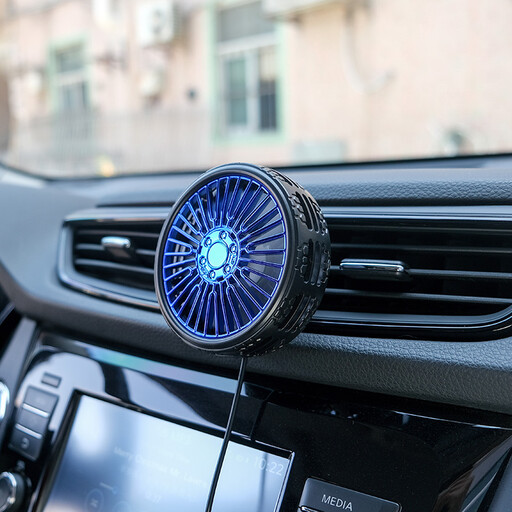
Why This Fits Their Persona: A practical choice for commuters who want a compact USB car cooling fan with flexible placement without adding a larger appliance to the cabin.
It combines a suction cup mount with an air vent clip, giving buyers two installation approaches instead of relying on one mounting surface.
USB powered, 5-blade design, 3-speed control and 360-degree adjustment.
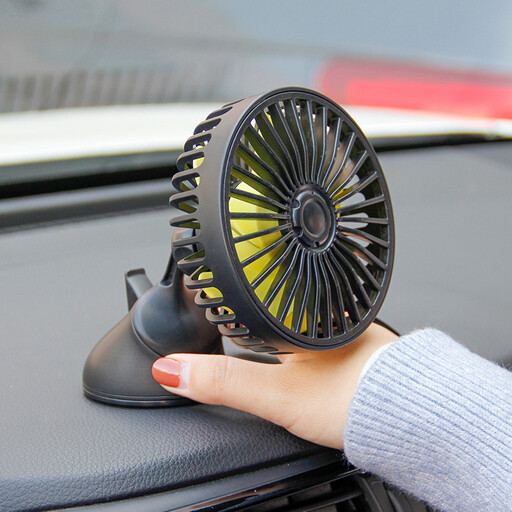
Why This Fits Their Persona: Suits drivers who prioritise targeted airflow and a tidy dashboard arrangement during regular commuting or longer journeys.
The adjustable head helps direct air towards a specific seat, reducing the need to run the fan at one fixed angle.
Strong suction cup mounting, 360-degree rotation, 5 blades and low-noise airflow description.

Why This Fits Their Persona: Designed for families, vans, SUVs and shared journeys where the driver and passengers may need airflow at the same time.
The twin-head layout provides broader coverage than a single portable car fan, while the foldable design helps with storage.
Dual fan heads, 360-degree multi-angle adjustment, 3 speeds and 12V/24V vehicle compatibility.
Usually, a compact fan is intended to improve local airflow rather than lower the whole cabin temperature. A 360-degree adjustable model can direct air towards one seat, while a dual-head fan may provide wider coverage for several occupants.
Many USB-powered vehicle fans can connect to a power bank, but check the product instructions and the power bank’s output rating first. Keep the power bank ventilated, avoid exposing it to excessive heat and do not leave electrical equipment unattended in a hot vehicle.
Lifespan depends on operating hours, dust, moisture, storage conditions and cable care. Clean the grille periodically with the fan disconnected, avoid blocking the blades and inspect the mount and cable before each extended journey. A fan that begins vibrating, overheating or producing unusual noise should be switched off and checked.